

Natural Himalayan Crystals: Origin, Benefits & Buying Guide
Where they actually come from, what the benefits realistically are, and how to buy a genuine piece rather than an imported imitation with a good story attached.
"Himalayan crystal" gets used as a marketing phrase almost as often as it gets used accurately, which is a shame, because the actual story behind these stones is genuinely more interesting than the label suggests. There's real geology behind why this specific mountain range produces such a wide, distinctive range of crystal-quality minerals, a centuries-long cultural relationship with stone and sound that long predates the current wellness trend, and a still-active artisan tradition that most buyers never hear about because it's easier to just print "natural crystal" on a label and move on.
This is the long version — where these stones actually come from, what's realistically true and untrue about their benefits, and what to actually look for so you're not paying natural-stone prices for something that spent its entire existence in a factory mold.
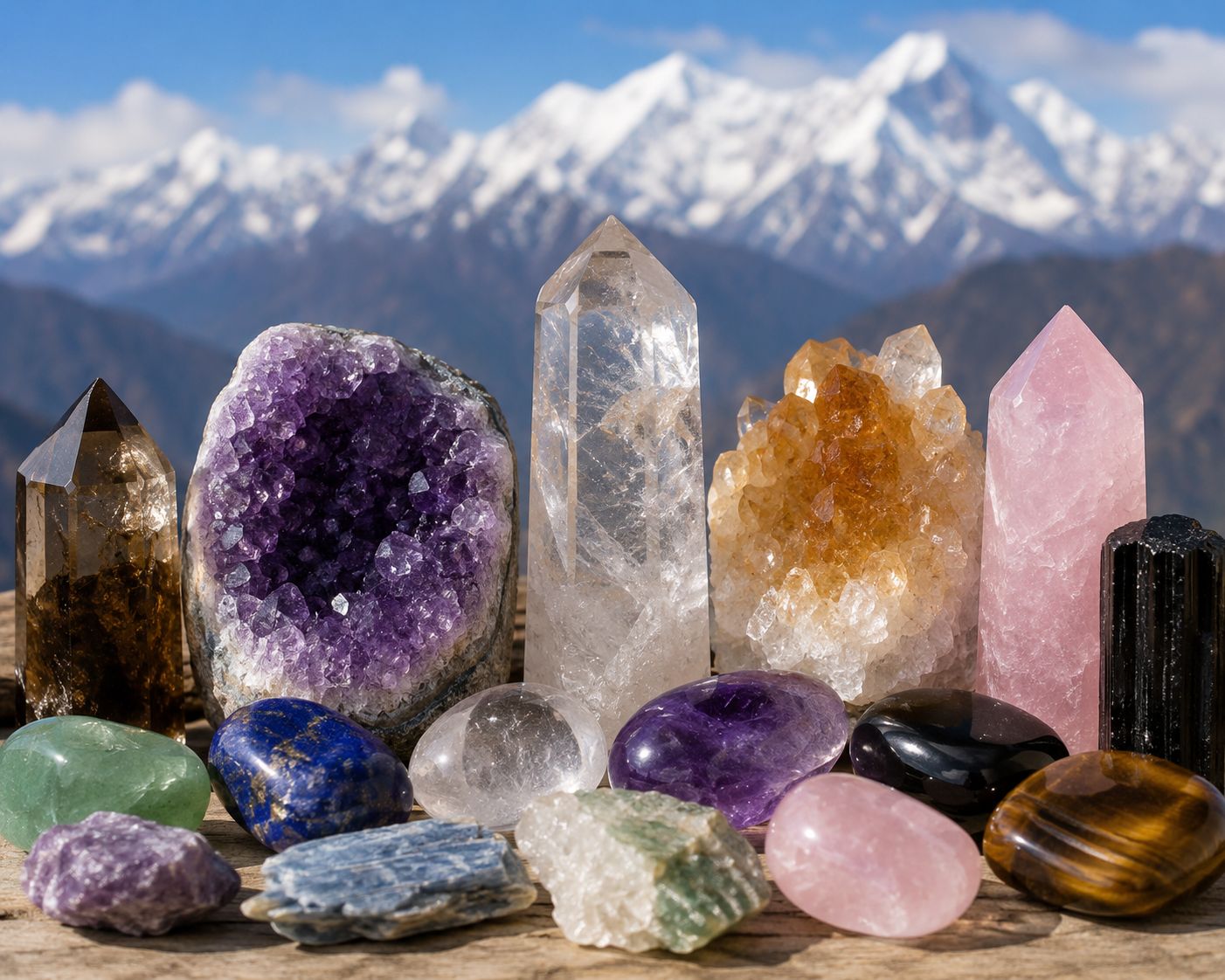
Why the Himalayas Produce Such Distinctive Crystals
The Himalayas exist because the Indian and Eurasian tectonic plates have been slowly colliding for roughly fifty million years, and they're still pushing into each other today — it's part of why the range keeps getting taller, millimeter by millimeter, rather than being a fixed, ancient formation frozen in place. That ongoing collision is genuinely unusual on a geological scale, and it's created conditions that are particularly good at producing large, well-formed crystal deposits.
Quartz and its many colored varieties — amethyst, citrine, smoky quartz, rose quartz — form when silica-rich fluid slowly cools and crystallizes within cracks and cavities in rock, a process that plays out over thousands to millions of years. The intense pressure and heat generated by two continental plates grinding against each other creates exactly the kind of mineral-rich fluid movement this process depends on, at a scale that's less common in geologically quieter parts of the world. It's the same underlying reason the region also produces turquoise, lapis lazuli, and a long list of other prized minerals, each shaped by slightly different combinations of pressure, heat, and the specific minerals present in that particular pocket of rock.
None of this is unique to the Himalayas in an absolute sense — Brazil, Madagascar, and parts of Africa all have their own significant crystal deposits, shaped by their own geological histories. What makes the Himalayan region specifically notable is the sheer range of different minerals found within a relatively contained area, plus the fact that a lot of the mining and initial processing here is still done on a small, artisan scale rather than through large industrial operations, which changes the character of what actually reaches the market.
A Region With a Long Spiritual Relationship to Stone
This part matters more than most crystal marketing gives it credit for, because it's not a backstory invented to sell bracelets — Nepal and the wider Himalayan region have used stone, metal, and sound in spiritual practice for a very long time, well before "healing crystal" became an international retail category.
Buddhist and Hindu traditions across the region both incorporate gemstones into ritual objects, prayer tools, and religious jewellery, often with specific meanings attached to specific stones that predate any modern crystal-healing framework by centuries. Turquoise and coral, for instance, show up repeatedly in traditional Tibetan jewellery and religious objects, not because someone decided they looked nice together, but because both carried specific protective and spiritual associations within that tradition. The same region produces the singing bowls used in meditation and sound practice — we've written about what the actual benefits of those are elsewhere — and the tasbih and mala traditions that combine prayer with counting beads made from natural stone, which we've also covered in more depth in our guide to prayer beads.
What this means practically is that a lot of what gets sold today as "Himalayan crystal jewellery" is drawing on genuinely old traditions, even if the specific bracelet or pendant in front of you was made last month. That's not the same as every seller being honest about sourcing — plenty aren't — but the underlying cultural relationship to these materials is real, not invented for marketing purposes.
The Artisan Tradition Behind What You're Actually Buying
Here's the part that tends to get flattened into a single vague phrase — "handmade in Nepal" — when there's actually a fairly detailed process behind it. Raw stone gets mined, often on a small scale, then moves through a chain of cutting, polishing, and setting that in many cases is still done by individual artisans or small family workshops rather than a large factory floor.
Silver filigree work, which shows up throughout Himalayan jewellery and home décor, involves twisting fine silver wire into decorative patterns by hand and soldering it into place — a technique that can take a skilled artisan days to complete on a single elaborate piece, and one we've gone into more detail on in our piece about handcrafted antique home décor. Gemstone-cutting and bead-making follow a similarly hands-on process, especially for smaller workshops that haven't mechanized their cutting equipment. Singing bowls go through their own separate hand-hammering process, which we've compared directly against machine-made alternatives in a full breakdown of that difference, since it genuinely changes how the finished piece sounds.
This matters for the buying guide part of this article specifically because it explains why sourcing transparency is actually possible, not just a marketing claim. A seller working with a small number of known workshops can generally tell you where a piece came from in real detail. A seller sourcing anonymously through bulk import channels usually can't, regardless of what the product description says.
The Stones You'll Actually Find
The range of crystal varieties associated with the Himalayan region is bigger than most people expect walking in. Here's an honest rundown of what actually shows up most often, and what each one is genuinely known for.
Clear quartz is the one you'll see everywhere, and for good reason — it's abundant, versatile, and traditionally treated as the "amplifier" stone that pairs well with almost anything else. It shows up in raw clusters, tower pendants, bracelets, and tasbih, and we've written a full piece specifically on how to tell genuine clear quartz from the glass and synthetic versions that circulate at a similar price point, since this is one of the most commonly imitated stones in the entire category.
Amethyst gets its violet color from trace iron content combined with natural irradiation during formation, and it ranges from a pale lilac to a deep, near-black purple depending on how much iron was present. It's the traditional birthstone for February and carries a long-standing reputation for calm and spiritual clarity — we've covered the fuller history and meaning behind amethyst specifically elsewhere, along with a separate piece comparing raw versus polished amethyst if you're trying to decide which form suits what you actually want it for.
Citrine is the warm, golden-orange member of the same quartz family, historically nicknamed the "merchant's stone" for its association with prosperity. Worth knowing upfront: most commercial citrine, including a lot of what's sold as Himalayan citrine, is actually heat-treated amethyst rather than naturally citrine-colored quartz — which doesn't make it fake, just a different process than most buyers assume. We go into that distinction properly in our full citrine guide.
Black tourmaline, sometimes called schorl, is the dense, near-black stone that's become one of the more requested pieces in recent years, particularly as jewellery for men who want something that reads as understated rather than decorative. It's tied to grounding and protection, and to the root chakra specifically — there's a full breakdown of the benefits and meaning behind black tourmaline if that's the stone you're actually here for.
Rose quartz carries the softest reputation of the group — self-compassion, emotional healing, gentle openness — and its pale pink color comes from trace titanium or manganese. It tends to show up most often as pendants and bracelets rather than raw clusters, since the softer pink tone reads better polished than rough.
Smoky quartz gets its brown-grey tone from natural irradiation exposure during formation, and it's generally treated as a grounding, stabilizing stone — a slightly quieter cousin of black tourmaline in terms of what it's used for, though the two aren't the same mineral at all.
Tiger's eye has that distinctive golden-brown shimmer caused by a fibrous internal structure that catches light in bands as you turn it — genuinely one of the more visually interesting stones on this list, and traditionally linked to confidence and courage rather than anything calmer.
Lapis lazuli and turquoise both carry deep roots in the region's traditional jewellery and religious objects specifically, beyond their more recent adoption into general crystal healing. Lapis is tied to communication and the throat chakra; turquoise carries a long-standing protective reputation across several Himalayan and Central Asian traditions, well before either stone had anything to do with modern wellness marketing.
Moonstone rounds out the list with its soft, almost glowing sheen, associated with intuition and emotional balance — a popular pick for those navigating some kind of transition, and a favorite in bracelet form specifically because the shimmer reads best against skin.
If you want a broader reference for how all of these stones relate to each other and which chakras or intentions they're commonly associated with, our general guide to crystals and their meanings covers that ground in more depth than fits comfortably here.
What People Actually Buy These For
It's worth being honest about this rather than reciting a list of energetic properties as if they were settled facts. Reasons people actually buy Himalayan crystals tend to cluster into a few overlapping categories, and they're not mutually exclusive.
A lot of people are buying into a specific belief system — that these stones carry energetic properties capable of supporting emotional, spiritual, or even physical wellbeing. That's a matter of personal conviction, not something we're going to try to prove or disprove here, and plenty of thoughtful people hold that belief sincerely.
A separate, overlapping group is buying more for the ritual and mindfulness value than any specific energetic claim — the act of choosing a stone with intention, wearing it as a reminder of that intention, or using it as a focal point during meditation has a genuine psychological grounding effect regardless of whether you believe the mineral itself is "doing" anything. This is closer to what a lot of the more measured research into practices like singing bowl sound therapy actually supports — not that the stone has a measurable physical effect, but that ritual, intention, and a physical anchor point can genuinely support relaxation and focus.
And a third group is simply buying for the aesthetic and cultural value — a beautiful, ethically sourced object with a real story behind it, whether or not they buy into any of the energetic framing at all. All three of these are legitimate reasons to own a crystal, and most people, honestly, are some mix of all three rather than firmly in one camp.
The Different Forms They Come In
Beyond the stone itself, Himalayan crystals show up across a genuinely wide range of formats, and which one makes sense depends entirely on what you're actually trying to do with it.
Jewellery is where most people start — bracelets, rings, pendants, and necklaces, generally the most practical way to keep a stone in continuous contact with you throughout the day. Bead size, single-stone versus mixed designs, and metal setting all factor into choosing the right piece, and we've written dedicated guides on choosing the right crystal bracelet if that's the format you're leaning toward.
Raw, unpolished stone — points, clusters, rough chunks — appeals to people who want the mineral in its natural state, unaltered by cutting or tumbling, typically for a meditation space or home altar rather than wearing. This is also where you'll see the most dramatic natural variation between individual pieces, since nothing's been shaped to a uniform standard.
Tasbih and prayer beads combine gemstone material with religious practice specifically, most commonly in citrine, tiger's eye, aquamarine, or clear quartz, typically strung in sets of 33 beads matching traditional dhikr counts.
Singing bowls aren't technically "crystal" in the gemstone sense — they're a metal alloy — but they belong firmly in this same broader Himalayan sound and spiritual tradition, and the difference between a genuinely hand-hammered bowl and a machine-stamped one is significant enough that it's worth reading up on before buying.
Home décor is the category most people don't expect from a crystal shop — silver filigree bowls, gemstone-inlaid boxes, carved stone figures, sometimes combining several different Himalayan gemstones into a single elaborate piece. These tend to sit at a considerably higher price point than jewellery, reflecting the labor involved rather than any difference in the stone itself.
Telling Genuine Himalayan Stone From an Imported Imitation
This is the part that actually protects your money, so it's worth taking seriously rather than skimming. A few physical checks apply across almost every stone on this list.
Genuine crystal feels cool against your skin for a few seconds before warming up, while glass, resin, and plastic warm almost instantly because they simply don't conduct heat the same way. Weight is the second check — real stone is denser than it looks for its size, so anything that feels suspiciously light for its apparent volume is worth a second look. Natural stone also tends to show some imperfection — a faint inclusion, a slight variation in color from bead to bead, a bit of natural cloudiness — rather than being perfectly flawless and uniform throughout. Counterintuitively, that "too perfect" look is more often a sign of glass, dyed material, or lab-grown stone than a sign of quality.
Beyond the physical checks, the seller matters just as much. Someone who can tell you specifically which region a piece came from, whether it's natural or treated in any way, and how it was processed is giving you real, checkable information. Someone who repeats "100% natural" without any further detail, regardless of how confidently they say it, isn't actually telling you anything you can verify. We've gone into significantly more depth on this exact question in our dedicated guide to choosing an authentic Himalayan crystal, including the specific differences between natural, heat-treated, and lab-grown material, which is worth reading in full if authenticity is your main concern going into a purchase.
What Things Actually Cost, and Why
Pricing across this category varies a lot, and understanding roughly why helps you sanity-check a listing before buying. Simple, common stones like clear quartz and rose quartz tend to sit at the more accessible end, generally somewhere between AED 75 and AED 150 for a bracelet or small pendant, since the raw material is abundant and doesn't require rare sourcing. Stones that are somewhat less common, or that require more elaborate cutting and setting — think silver-set rings, or pieces combining multiple gemstone varieties — climb into the AED 150 to AED 350 range fairly quickly.
Home décor pieces are their own category entirely, and price here is driven almost entirely by labor rather than the stone itself — a hand-hammered silver filigree piece can run into the thousands of dirhams, reflecting days of skilled artisan work rather than expensive raw material. Singing bowls sit somewhere in between, generally scaling with size and the complexity of the hand-hammering involved rather than any single fixed formula.
The genuinely useful rule of thumb is this: a price that seems dramatically lower than comparable listings for the same stone, format, and claimed origin is worth questioning before it's worth celebrating as a bargain. Real craftsmanship and genuine sourcing both cost something to maintain, and a seller charging noticeably less than everyone else is usually cutting a corner somewhere in that chain.
Looking After What You Buy
Care requirements vary a little by stone, but a few habits cover most of this category safely. Keep pieces away from harsh chemicals — perfume, lotion, and cleaning products all dull natural stone surfaces over time — and take jewellery off before swimming, showering, or anything involving prolonged water exposure, since elastic cord and certain metal settings don't hold up well to repeated soaking. A soft, dry cloth handles routine cleaning for almost everything here; skip ultrasonic cleaners, which are harder on natural stone than most people assume.
Sunlight deserves a specific mention, since a few stones — amethyst and smoky quartz among them — can fade slightly with prolonged, intense UV exposure. If you're displaying a raw cluster or piece long-term, a spot with indirect light preserves the color better than a sunny windowsill.
Cleansing — using moonlight, sound, or smoke to reset a stone's energy — is a traditional practice some people build into regular care, more ritual than measurable science, but a genuinely nice habit to have regardless of how literally you take the energetic side of it.
Buying in the UAE
Demand for natural crystals has grown quickly across Dubai, Abu Dhabi, and Sharjah over the past several years, and the market here has grown alongside it — meaning both more legitimate options and more of the vague, unverifiable listings covered earlier in this guide. If you're shopping locally, everything discussed above applies just as much to a stall at a weekend market as it does to an online storefront.
At Alpine Crystals UAE, our range spans bracelets, rings, pendants and necklaces, raw stone, tasbih, singing bowls, and handcrafted home décor, sourced through artisan relationships we can actually speak to in detail rather than a chain of anonymous suppliers. We've written a more general piece on buying authentic healing crystals in the UAE if you want the fuller version of that specific conversation. Delivery runs across the whole country, generally within a day or two, with free shipping on orders above AED 150.
If you've got a specific stone or piece in mind and want a straight answer about what's currently available, message us on WhatsApp rather than guessing from photos alone.
Questions People Ask
What actually makes a crystal "Himalayan" rather than just natural?
Strictly, it means the stone was mined within the Himalayan region — Nepal, Tibet, and neighboring areas — rather than sourced from Brazil, Madagascar, or elsewhere. In practice, the term is sometimes used loosely as a marketing label, which is why sourcing transparency matters more than the label itself.
Are Himalayan crystals actually different from crystals mined elsewhere?
Chemically, no — the same mineral is the same mineral regardless of where it formed. What differs is the specific range of minerals commonly found in this region, and the artisan traditions around cutting, setting, and craftsmanship that have developed here over centuries.
Do I need to believe in crystal healing to get something out of owning one?
No. Many people value these pieces for their craftsmanship, cultural history, or the mindfulness and intention-setting ritual around wearing or using one, independent of any specific belief about energetic properties.
How do I know if a "Himalayan crystal" I'm looking at is genuine?
Check for natural imperfections rather than flawless uniformity, confirm weight and temperature feel consistent with real stone, and ask the seller for specific sourcing details rather than a generic "natural crystal" claim.
What's the most affordable way to start a Himalayan crystal collection?
A single-stone bracelet in a common variety like clear quartz or rose quartz is generally the most accessible entry point, both in price and in how easy it is to verify authenticity compared to rarer or more elaborate pieces.
Where can I buy genuine Himalayan crystals in the UAE?
You can shop our full crystal collection, sourced through direct artisan relationships in Nepal, with delivery across Dubai, Abu Dhabi, Sharjah, and the wider UAE.