

Aqeeq Stone: Meaning, Benefits and How to Spot a Real One
What the stone actually is, where its significance in Islamic tradition comes from, and the specific checks that separate genuine Aqeeq from dyed imitation.
Aqeeq is one of the most requested stones we get asked about, and also one of the most loosely explained across the sites that sell it. Most listings either recite the same few sentences about the Prophet's ring without any real detail, or treat "Aqeeq" as if it only ever means one specific red stone, when it actually covers a much wider mineral family. This is the fuller version — what Aqeeq actually is geologically, where its Islamic significance genuinely comes from, and critically, how to tell a real one from the dyed glass and synthetic imitations that make up a surprising share of what gets sold under this name.
Because this stone carries real religious and cultural weight for a lot of people, we've tried to be careful throughout this guide to separate what's genuinely documented tradition from what's contested scholarship, and to be upfront about the limits of what a crystal retailer can responsibly say on the religious side of the topic. The authenticity section in particular is worth reading closely, since it's the part most other guides on this stone skip almost entirely.
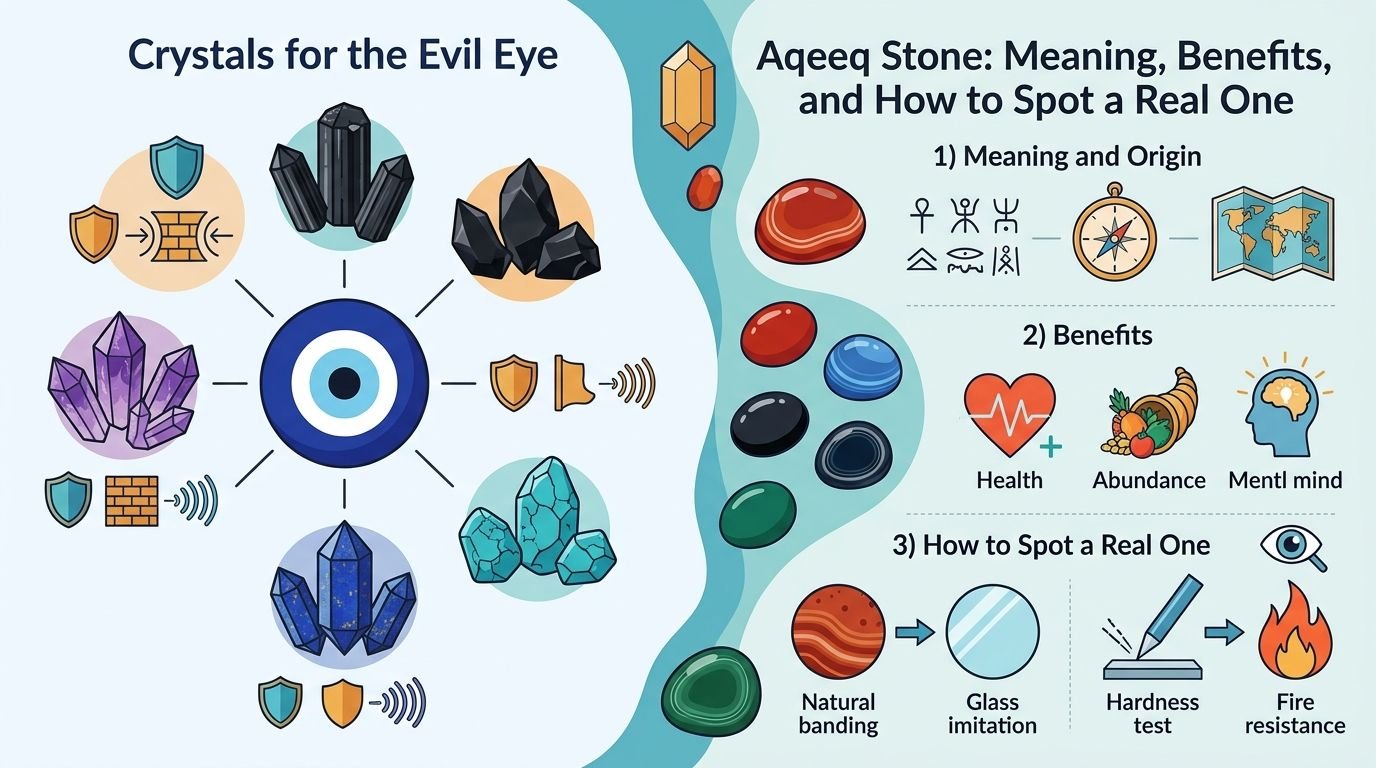
What Aqeeq Actually Is
Aqeeq is the Arabic and Turkish name for what's known in English as agate, and more broadly for the wider chalcedony family of stones it belongs to. Chalcedony is a microcrystalline form of quartz — meaning it's made of the same silicon dioxide as clear quartz or amethyst, but formed from crystals so fine they're not individually visible, giving the stone a smooth, slightly waxy appearance rather than the glassy, faceted look of larger quartz crystals. Agate specifically refers to the banded variety of chalcedony, showing concentric rings or parallel layers of color built up as mineral-rich fluid deposited silica in stages within a cavity, usually inside volcanic rock. Carnelian, the reddish-orange variety most people picture when they hear "Aqeeq," and onyx, the black or dark-banded variety, are both close relatives within this same chalcedony family, and both are commonly sold and referred to as Aqeeq depending on regional and linguistic convention.
Agate sits at 6.5 to 7 on the Mohs hardness scale, comparable to quartz generally, which makes it durable enough for daily-wear jewellery without being especially prone to scratching under normal use. It forms as nodules within volcanic rock, in veins running through other rock types, or occasionally replacing organic material like wood or fossils over long periods — a process scientists still don't fully understand in detail, since the exact mechanism behind agate's distinctive banding has never been successfully reproduced synthetically, despite more than a century of attempts.
Why Agate's Formation Is Still Genuinely Mysterious
This is worth dwelling on for a moment, because it's unusual among common gemstones. Quartz, amethyst, and citrine can all be grown synthetically today using well-understood hydrothermal processes. Agate cannot — despite the underlying chemistry being simple silica deposition, the specific mechanism that produces its characteristic concentric or parallel banding has resisted replication, and geologists still debate the exact combination of factors involved, including cyclical changes in the chemistry of the fluid depositing the silica over time. Every piece of genuine agate is, in a real sense, still something nature alone can produce.
Where the Name Comes From
The English word "agate" traces back to the Ancient Greek Achates, the name of a river in southwestern Sicily where the stone was first documented by the philosopher and naturalist Theophrastus sometime in the 4th or 3rd century BCE. "Aqeeq," by contrast, is a separate Arabic term with its own distinct linguistic history, and in Arabic the word can refer to quartz generally as well as agate specifically, depending on context. In Turkish, the same root has narrowed more specifically to mean agate. The two words — agate and Aqeeq — arrived at overlapping but not identical meanings through completely separate linguistic paths, which is part of why translations between the two aren't always perfectly clean, and why "Aqeeq" in casual usage sometimes gets applied a little more broadly than a strict mineralogical definition of agate would allow.
You'll also see the word transliterated several different ways depending on the source — Aqeeq, Akik, Aqiq, and Hakik all refer to the same stone, with the variation coming down to differences in how Arabic and Urdu pronunciation get rendered into English lettering rather than any difference in the stone itself. This is worth knowing specifically if you're searching for the stone online, since sellers and buyers alike use these spellings somewhat interchangeably, and none is more "correct" than another.
The Many Colors and Types of Aqeeq
One of the most common misconceptions is that Aqeeq refers to a single stone. In reality, it spans a genuinely wide color and pattern range, and knowing the differences helps explain both the variation in price and the variation in claimed meaning across pieces. This variation isn't a modern marketing invention either — historical sources describing Aqeeq across different regions and periods consistently reference multiple colors and qualities, treating the category as a family of related stones rather than a single fixed material from the very beginning.
| Type | Appearance | Notes |
|---|---|---|
| Red / Carnelian Aqeeq | Warm orange-red, sometimes with faint banding | The most historically significant color, especially in Yemeni sourcing |
| Black Aqeeq (Onyx) | Deep black, sometimes with fine parallel banding | Associated with grounding and protection in most traditions |
| Green Aqeeq | Pale mint to deep forest green | Widely worn specifically because green is associated with Paradise in Islamic tradition |
| Honey / Golden Aqeeq | Warm amber to golden-brown | Popular in Middle Eastern jewellery, associated with prosperity |
| Botswana Aqeeq | Grey-brown with distinct concentric banding | Named for its primary source region; a true banded agate |
| Moss Aqeeq | Clear to milky white with green, moss-like inclusions | Technically a form of chalcedony rather than true banded agate, though sold under the same name |
Worth noting: not every stone commercially sold as "agate" or "Aqeeq" is a true banded agate in the strict mineralogical sense. Moss agate, for instance, gets its pattern from mineral inclusions rather than banding, which technically makes it a different variety of chalcedony — but the trade name has stuck regardless, and this kind of naming looseness is extremely common across the gemstone world generally, not unique to Aqeeq.
Why So Much Commercial Agate Is Dyed
It's worth understanding this upfront, since it directly affects the authenticity checks covered later in this guide. A large share of agate mined commercially, particularly from Brazil, comes out of the ground in a fairly pale, unremarkable grey or brown. Dyeing agate to achieve vivid, consistent color has been standard commercial practice for well over a century, and it isn't necessarily deceptive in itself when disclosed honestly — a dyed agate bracelet sold clearly as such is a legitimate, affordable product. The problem is specifically when dyed material is sold without disclosure as if it were naturally that color, which happens constantly across the lower end of the Aqeeq and agate market precisely because the visual difference between a fine natural specimen and a well-dyed imitation can be difficult for an untrained eye to spot without knowing what to look for.
Yemeni Aqeeq: Why It's Considered the Finest
Among all sourcing regions, Yemeni Aqeeq holds a specific, elevated status that other agate sources generally don't carry. This isn't purely about physical quality, though Yemeni material is genuinely prized for its rich, deep reddish-brown tone and clarity — it's also tied directly to the stone's association with early Islamic history, given Yemen's geographic and historical proximity to the Arabian Peninsula during the period most connected to Aqeeq's religious significance. Agate is also sourced from India, Iran (where it's sometimes called Khorasani Aqeeq after the historical region), Brazil, and elsewhere, and all of it is chemically identical chalcedony regardless of origin — but Yemeni material specifically commands the strongest demand and highest prices in markets across Saudi Arabia, Pakistan, and the wider Gulf region, driven by that combined reputation for both quality and religious association.
It's worth knowing that genuine Yemeni-sourced material has become harder to reliably verify at scale as demand has grown, since mining and export from the region have faced real disruption in recent years. A seller confidently claiming "genuine Yemeni Aqeeq" without any further sourcing detail is making a claim that's difficult to verify either way — worth keeping in mind rather than treating the label alone as a guarantee.
What "Yemeni" Actually Signals to a Buyer
Beyond the specific mining region, "Yemeni Aqeeq" has become something closer to a quality tier in the broader market, similar to how "Ceylon" attached to a sapphire signals a specific expected character even when buyers can't always verify the literal origin themselves. This doesn't make the label meaningless, but it does mean a buyer relying on it should weigh it alongside the physical characteristics of the stone itself — depth of color, natural banding, and the general quality markers covered later in this guide — rather than treating the word "Yemeni" alone as sufficient verification of either origin or quality.
Aqeeq in Islamic Tradition
This is the part of Aqeeq's story that gives it a weight and significance most other gemstones simply don't carry, and it's worth covering both what the tradition says and being honest about where scholarly discussion exists.
The Historical Account
Aqeeq's religious significance is tied to accounts describing the Prophet Muhammad (peace be upon him) wearing a ring set with a carnelian or Aqeeq stone in a silver setting, with some accounts connecting this specifically to the period following the removal of idols from the Grand Mosque in Mecca in 630 CE. Wearing an Aqeeq ring is widely considered a Sunnah — a practice following the example of the Prophet — particularly emphasized within Shia tradition, where the significance placed on it by the Prophet and by Imam Ali and the broader Ahlul Bayt has made it an especially prominent and consistently worn stone. Historical accounts of Imam Ali specifically describe him wearing and valuing an Aqeeq ring, a detail that has reinforced the stone's significance within Shia practice across the centuries since, distinct from though overlapping with its broader recognition throughout the wider Muslim world.
Rings as Seals in Early Islamic History
It's worth understanding the broader historical context that made ring-wearing significant in the first place. In the early Islamic period, a personal ring frequently doubled as a seal, pressed into wax or clay to authenticate correspondence and official documents — a genuinely practical function rather than purely decorative jewellery. This dual role, part spiritual and part functional, is part of why the specific choice of stone and setting for a personal ring carried more weight in that era than jewellery choices typically do today, and it helps explain why historical accounts paid close enough attention to the Prophet's ring to describe its stone specifically. A ring wasn't simply an accessory in this context — it was closer to a signature, carried on the body and used to authenticate the wearer's own word, which naturally made the specific stone chosen for it a matter worth recording for later generations.
A Note on Scholarly Discussion
As with many practices tied to hadith literature, the specific narrations describing the virtues of wearing an Aqeeq ring have received varying scholarly assessment — some hadith scholars have classified certain specific narrations on this topic as weak (da'if) in terms of chain of transmission, while the broader practice remains widely observed and considered meaningful across large parts of the Muslim world regardless. This is a genuinely contested area of religious scholarship rather than a settled question, and it isn't something a crystal retailer is in a position to adjudicate. If the specific religious weight of these narrations matters to your own practice, that's a question worth taking to a knowledgeable religious scholar rather than a gemstone guide.
Engraving and Personalization
A distinctive feature of Aqeeq jewellery within Islamic tradition is engraving — the flat surface of a cut stone is often inscribed with a verse from the Quran, one of the names or attributes of Allah, or the name of the Prophet or a revered figure from early Islamic history, sometimes inlaid with gold to make the engraving stand out against the stone's natural color. This turns each ring into a genuinely personal, one-of-a-kind object rather than a mass-produced piece, and it's part of why custom-engraved Aqeeq rings remain a specialized craft in their own right across the regions where this tradition is strongest.
Aqeeq During Prayer and Pilgrimage
Beyond everyday wear, Aqeeq holds particular significance during acts of worship specifically — many who follow this tradition describe wearing their Aqeeq ring deliberately during prayer, viewing the physical object as a quiet reminder of intention and presence during that specific act. It's also commonly worn or carried during Hajj and Umrah, tying the stone's Arabian historical roots directly to the pilgrimage experience itself, and making it a popular item to acquire or gift specifically around that occasion.
Who Wears Aqeeq, and How
Aqeeq is not restricted by gender in Islamic tradition — both men and women are described as benefiting from wearing it according to the tradition, though contemporary styling often adjusts cut, size, and setting to suit different tastes, with bolder, larger stones more commonly marketed toward men and more delicate cuts toward women. Rings remain the most traditional format, tied directly to the historical accounts of the Prophet's own ring, though bracelets, prayer beads, and pendants incorporating Aqeeq are also common, particularly for those who want the stone's significance without the specific ring format.
Some traditions describe a preference for wearing the ring on the right hand, on the little or ring finger specifically, though as with much of this broader area of practice, specifics vary between communities and individual guidance, and it's worth treating this as common custom rather than a fixed universal rule.
Children and Aqeeq
In some of the traditions where Aqeeq is most strongly observed, particularly within Shia practice, it's also common to acquire smaller Aqeeq pieces for children, sometimes as a first ring given at a meaningful age or occasion, extending the same intention behind adult practice to the next generation from early on. As with adult jewellery, sizing and setting for children's pieces differ from adult versions for practical safety reasons.
Setting and Metal Choice
Silver is by far the most traditional metal setting for Aqeeq, tied directly to the historical description of the Prophet's ring specifically as silver rather than gold. This preference persists strongly today — while gold-set Aqeeq pieces do exist and are sold commercially, silver remains the setting most closely associated with the religious tradition specifically, and it's the setting used across the pieces in our own catalog for exactly this reason.
Aqeeq Beyond Islamic Tradition
While Aqeeq's most prominent modern significance is within Islamic practice, agate and carnelian carry their own separate, much older history across other cultures and traditions entirely. Agate jewellery dates back to the Indus Valley Civilization in the third millennium BCE, and Ancient Greek warriors used agate in both jewellery and carved seal stones. Agate and carnelian both appear as valued materials in ancient Egyptian jewellery and amulets, predating Islamic tradition by thousands of years. In Hindu and Sikh traditions, agate is also referenced as an auspicious stone, sometimes linked astrologically to the planet Mars, and traditional Ayurvedic medicine references agate in the context of digestive and physical wellbeing alongside its use in Islamic folk medicine for similar purposes.
Agate in the Ancient and Medieval World More Broadly
Beyond its use in jewellery, agate held practical significance across several ancient and medieval societies for reasons unrelated to spiritual meaning entirely. The medieval Islamic scientist al-Biruni documented agate mines in the hills near Cairo and described a related stone used specifically by bookbinders for polishing gold leaf — a genuinely practical craft application that had nothing to do with jewellery or religious symbolism. Agate's hardness and smooth polish also made it a preferred material for engraved seal stones across multiple ancient civilizations independently, valued for its ability to hold fine engraved detail while resisting wear over repeated use, centuries before its specific religious significance within Islamic tradition developed.
This wider context matters because it explains why Aqeeq shows up as a significant stone across such a broad geographic and cultural range — it isn't a single unified tradition, but several independent lines of significance that happen to converge on the same physical material.
Claimed Benefits of Wearing Aqeeq
As with any stone carrying this much traditional weight, the claimed benefits span both the spiritual and the physical, and it's worth separating genuine tradition from anything resembling a medical claim.
Spiritual and Emotional
Within Islamic tradition specifically, Aqeeq is associated with blessing, protection, and a stronger sense of connection during prayer — part of why it's traditionally worn during religious observance rather than treated purely as everyday jewellery. More broadly across crystal-healing traditions, agate in general is associated with calm, emotional balance, and grounding, regardless of the specific color variety.
Traditional Physical Associations
Various folk traditions, including references within historical Islamic and Ayurvedic medicine, describe agate as supportive of digestion and circulation, and some traditional accounts describe carrying or wearing agate as beneficial for eye comfort and clarity. These are long-standing traditional beliefs rather than claims supported by modern clinical evidence, and none of this is intended as medical advice or a substitute for proper healthcare — if you have a genuine health concern, that's a conversation for a qualified medical professional, not a gemstone.
Why These Claims Persist Across So Many Traditions
It's worth noting how consistently agate's traditional associations repeat across otherwise unconnected cultures — calm, grounding, physical vitality show up in Islamic, Ayurvedic, and Western folk traditions alike, described using different language but pointing toward remarkably similar themes. This kind of cross-cultural consistency doesn't prove any specific claim, but it does suggest agate has occupied a similar symbolic role across human history regardless of the specific belief system attached to it, likely tied to the stone's calm, earthy visual character as much as anything else.
How to Spot a Real Aqeeq Stone
Given how significant Aqeeq is within religious practice specifically, buying an imitation isn't just a matter of losing money on a fake gemstone — it means the specific stone tied to that tradition isn't actually the one you're wearing. This makes authenticity genuinely more important here than for a purely decorative crystal, and it's worth taking the following checks seriously.
Check for Natural Banding or Translucency
Hold the stone up to a strong light source. Genuine agate, being translucent chalcedony, typically allows some light through at the edges, and true banded varieties will show visible internal layering when backlit. A stone that's completely opaque and shows absolutely no light transmission at any edge, despite being sold as agate, is worth questioning — this is one of the more reliable and easy-to-perform checks available to an ordinary buyer.
Look for Natural Imperfection, Not Flawless Uniformity
This is counterintuitive but consistent with nearly every natural stone: genuine Aqeeq typically shows some natural variation — slightly uneven banding, subtle color shifts, tiny natural inclusions — rather than a perfectly uniform, saturated color throughout. A suspiciously vivid, completely even red or black, especially at a low price point, is one of the most common signs of dyed agate or glass rather than natural stone. Dyeing is genuinely common in the lower end of the agate market specifically, since undyed lower-grade agate is naturally pale and grey, and dye is a cheap, effective way to produce a more visually appealing "premium" color.
Weight and Temperature
Genuine chalcedony feels cool against the skin for a few seconds before warming, and it carries real density for its size — a piece that feels suspiciously light is more likely glass or resin than genuine stone. This check applies across nearly every natural gemstone, and Aqeeq is no exception.
Scratch Resistance
At 6.5 to 7 on the Mohs hardness scale, genuine agate should resist scratching from a steel pin or a copper coin, both of which sit lower on the hardness scale. Glass, by comparison, generally scratches more easily and shows wear faster under the same test. This is worth doing on an inconspicuous spot only, and treated as one data point among several rather than a definitive test on its own.
Check the Cut for Facet Marks and Air Bubbles
Genuine cut and polished Aqeeq should show a smooth, slightly waxy surface rather than the sharp, glassy facets typical of cut glass. Held under bright light and rotated slowly, glass often shows small trapped air bubbles as tiny perfect spheres somewhere within the piece — something that simply never occurs in natural chalcedony, regardless of color or origin. This is one of the more reliable tests available, particularly for smaller cut stones like ring settings where the internal structure is easier to examine closely.
Consider Getting a Professional Opinion for Significant Purchases
For a larger, more expensive piece — particularly one marketed specifically as premium Yemeni material — it's reasonable to ask a seller whether the piece has been assessed by a gemologist, or to have it independently checked yourself before a significant purchase. This isn't necessary for an everyday bracelet, but it's a genuinely sensible step for a piece where both the financial and religious significance are substantial.
Be Skeptical of Overly Specific "Yemeni" Claims Without Detail
As covered above, genuine Yemeni sourcing carries real premium value, which unfortunately makes it one of the most commonly claimed — and hardest to verify — origin labels in the market. A seller who can speak specifically about sourcing, rather than simply attaching "Yemeni" to every red stone in the catalog, is giving you more to actually evaluate than one relying on the label alone.
Ask Directly, and Expect a Specific Answer
Across every check above, the seller themselves remains one of the most useful sources of information. Someone who can describe specifically where a stone was sourced, whether it's been treated or dyed, and how it was cut is giving you real, checkable detail. A generic "100% natural Aqeeq" claim with nothing further behind it is worth the same skepticism you'd apply to any unverified claim.
Real Aqeeq and Chalcedony Options
Here's an honest look at genuine chalcedony-family pieces currently in our own range — agate, carnelian, and onyx, the three varieties most directly connected to the Aqeeq tradition.

Botswana Agate Bracelet (10mm)
AED 120
A true banded agate with distinct concentric grey-brown layering, genuinely representative of what "agate" means in the strict mineralogical sense.
View Product
Moss Agate Bracelet (8mm)
AED 90
Pale, milky chalcedony with green moss-like inclusions rather than banding — a different pattern type within the same broad Aqeeq family. Check current stock before ordering.
View Product
Red Carnelian Bracelet (8mm)
AED 100
The warm orange-red variety most closely associated with the classic image of red Aqeeq, in a simple everyday bracelet format.
View Product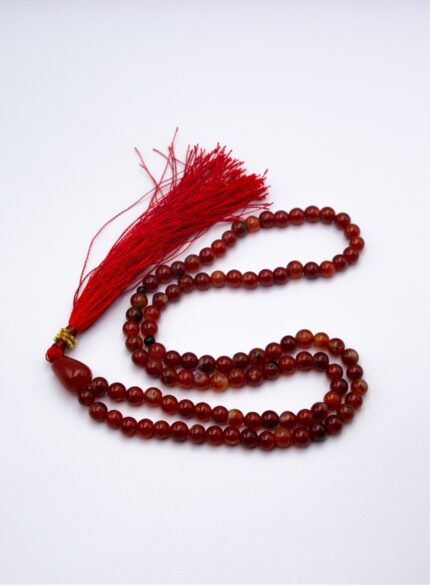
Red Carnelian Tasbih (6mm, 99 beads)
AED 150
Red carnelian strung as a full 99-bead tasbih, combining the stone's traditional significance directly with daily prayer practice.
View Product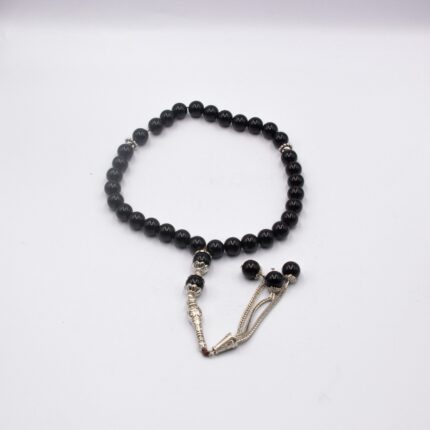
Black Onyx Tasbih (10mm, 33 beads)
AED 150
The black variety within the same chalcedony family, associated with grounding and protection, in a 33-bead tasbih.
View ProductWe also carry a Natural Agate Crystal Ring with silver linings — the format most directly tied to the historical accounts covered above — currently limited stock, so it's worth checking our full Crystal Rings collection or messaging us directly for current availability. You can browse the wider range across our bracelets and tasbih collection as well.
Caring for Aqeeq Jewellery
Agate and carnelian both handle daily wear well given their hardness, but a few habits keep pieces looking their best over years of use. Avoid harsh chemicals and perfumes, which can dull the surface over time, and remove bracelets before swimming or extended water exposure, which weakens elastic cord faster than normal wear. A soft, dry cloth handles routine cleaning for the whole family of stones covered here. Dyed agate specifically — even when the dye itself is stable — can fade slightly faster under prolonged, intense sunlight than genuinely natural-colored stone, so indirect light is the safer choice for long-term display pieces or engraved rings kept on a stand rather than worn daily.
Caring for an Engraved Ring Specifically
For a ring with fine engraving, avoid ultrasonic jewellery cleaners entirely, since the vibration can gradually wear down fine engraved detail over repeated use in a way that isn't immediately obvious but compounds over years. Cleaning with a soft brush and mild soap, followed by careful drying with attention to any recessed engraved lines where moisture can linger, is the safer routine for a piece meant to be kept and passed down rather than treated as disposable jewellery.
Aqeeq as a Gift
Given its religious and cultural weight, Aqeeq makes a genuinely meaningful gift for occasions tied to faith and milestone events specifically — returning from Hajj or Umrah, Ramadan and Eid, a wedding, or marking a child reaching an age where a first ring feels significant. An engraved piece carries particular weight as a gift precisely because it can be personalized with a name, a verse, or a specific meaningful phrase, turning it into something the recipient couldn't simply buy for themselves off a shelf. Unlike more generic jewellery gifts, Aqeeq's specific tradition means the gift itself carries an explanation and a story, rather than needing one invented for the occasion.
Final Thoughts
Aqeeq occupies a genuinely unusual place among gemstones — a mineral common enough to be found on riverbanks worldwide, yet carrying specific historical and religious weight that few other widely available stones can claim. That combination is part of what makes buying it carefully worth the extra effort: the physical stone itself is not rare or expensive by gemstone standards, but the tradition attached to it deserves the genuine article rather than a dyed substitute standing in for it. Whether you're drawn to Aqeeq for its religious significance, its long independent history across other cultures, or simply its earthy, banded beauty, the checks covered in this guide should give you a solid, practical foundation for buying with real confidence.
Looking for a specific color or format?
Ring stock and specific colors shift regularly. Message us to check what's currently available before you order.
Questions People Ask
What is the difference between Aqeeq and agate?
Aqeeq is the Arabic and Turkish name for agate and the broader chalcedony family it belongs to, including carnelian and onyx. The English word "agate" comes from a separate Greek etymology, but both refer to essentially the same mineral.
Why is Yemeni Aqeeq considered the best?
Yemeni Aqeeq is prized both for its natural quality, particularly its deep reddish-brown color, and for its historical and religious association tied to early Islamic history, which together give it a premium status other sourcing regions don't carry.
Is wearing an Aqeeq ring a confirmed Islamic teaching?
It is widely regarded as Sunnah, tied to historical accounts of the Prophet's ring. Scholarly assessment of specific supporting hadith varies, with some narrations classified as weak by certain scholars. This is a matter of religious scholarship best directed to a knowledgeable source.
How can I tell if my Aqeeq stone is genuine?
Check for natural banding or translucency when held to light, some natural variation in color rather than perfect uniformity, cool temperature and real weight, and resistance to scratching. A completely opaque, flawlessly uniform stone at a very low price is worth questioning.
Can women wear Aqeeq, or is it traditionally only for men?
Aqeeq is not restricted by gender in Islamic tradition. Both men and women are described as benefiting from wearing it, with contemporary styling simply adjusting cut and size to suit different tastes.
What does it mean when Aqeeq is engraved with Arabic text?
Engraved Aqeeq typically features a Quranic verse, a name or attribute of Allah, or the name of a revered figure from early Islamic history, turning the piece into a personalized, one-of-a-kind object rather than a generic gemstone.
Does the color of Aqeeq change its meaning?
Different colors carry somewhat different associations. Green is especially significant in Islamic tradition due to its association with Paradise, while red carnelian carries the strongest historical connection to the Prophet's ring specifically.
Where can I buy genuine Aqeeq or agate stone in the UAE?
You can browse our range of genuine agate, carnelian, and onyx pieces across our crystal collection, with delivery across Dubai, Abu Dhabi, Sharjah, and the wider UAE.
Why is so much commercial agate dyed?
Much commercially mined agate, particularly from Brazil, comes out of the ground in a pale, unremarkable grey or brown. Dyeing has been standard practice for over a century to produce more visually appealing color, and is legitimate when disclosed but a common source of undisclosed imitation when it isn't.
Is Aqeeq the same in every color, or does the color matter?
The underlying mineral is the same chalcedony family regardless of color, but different colors carry somewhat different traditional associations, and red carnelian specifically carries the strongest historical connection to the Prophet's ring.