

Smoky Quartz: Meaning, Benefits and Who Should Wear It
The quietest of the grounding stones — here's what it actually means, what it's genuinely good for, and who it suits.
Smoky quartz doesn't get the same attention as amethyst or clear quartz, and that's oddly fitting — it's a genuinely understated stone, both in color and in what it's actually meant to do. This guide covers what smoky quartz meaning is actually rooted in, what benefits are traditionally associated with it, and — since this genuinely isn't the right stone for everyone — who it actually suits and why.
We'll also cover something most guides on this stone skip entirely: the real difference between naturally smoky quartz and the commercially irradiated material that makes up a meaningful share of what's actually sold under this name, since that's worth knowing before you buy rather than after.
What Smoky Quartz Actually Is
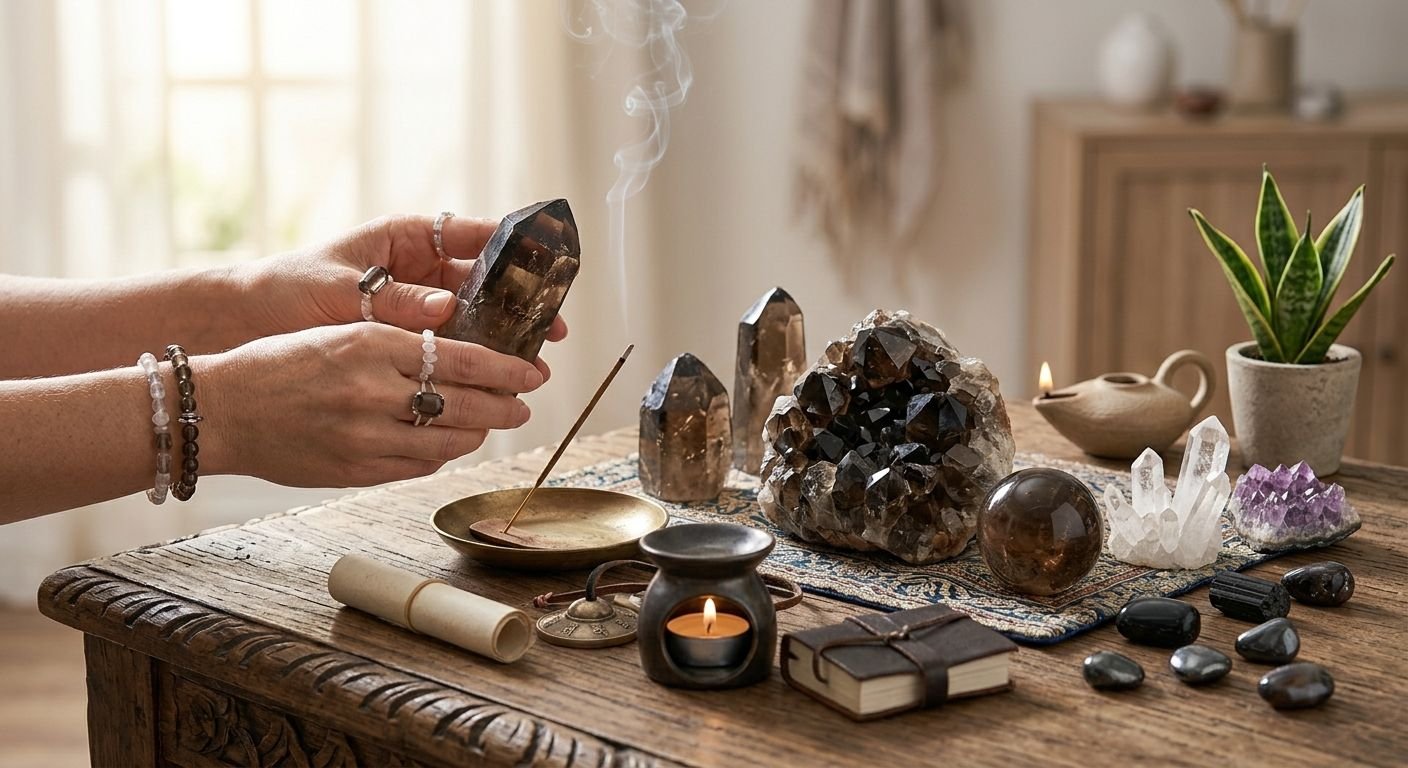
Smoky quartz is a brown-to-black, translucent variety of quartz, part of the same broad mineral family as amethyst, citrine, and clear quartz. Its distinctive smoky color comes from a genuinely interesting natural process: trace aluminum impurities within the quartz structure interact with natural background radiation from the surrounding rock over long periods, creating what mineralogists call color centers — microscopic structural changes that absorb light differently and produce the stone's characteristic brown-grey-to-black tone.
The color itself ranges considerably, from a barely-there pale smoky tint to a deep, almost opaque near-black. Unlike some other colored quartz varieties, smoky quartz's color isn't tied to a different trace element entirely — it's essentially the same base aluminum-bearing quartz that could, under different radiation exposure, have become something else, which is part of why smoky quartz and clear quartz are sometimes found within the same larger formation.
Where Smoky Quartz Is Found
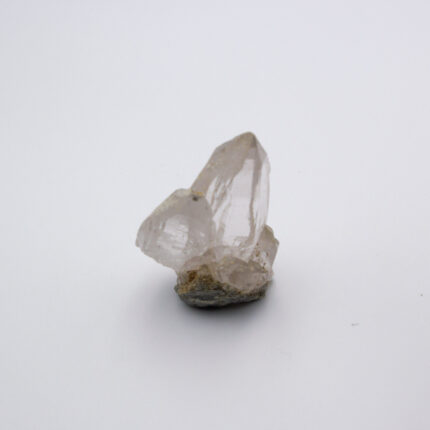
Smoky quartz forms in many of the same geological settings as clear quartz — within granite, in mineral veins, and inside cavities in volcanic rock — and it's found across a genuinely wide range of locations globally, including significant deposits in the Himalayan region, Brazil, Madagascar, and parts of Europe and the United States. Himalayan smoky quartz specifically tends to form as well-defined, prismatic crystal points, often with visible color zoning where the depth of tone shifts gradually along the length of a single crystal.
Sitting at 7 on the Mohs Scale
Like other quartz varieties, smoky quartz sits at a 7 on the Mohs hardness scale, which is genuinely durable for everyday handling and jewellery use. This shared hardness across the whole quartz family is part of why clear quartz, amethyst, citrine, and smoky quartz are all viable choices for daily-wear bracelets and rings without much concern about scratching under normal conditions.
Smoky Quartz Meaning
The meaning attached to smoky quartz is remarkably consistent across different traditions and sources, which is fairly unusual for a crystal without one single, dominant historical narrative behind it the way amethyst or citrine have. Across the board, smoky quartz is described first and foremost as a grounding stone — one associated with stability, practicality, and a calm, steady presence rather than anything dramatic or attention-seeking.
This meaning lines up naturally with the stone's own appearance. A muted, earthy brown-to-black tone doesn't carry the same immediate visual drama as a vivid purple or golden stone, and the traditional meaning assigned to smoky quartz reflects that same understated quality — it's consistently framed as a stone for staying steady rather than one for standing out.
A Historical Note
Smoky quartz has a longer documented history of use than its relatively quiet modern reputation might suggest — it was used in jewellery and carved seal stones in ancient Rome, and later became closely associated with Scottish Highland dress specifically, where a variety known as cairngorm, named after the Cairngorm Mountains, was traditionally set into kilt pins, sporrans, and dirk handles. This historical use, entirely separate from the modern crystal healing framing, points to a longer-standing appreciation for the stone's understated, wearable character across genuinely different cultural contexts.
Smoky Quartz Benefits
The traditional benefits associated with smoky quartz cluster fairly tightly around a few consistent themes.
Grounding is the single most consistent association across every source discussing this stone. In practical terms, this tends to mean feeling less scattered, less reactive, and more anchored in the present moment — the kind of steadiness people reach for during a stressful stretch rather than a specific dramatic shift. This is often described as the difference between reacting immediately to a stressful situation and having a brief, steadying pause before responding.
Absorbing and transmuting negative energy is the second major theme, closely related to smoky quartz's darker color. Some traditions specifically describe it as absorbing difficult or negative energy from its surroundings, similar to the reputation black tourmaline carries, though smoky quartz's version of this is generally described as gentler and less intense. Some practitioners specifically favor smoky quartz over darker, more absolute stones precisely because of this gentler quality, particularly if a more intense grounding stone feels overwhelming.
Supporting focus during meditation comes up frequently too — smoky quartz is a popular choice specifically for keeping meditation practical and present-focused, rather than the more expansive, spiritually-oriented associations carried by lighter-colored quartz varieties like amethyst. It's commonly recommended for meditation sessions aimed at working through a specific practical problem, rather than sessions oriented toward broader spiritual exploration.
Helping process and release what no longer serves you is a slightly more emotional association, tied to the grounding theme — smoky quartz is commonly reached for during a period of letting go, whether that's a difficult habit, a finished chapter, or simply accumulated stress that needs somewhere to go. This association pairs naturally with its root chakra connection, since the root chakra itself is tied to a basic sense of security that makes genuine release and letting go feel safer to attempt.
Easing anxious or overactive thinking rounds out the common associations — smoky quartz's grounding character is often specifically recommended for a racing or anxious mind, treated as something to hold or wear specifically during moments when thoughts feel difficult to settle.
Smoky Quartz and the Root Chakra
Smoky quartz is tied specifically to the root chakra, the energy center at the base of the spine associated with safety, stability, and feeling anchored in your own body and circumstances. This connection lines up directly with everything covered above — grounding, stability, and a calm, practical presence are essentially root chakra concerns described in different language. Practitioners working specifically on root chakra balance sometimes hold or place smoky quartz at the base of the spine during meditation, though wearing it as a bracelet or keeping a piece nearby during the day is the more practical version of the same idea.
Who Should Wear Smoky Quartz
This is worth being specific about, since smoky quartz genuinely isn't the right fit for every situation the way a more all-purpose stone like clear quartz might be.
People dealing with a genuinely stressful, high-pressure period are probably the most natural fit — anyone whose days feel scattered, reactive, or constantly pulled in different directions tends to respond well to a stone whose entire traditional meaning centers on steadiness.
Empaths and people who feel drained by others' energy are frequently drawn to smoky quartz specifically because of its absorbing, protective reputation, similar to why black tourmaline appeals to the same group, but with a gentler, less intense character that some people specifically prefer.
Anyone going through a period of transition or letting go — a career change, the end of a relationship, moving away from an old habit — fits the "release what no longer serves you" association covered earlier particularly well.
Men specifically drawn to darker, more understated stones often gravitate toward smoky quartz for the same reason black tourmaline has become popular in men's jewellery — it reads as hardware rather than decoration, without needing to lean on a stark black tone the way tourmaline does.
Beginners to crystal work who find brighter stones overwhelming sometimes specifically prefer smoky quartz's muted presence as a gentler entry point, particularly if a more vivid stone feels like "too much" as a first piece.
Anyone in a demanding, decision-heavy role — managers, caregivers, and anyone whose day involves constant small decisions and competing demands — often responds well to a stone associated specifically with staying level rather than reactive, since that steadiness has an obvious practical application in exactly this kind of role.
People who already meditate but find their mind hard to settle are a natural fit for smoky quartz's specific reputation for supporting focus and calming an overactive mind, as distinct from stones associated with more expansive spiritual states.
Conversely, if you're specifically looking for a stone associated with joy, romance, or high energy, smoky quartz's whole character runs in the opposite direction — that's not a flaw, just a mismatch worth knowing before you buy.
Smoky Quartz vs. Other Grounding Stones
Smoky quartz sits within a small family of stones people often compare directly, and it's worth knowing the actual differences rather than treating them as interchangeable.

Smoky quartz vs. black tourmaline: both are grounding, protective stones, but black tourmaline is generally described as more intense and absolute — a near-total block against negative energy — while smoky quartz's reputation is gentler, more about steady processing than hard blocking. Visually, they're also fairly distinct once you look closely: black tourmaline is genuinely opaque and matte, while smoky quartz retains quartz's characteristic translucency even at its darkest, letting light pass through at the edges in a way tourmaline never does. We've covered black tourmaline's full meaning and benefits separately if that's the stone you're actually comparing against.
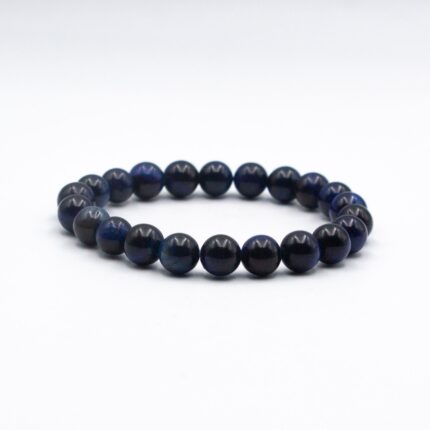
Smoky quartz vs. tiger's eye: tiger's eye shares some grounding association but leans more toward confidence, courage, and outward-facing willpower, while smoky quartz stays closer to internal steadiness and calm. If you want a stone for facing a specific challenge head-on, tiger's eye is generally the better match; if you want something to simply keep you level day to day, smoky quartz fits more naturally. Tiger's eye's banded, golden-brown shimmer is also considerably more visually striking than smoky quartz's muted, translucent tone, which is worth factoring in if appearance matters as much as meaning in your decision.
Smoky quartz vs. clear quartz: since they're the same base mineral, the difference is really about intention. Clear quartz is traditionally treated as an amplifier with no fixed direction of its own, while smoky quartz's irradiation-driven color gives it a specific, consistent grounding character that clear quartz doesn't carry on its own. Some practitioners specifically pair the two, using clear quartz to amplify smoky quartz's grounding intention rather than choosing one over the other.
A Quick Reference for Choosing Between Them
If you had to pick just one based purely on intensity, black tourmaline sits at the strongest end of this grouping, smoky quartz in the middle, and tiger's eye off to the side entirely with its more outward, confidence-focused character rather than a directly comparable point on the same spectrum. Most people find their preference through handling the actual stones rather than reasoning it out in the abstract — the visual and tactile difference between a matte black tourmaline and a translucent smoky quartz is often more decisive than the written meaning alone.
Natural vs. Irradiated Smoky Quartz
This is worth covering honestly, since it's a genuinely common point of confusion in this specific category. A meaningful share of commercially sold smoky quartz, particularly darker, more uniformly colored material, has been artificially irradiated in a lab to deepen or produce the smoky color, rather than acquiring it naturally over geological time. This is a similar situation to citrine, where most commercial material is heat-treated rather than naturally that color — the practice isn't necessarily deceptive when disclosed, but it's worth knowing rather than assuming every dark, uniform piece formed that way in the ground.
Naturally smoky quartz tends to show more variation in color depth across a single piece, sometimes with visible zoning or a gradient rather than one flat, uniform tone throughout. A completely even, very dark near-black color across an entire large piece is more often a sign of lab irradiation than natural formation, though this isn't a hard rule on its own — genuine natural material can occasionally reach a similarly deep tone too. As with most authenticity questions in this category, asking a seller directly about treatment and origin gets you further than guessing from appearance alone.
Why Irradiated Quartz Isn't the Same as a Fake
It's worth being precise about this distinction, since "irradiated" and "fake" get conflated far too often. Irradiated smoky quartz is still genuinely quartz, chemically identical to naturally smoky material — the treatment simply accelerates a color-forming process that would otherwise take geological time. This is fundamentally different from dyed glass or plastic sold as smoky quartz, which contains none of the actual mineral at all. If formation history matters specifically to your own practice, natural material is worth seeking out and asking about directly; if you're mainly drawn to the color and meaning, treated material is a legitimate, more affordable way to get there.
Checking for Genuine Quartz Regardless of Treatment
Whether natural or irradiated, the basic physical checks that separate real quartz from glass or plastic imitations still apply. Genuine smoky quartz feels cool against the skin before warming, carries real density for its size, and should show at least some natural inclusion or variation rather than being perfectly, uniformly flawless. These checks won't tell you whether a piece was irradiated, but they will confirm you're actually holding quartz rather than a dyed imitation of it.
How to Wear and Use It
Smoky quartz works well in most jewellery formats, though given its grounding, root-chakra association, a bracelet or ring tends to suit daily, practical use particularly well, keeping the stone in constant contact throughout ordinary activity rather than reserved for quiet, seated moments only. For meditation specifically, holding a piece or keeping it nearby during the session, rather than only wearing it passively, is a common way to lean into its more deliberate, grounding use.
Raw, unpolished pieces are also popular for this particular stone, kept on a desk, by an entryway, or near a workspace — precisely the kind of fixed, practical placement that suits smoky quartz's steady, background character better than a dramatic display piece would.
A Simple Way to Use It Intentionally
If you want to move beyond simply wearing or displaying the stone, a brief, specific practice works well with smoky quartz's grounding character. Holding the piece for a moment before a stressful meeting, a difficult conversation, or simply the start of a demanding day, while taking a few slow breaths, gives the stone a specific intention to be associated with rather than functioning purely as passive jewellery. This kind of brief, practical ritual suits smoky quartz's understated, no-fuss character better than a more elaborate ceremony would.
Placement at Home or in a Workspace
Beyond personal wear, a raw piece kept specifically near an entryway is a common placement, on the logic that this is where a home or workspace's energy is most directly affected by whoever or whatever passes through. A piece kept on a desk during particularly demanding work is another common placement, treated as a quiet, steady presence during the parts of the day that call for the most focus and patience.
Real Smoky Quartz Worth Considering
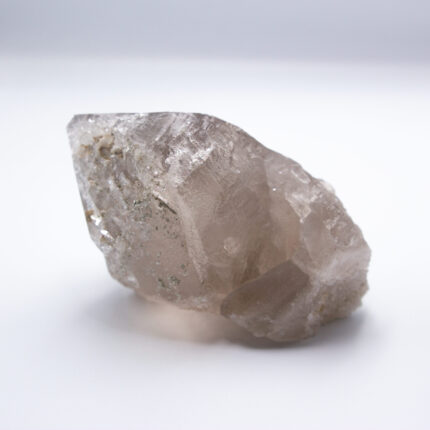
Our Ganesh Himal Natural Smoky Quartz, handpicked from the Himalayas in Nepal, is a genuine raw specimen — exactly the kind of piece suited to a desk, meditation space, or entryway rather than jewellery. If you'd rather explore other grounding stones alongside it, our black tourmaline bracelet and tiger's eye bracelet are both worth a look for a more wearable option from the same general family. You can also browse our wider raw healing crystals collection for more pieces in a similar spirit.
Basic Care
Smoky quartz is genuinely durable, sitting at the same hardness as other quartz varieties, so it handles regular handling well. Keep it out of prolonged, intense sunlight specifically, since smoky quartz can fade slightly with extended UV exposure over time — more so than some other quartz colors. A soft, dry cloth handles routine cleaning, and if you cleanse crystals periodically, moonlight or sound are safer choices than direct sun exposure for this particular stone.
Looking for smoky quartz in a specific format?
Stock and available pieces shift regularly. Message us and we'll tell you what's genuinely available right now.
Questions People Ask
What does smoky quartz actually mean?
Smoky quartz is traditionally associated with grounding, stability, and absorbing negative energy. Its meaning is consistently described across sources as calm and practical rather than dramatic or high-energy.
Who should wear smoky quartz?
It particularly suits people dealing with a stressful period, empaths who feel drained by others' energy, anyone going through a transition, and those who prefer an understated, darker stone over something bright or decorative.
Is all smoky quartz natural, or is some of it treated?
A meaningful share of commercial smoky quartz is artificially irradiated to deepen or produce its color, similar to how most citrine is heat-treated. This isn't necessarily deceptive when disclosed, but it's worth asking a seller about directly.
What's the difference between smoky quartz and black tourmaline?
Both are grounding, protective stones, but black tourmaline's reputation is more intense and absolute, while smoky quartz is generally described as gentler and more about steady processing than hard blocking.
Can smoky quartz fade over time?
Yes, with prolonged, intense sun exposure. Keeping it out of direct sunlight for extended periods helps preserve its color over the years.
Is irradiated smoky quartz still real quartz?
Yes. Irradiated smoky quartz is chemically identical to naturally smoky material, since the treatment simply accelerates a color-forming process that would otherwise take geological time. It's genuinely different from dyed glass or plastic imitations.
Can smoky quartz be worn with other crystals?
Yes, it pairs well with other grounding stones like black tourmaline, and some practitioners specifically combine it with clear quartz, using clear quartz to amplify smoky quartz's grounding intention.