

Rutilated Quartz: What Those Golden Threads Actually Mean
The needle-like threads running through this stone are a real mineral in their own right — here's what they actually are, and what they're believed to do.
Rutilated quartz is one of the more visually striking stones in the whole quartz family, and also one of the more misunderstood — a lot of people assume those golden threads running through the crystal are some kind of internal damage or impurity. They're actually a completely separate mineral, grown right alongside the quartz itself, and understanding what they are changes how you think about the stone's meaning entirely.
What Rutilated Quartz Actually Is
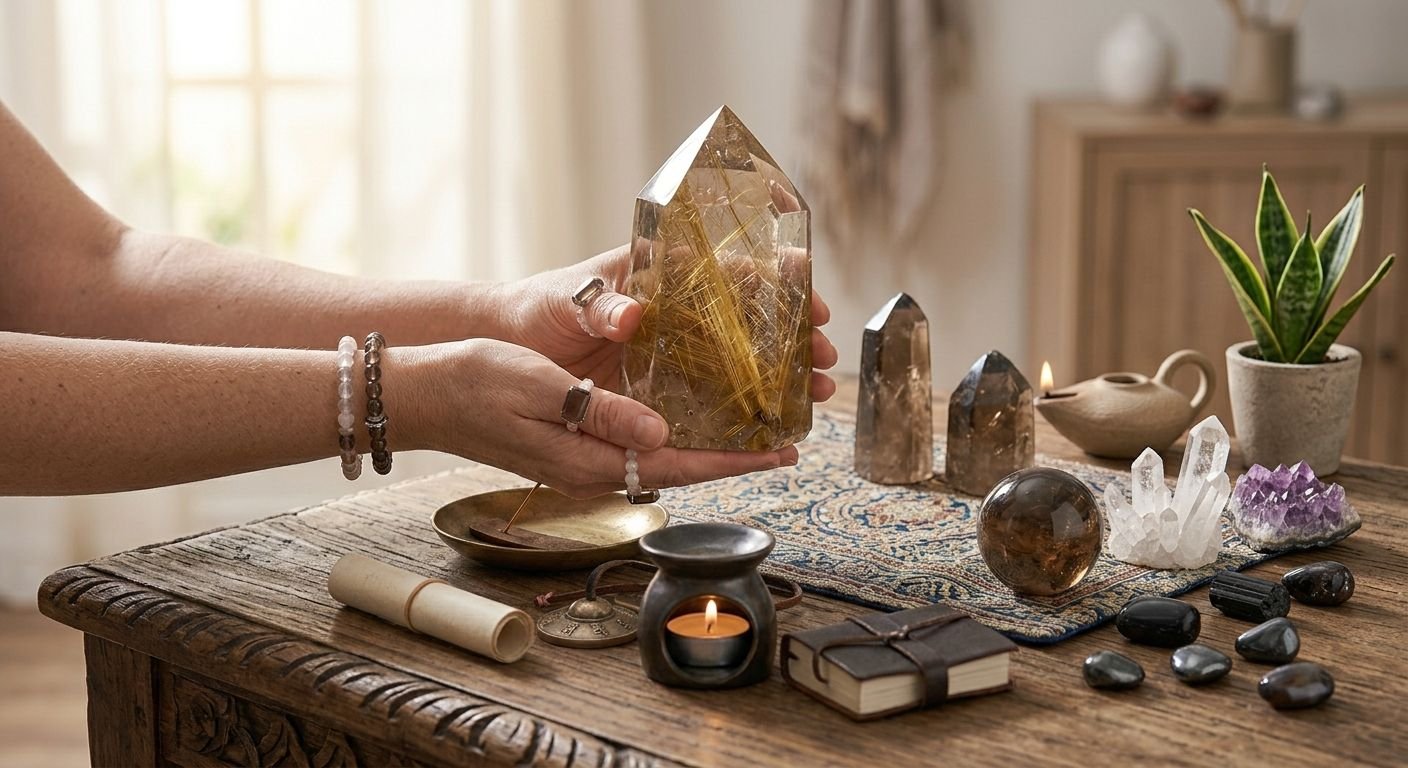
Rutilated quartz is clear or smoky quartz containing needle-like inclusions of a separate mineral called rutile — a form of titanium dioxide that crystallizes in thin, straight, or slightly curved strands as the surrounding quartz forms around it. These inclusions most commonly appear golden or copper-colored, though they can also occur in silver, reddish, or black tones depending on trace elements present during formation. The needles can be sparse, scattered singly through an otherwise clear stone, or dense enough to make the quartz body almost entirely opaque with fine golden strands.
The two minerals form together, but not simultaneously in the way people sometimes assume — rutile crystals typically begin forming first, within cracks or cavities in the host rock, and quartz subsequently grows around and through them, effectively trapping the rutile needles in place as the quartz crystal develops. This is why the needles often appear to radiate outward or cross at specific angles rather than scattering randomly, following the underlying crystal structure of the rutile itself.
How Common Is It, Really
Rutile inclusions occur across a genuinely wide range of quartz specimens globally, with notable deposits in Brazil, Madagascar, and parts of the Himalayan region among others, but the specific combination of a clear, attractive host crystal with dense, well-formed golden needles is considerably rarer than plain clear quartz. Most rough quartz containing rutile either has too little inclusion to be visually interesting, or the host crystal itself lacks the clarity needed to properly showcase the needles once cut and polished — which is part of why a genuinely striking piece commands real attention within the broader quartz family.
The Titanium Connection
Rutile is worth knowing about slightly beyond its decorative role, since it's also a commercially significant mineral in its own right — mined separately as one of the primary industrial sources of titanium dioxide, used in everything from paint pigment to sunscreen. The rutile trapped inside a piece of rutilated quartz is chemically identical to this industrially important mineral, simply captured in a far more decorative context than a paint factory.
Where the Name — and Its Nicknames — Come From
"Rutile" comes from the Latin rutilus, meaning reddish or golden, a reference to the mineral's most common color rather than to quartz at all — rutile is a legitimate mineral in its own right, also mined separately as a source of titanium for industrial use, well beyond its decorative role inside quartz.
The stone has picked up several evocative folk names over time. It's sometimes called Venus's hair stone, based on old folklore describing the fine golden threads as strands of the goddess's hair trapped within the crystal. Another common nickname, angel hair quartz, draws on similar imagery. Less commonly, older sources describe the needles as "Cupid's arrows" or "fléches d'amour," a French term reflecting a long-standing, if fairly whimsical, association between this specific stone and romantic and intention-based symbolism.
Why So Many Names Point Toward the Same Imagery
It's worth noticing that nearly every historical nickname for this stone reaches for the same general image — fine, golden, hair-like threads suspended in something clear and precious. This consistency across genuinely different eras and language traditions suggests the visual impression this stone makes is fairly universal, rather than any single culture inventing a uniquely creative name for it. The needles simply look like something deliberate and beautiful trapped in glass, and that impression has apparently struck observers similarly across a long stretch of history.
Rutilated Quartz Meaning
Rutilated quartz's meaning builds directly on clear quartz's own reputation as the "amplifier" stone, but with a specific direction added by the rutile inclusions themselves. Where plain clear quartz is traditionally treated as an open amplifier with no fixed direction of its own, rutilated quartz is generally described as combining that amplifying quality with rutile's own separate association — illumination, clarity of thought, and a kind of directed, purposeful energy, visually reflected in the way the golden threads seem to channel light through the stone in specific lines rather than diffusing it evenly.
This combination is part of why rutilated quartz carries a slightly different character than either mineral would on its own — less passive than plain clear quartz, and more specifically associated with manifestation, goal-setting, and mental clarity than a purely generic "amplifier" reputation would suggest.
The Visual Metaphor Behind the Meaning
It's worth noticing how directly the traditional meaning maps onto the stone's actual appearance, since this isn't a coincidence in how crystal meanings generally develop. Golden light, threads, rays, and channels are visual metaphors that appear repeatedly across many unrelated cultural traditions to represent illumination, insight, and directed energy — sunbeams, guiding threads, rays of clarity cutting through confusion. Rutilated quartz's meaning draws on this same well-worn visual language almost automatically, simply because the stone itself so literally resembles captured light or directed energy running through clear crystal.
Rutilated Quartz Benefits
The traditional benefits associated with rutilated quartz cluster around a few specific, fairly consistent themes.
Manifestation and goal clarity is probably the most consistently cited benefit — rutilated quartz is a popular choice specifically for intention-setting work, treated as a stone that helps direct energy toward a specific, defined outcome rather than a vague, unfocused hope. This ties directly back to the visual metaphor of the golden threads acting as channels or pathways within the stone. Some practitioners specifically use it alongside written goal-setting or vision-board work, treating the physical stone as a companion object to a more deliberate, structured planning process rather than as a substitute for one.
Mental clarity and decisiveness is a closely related theme — the stone is commonly associated with cutting through confusion or indecision, helping bring a scattered or overwhelmed mind back toward a clear, specific direction. This makes it a fairly popular choice during a significant decision or a period of feeling genuinely stuck between options.
Amplifying intention and energy work generally reflects the underlying clear quartz base — rutilated quartz is often specifically chosen to intensify whatever broader practice or intention it's incorporated into, similar to how plain clear quartz is used, but with the added directional quality the rutile inclusions are believed to bring. This is part of why it's sometimes recommended as a companion stone rather than a standalone piece, paired with something like citrine for a more focused abundance intention, or rose quartz for a more clearly directed emotional healing practice.
Emotional healing and breaking old patterns comes up frequently too, particularly in the context of the "angel hair" and "Venus's hair" folklore — some traditions describe the stone as helping untangle old emotional patterns or stuck thinking, drawing a fairly direct visual metaphor from the tangled or radiating threads themselves.
Why Inclusions Make This Stone More Valuable, Not Less
This is genuinely worth knowing, since it runs against how inclusions are usually treated in the wider gemstone world. For most gemstones, visible internal inclusions reduce value — they're treated as flaws that interfere with clarity and light performance. Rutilated quartz is a notable exception: the rutile inclusions are precisely what make a piece desirable, and a specimen with well-defined, visually striking needle patterns commands a genuine premium over plain, inclusion-free clear quartz of similar size.
This also means quality varies considerably within rutilated quartz itself, based on factors like needle density, color vibrancy, and how visually interesting the overall pattern is — a sparse scattering of thin, pale threads is a different tier of piece entirely from a dense, richly golden, dramatically patterned specimen, even though both are technically the same combination of minerals.
What Collectors and Cutters Actually Look For
Beyond simple density, the specific arrangement of the needles matters considerably to how a piece is valued. Needles radiating outward from a single point in a star-like or sunburst pattern are generally considered more visually striking, and more valuable, than needles scattered with no particular structure. Lapidaries — the specialists who cut and polish gemstones — often orient the cut of a rutilated quartz piece specifically to showcase the most visually interesting angle of the needle pattern, meaning the finished shape of a piece is frequently determined by the inclusions themselves rather than a standard, predetermined cut.
Rough vs. Cut and Polished Value
It's worth knowing that rough, unpolished rutilated quartz can look deceptively unremarkable — the needles are often far more visible and striking once the surrounding quartz has been cut and polished to full clarity, since a rough, unpolished surface scatters light in a way that obscures the internal pattern. This is part of why a skilled cutter's work adds genuine value to a rutilated quartz piece beyond simply shaping the stone.
Rutilated Quartz vs. Tourmalinated Quartz
These two stones get confused constantly, and it's worth clarifying the difference directly. Tourmalinated quartz follows the same basic principle — a separate mineral trapped as needle-like inclusions within a clear quartz host — but the inclusions are black tourmaline rather than golden rutile. Visually, this produces a strikingly different effect: dark, almost spider-web-like black threads through clear quartz, rather than the warm golden or copper strands that define rutilated quartz specifically.
The traditional meanings differ accordingly too. Tourmalinated quartz leans on black tourmaline's grounding, protective reputation combined with clear quartz's amplifying quality, while rutilated quartz leans toward illumination, clarity, and directed manifestation. If you've seen a piece described simply as "quartz with black threads," that's very likely tourmalinated quartz rather than rutilated quartz, despite the visual similarity in overall concept.
Other Quartz-With-Inclusion Varieties Worth Knowing
Beyond these two, a handful of other named varieties follow the same underlying pattern of a separate mineral trapped within a clear quartz host, each with its own distinct look and meaning. Included quartz containing fine, hair-like actinolite is sometimes marketed separately, and various other mineral inclusions occasionally show up in smaller, specialist quantities. None of these are quite as commercially established or consistently available as rutilated or tourmalinated quartz, but it's worth knowing this is a broader category of stone rather than just two isolated examples.
Natural vs. Fake Rutilated Quartz
Because genuine rutilated quartz commands a real premium specifically for its inclusions, it's a stone worth checking carefully before buying, particularly for larger or more dramatically patterned pieces.
Glass With Embedded Wire or Thread
The most common imitation involves clear glass with fine metallic wire, thread, or wisps embedded during manufacturing to mimic the appearance of rutile needles. This is usually detectable on close inspection — genuine rutile needles have a metallic, slightly reflective sheen and follow a natural, somewhat angular crystal structure, while embedded wire or synthetic fiber tends to look more uniformly smooth and can appear too perfectly straight or too obviously man-made under magnification.
Genuine Quartz With Added, Non-Rutile Inclusions
Some pieces use genuine quartz but with other materials — synthetic fibers, or even human or synthetic hair, according to some documented cases — inserted into a cavity or crack to mimic natural rutile. This is harder to catch through weight or temperature tests alone, since the base material genuinely is quartz. Careful visual inspection under good light, looking specifically for the metallic luster and natural angular growth pattern genuine rutile shows, remains the most reliable check.
What to Actually Look For
Genuine rutile needles typically show a bright, metallic golden sheen, often appear to cross at specific angles related to the underlying crystal structure rather than scattering randomly, and don't show air bubbles trapped alongside them the way a glass imitation with embedded thread sometimes will. As with any authenticity question in this category, asking a specialized seller directly about sourcing, and being cautious of pieces priced dramatically low for their apparent inclusion density, remains a sensible general practice.
The Weight and Temperature Test Still Applies
Beyond the specific rutile-focused checks above, the standard quartz authenticity tests still apply as a useful baseline. Genuine quartz feels cool against the skin for a moment before warming, and carries real density for its size compared to lightweight glass. A piece that fails these basic checks is worth questioning regardless of how convincing the internal needle pattern looks, since a well-made glass imitation can sometimes fool the eye more easily than it fools the hand.
How to Wear and Use It
Given its association with manifestation and directed intention, rutilated quartz is commonly worn as a pendant specifically, keeping it near the throat or heart where it can be seen and consciously engaged with throughout the day, rather than tucked away on a wrist where it's easy to forget about. Holding a piece briefly while setting a specific, clearly defined intention — rather than a vague, general hope — is a common practice that lines up directly with the stone's traditional meaning.
Because rutilated quartz pieces are often set as statement jewellery specifically to showcase the visible inclusion pattern, it's also commonly chosen as a piece meant to be looked at and appreciated visually, not just worn passively — the golden threads genuinely do catch and reflect light in a way that rewards a closer look.
A Simple Manifestation Practice Worth Trying
If you want a specific, low-effort way to use the stone in line with its traditional meaning, try this: hold the piece for a moment each morning, and state one single, specific, achievable goal for that day out loud or in your head — not a broad life ambition, but something concrete and completable. This keeps the practice grounded in the stone's specific "directed clarity" reputation rather than treating it as a vague, passive good-luck charm.
Real Rutilated Quartz Worth Seeing
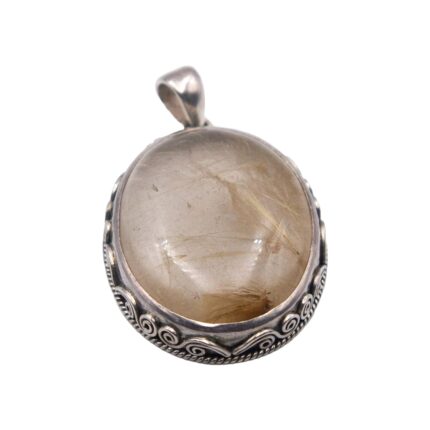
Our 925 Sterling Silver Vintage Real Rutilated Quartz Pendant is a genuine, handcrafted piece from our antique jewellery collection, set in sterling silver and sourced from Nepal — a good example of exactly what this guide has been describing, rather than an abstract concept. Given the individual nature of these pieces, it's worth checking current stock directly, since specimens like this vary naturally from piece to piece and don't get restocked identically once sold.

If you're drawn to stones valued specifically for a distinctive internal visual effect, our labradorite bracelet is worth a look too — a genuinely different mineral and optical phenomenon, but a similar underlying appeal. You can browse our wider antique jewellery collection for more individually sourced pieces in a similar spirit.
This gives a sense of the wider range within the same collection — each piece individually sourced and set, rather than a uniform, mass-produced product line.
Basic Care
Rutilated quartz shares clear quartz's hardness and general durability, sitting at 7 on the Mohs scale, so it handles regular wear reasonably well. That said, treat the rutile inclusions themselves with a bit more care than the surrounding quartz — while genuinely part of the crystal structure, dense or heavily included areas can occasionally represent a slightly weaker point structurally, so avoid sharp knocks specifically on heavily included sections. Clean with a soft, dry cloth, avoid harsh chemicals and ultrasonic cleaners, and keep the piece out of prolonged, intense sunlight to preserve its clarity over the years.
Cleaning Around the Setting
For a piece set in sterling silver, like a vintage pendant, pay particular attention to drying the metal thoroughly after any cleaning, especially around a bezel or prong setting where moisture can sit trapped against the silver and encourage tarnishing over time. A separate, gentle silver polishing cloth used on just the metal, avoiding direct contact with the stone itself, keeps the setting looking as good as the crystal.
Interested in this specific piece?
Vintage and antique pieces like this one are individually sourced and don't get restocked identically. Message us to check current availability.
Questions People Ask
What are the golden threads inside rutilated quartz actually made of?
They're a separate mineral called rutile, a form of titanium dioxide, which crystallizes as needle-like strands and becomes trapped inside the quartz as it grows around them.
Does rutilated quartz mean the same thing as clear quartz?
Not exactly. It builds on clear quartz's amplifying reputation but adds rutile's own association with illumination, clarity, and directed manifestation, giving it a more specific character than plain clear quartz.
What's the difference between rutilated quartz and tourmalinated quartz?
Rutilated quartz contains golden or copper rutile needles, while tourmalinated quartz contains black tourmaline needles. They look visually different and carry different traditional meanings.
Why do inclusions make rutilated quartz more valuable instead of less?
Unlike most gemstones, where inclusions are treated as flaws, rutilated quartz is specifically valued for its needle-like inclusions. A piece with well-defined, visually striking rutile patterns commands a premium over plain, inclusion-free quartz.
How can I tell if rutilated quartz is genuine?
Genuine rutile needles show a bright, metallic sheen and follow natural angular growth patterns, without trapped air bubbles. Imitations often use embedded wire or synthetic fiber in glass, which tends to look too uniform or perfectly straight under close inspection.
Where does rutilated quartz come from?
Notable deposits are found in Brazil, Madagascar, and parts of the Himalayan region, among other locations. Genuinely striking specimens with dense, well-formed needle patterns are considerably less common than plain clear quartz.
Is rutile the same material used industrially?
Yes. Rutile is mined separately as a major industrial source of titanium dioxide, used in products like paint pigment and sunscreen. The rutile inside rutilated quartz is chemically identical to this industrial mineral.