

Tiger's Eye Bracelet: Benefits, Meaning and Which Wrist to Wear It On
What the golden shimmer actually is, what tiger eye bracelet benefits are traditionally believed to be, and which wrist tradition actually recommends.
Tiger's eye is one of the most recognizable stones out there — that shifting golden band of light is hard to mistake for anything else. What's less well known is what's actually happening inside the stone to produce that effect, what tiger eye bracelet benefits are genuinely rooted in versus recently invented, and the specific wrist tradition that comes up constantly but rarely gets explained properly. This guide covers all three.

What Makes Tiger's Eye Look That Way
Tiger's eye is a variety of quartz that owes its shifting, silky band of light to an optical effect called chatoyancy — from the French œil de chat, meaning "cat's eye." Unlike most quartz, which forms directly from silica-rich fluid, tiger's eye begins life as an entirely different mineral: crocidolite, a fibrous blue mineral in the asbestos family. Over long geological timescales, silica gradually replaces the crocidolite fibers in a process called pseudomorphism, preserving their fine, parallel structure while converting the material into quartz. As iron present during this process oxidizes, it produces the familiar golden-to-brown color, while the preserved fibrous structure is what creates the shifting, light-catching band as the stone moves.
More recent mineralogical research has actually refined this picture slightly — rather than a simple, complete replacement of one mineral by another, current understanding points to a "crack-seal" growth mechanism, where quartz and crocidolite fibers grew together in repeated cycles as microscopic cracks opened and filled. Either way, the practical result is the same: a genuinely unique stone whose internal structure literally belongs to a different mineral family than the quartz it's technically classified as.
Where Tiger's Eye Actually Comes From
The primary global source of tiger's eye is South Africa's Northern Cape province, specifically the Griqualand West region, where extensive crocidolite deposits within ancient iron formations have been progressively silicified over geological time to produce the majority of the tiger's eye reaching the global market. The town of Griquatown itself even has a dedicated geological museum documenting the local mineralogy. Beyond South Africa, meaningful deposits also occur in Australia, Thailand, Namibia, India, Myanmar, Brazil, Canada, China, and parts of the United States, including Arizona and Montana.
A Related Variety Worth Knowing
Tiger's eye and hawk's eye — covered in more detail below — often occur together within the same geological formation, sometimes even within a single specimen, showing a visible transition zone where blue-grey hawk's eye coloring gradually shifts into golden tiger's eye as the degree of iron oxidation changes across the stone. This isn't a defect; it's a genuinely interesting window into the formation process happening in real time within one piece.
Tiger Eye Bracelet Benefits
The benefits traditionally associated with a tiger eye bracelet cluster fairly consistently around a handful of themes, most of them tied loosely to the stone's bold, warm, watchful appearance.
Confidence and courage is the benefit most consistently cited across nearly every source discussing this stone. Tiger's eye is commonly reached for specifically before something that requires nerve — a difficult conversation, a presentation, a decision that's been sitting unresolved. The logic tracks the stone's own visual character fairly directly: bold, watchful, and unmistakably present. Some people specifically describe holding or touching the bracelet as a brief, physical anchor right before stepping into a situation they feel nervous about, using the stone as a deliberate pause rather than something purely passive.
Grounding combined with motivation is a slightly less obvious tiger eye bracelet benefit, but a genuinely common one — unlike purely calming grounding stones, tiger's eye is generally described as grounding energy toward action rather than toward stillness, making it a popular choice for anyone who needs to feel steady and capable of moving forward at the same time, rather than steady and passive. This distinguishes it clearly from stones like smoky quartz or black tourmaline, whose grounding character leans considerably more toward calm and stillness than toward active momentum.
Protection rounds out the most commonly cited benefits, tied to the "watchful eye" visual metaphor discussed elsewhere in crystal folklore more broadly — a stone that resembles an eye has been treated as symbolically protective across many unrelated cultures, and tiger's eye's banded pattern fits this pattern about as literally as a stone can. Ancient Egyptian and Roman use of the stone specifically for this protective purpose is well documented, predating any of the modern crystal-healing framing by many centuries.
Mental focus and clear decision-making is the fourth theme worth mentioning, often paired with the confidence association above — tiger's eye is a fairly popular choice specifically during a period of decision-making, treated as supportive of clear-headed judgment rather than second-guessing. This association pairs naturally with the stone's traditional link to willpower and personal resolve, treated less as a source of new information and more as support for trusting a decision once it's already been reasoned through.
Tiger's Eye Bracelet Meaning
Tiger's eye's meaning is tied closely to its name and appearance — the stone has been associated with vigilance, strength, and protection across a genuinely wide range of cultures and historical periods, including ancient Egypt and Rome, where it was reportedly worn or carried specifically for its protective, watchful symbolism. This long, cross-cultural consistency is fairly unusual for a crystal meaning and suggests the association developed independently in multiple places, most likely triggered by the same fairly obvious visual resemblance to an actual eye rather than a single point of origin.
Modern usage has broadened this meaning somewhat, adding the confidence and motivation themes covered above to the older, more narrowly protective symbolism — but the throughline from ancient watchfulness to modern confidence is a fairly direct one, both rooted in the same basic idea of alert, capable strength rather than passive calm.
A Zodiac and Anniversary Association
Tiger's eye is traditionally linked to the zodiac sign Leo, a pairing that lines up naturally enough given Leo's own association with boldness, confidence, and warmth — themes the stone's meaning already shares independently of any astrological framing. It's also recognized as a traditional gemstone associated with the ninth wedding anniversary in some Western gift-giving traditions, worth knowing if you're specifically looking for a meaningful anniversary gift rather than buying purely for personal use.
Golden Tiger's Eye vs. Blue Tiger's Eye

These aren't two different stones — they're two stages of the same formation process. Golden tiger's eye is the fully oxidized end result, where iron has completed its color-changing reaction to produce the classic warm brown-gold banding. Blue tiger's eye, more properly called hawk's eye, represents an earlier stage where iron oxidation hasn't progressed as far, leaving the stone with the original blue-grey tone of the unaltered crocidolite fibers still largely intact.
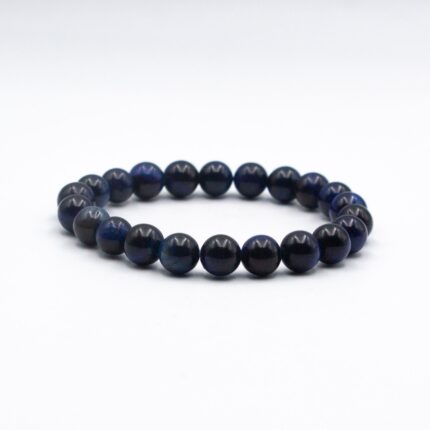
The traditional meanings shift slightly along with the color. Golden tiger's eye leans more toward bold confidence and outward action, while blue tiger's eye — hawk's eye — is generally described as calmer and more introspective, associated with clear perception and intuition rather than assertive confidence specifically. Both share the underlying watchful, protective symbolism; the difference is more about tone than substance.
A Third, Rarer Variety
A red tiger's eye variety also exists, produced through heat treatment of golden tiger's eye that pushes the iron oxidation further than it would naturally progress, deepening the color into a rich reddish-brown. Unlike the naturally occurring golden-to-blue transition, red tiger's eye is essentially always a treated stone rather than a naturally occurring color, worth knowing if authenticity or natural formation matters specifically to you.
Which Wrist to Wear a Tiger's Eye Bracelet On
This comes up constantly, and the short answer is that it depends on which specific benefit you're aiming for, following a broader tradition used across many crystal bracelets rather than something unique to tiger's eye specifically. The left hand is traditionally associated with receiving energy, while the right hand is associated with giving or projecting energy outward.
Given tiger's eye's core association with confidence, courage, and outward action, tradition generally points toward the right wrist — the "giving" or "acting" hand — as the more fitting placement, since the whole point of the stone's traditional meaning is projecting confidence outward into a situation rather than passively absorbing something. That said, some practitioners specifically wear it on the left wrist when the goal is receiving strength or protection during a difficult period, rather than actively asserting confidence in a specific moment.
As with most wrist traditions in this space, this is common practice rather than a fixed rule, and plenty of people simply wear it on whichever wrist is more comfortable without any issue. If you're specifically trying to align the placement with the stone's traditional meaning, right wrist for active confidence-building, left wrist for more passive, receptive protection, is the general guidance worth following.
Wearing It on Both Wrists
Some people choose to wear a tiger's eye bracelet on both wrists simultaneously, or pair it with a different, complementary stone on the opposite wrist, on the logic that this covers both the giving and receiving side of the stone's traditional meaning at once. There's no strict rule against this, and it's a genuinely common approach for anyone who doesn't want to choose between the two associations.
Right-Handed vs. Left-Handed Wearers
A related, fairly common question is whether hand dominance changes this guidance. Traditionally, this wrist convention is tied to the symbolic left-right, receiving-giving framework rather than to which hand you write or work with day to day, so most sources treat it the same way regardless of dominant hand. If you'd prefer to align the placement with your dominant, more "active" hand instead of the traditional symbolic framing, that's a reasonable personal adaptation rather than a departure from any strict rule.
A Brief, Honest Safety Note
This is worth including since most guides on this stone skip it entirely. Tiger's eye forms from crocidolite, which is a type of asbestos — a known health hazard in its raw, fibrous form. In finished, polished tiger's eye jewellery, the original crocidolite fibers have been fully replaced by silica and are locked tightly within the quartz structure, and normal wear poses no meaningful risk. The relevant caution applies specifically to raw, unpolished, or roughly cut material, where cutting, grinding, or otherwise generating dust from the stone could release fine particles worth avoiding inhaling. For ordinary bracelet or jewellery use, this is not a practical concern, but it's worth knowing the full picture rather than an incomplete one.
Why This Doesn't Make Tiger's Eye Unusual
It's worth adding some context here, since this fact sometimes gets presented more alarmingly than it deserves. A number of other well-established gemstones and minerals, including some varieties of jade and certain forms of talc, share a similar relationship to fibrous mineral structures. The relevant safety principle in all these cases is the same: finished, polished jewellery poses essentially no risk, while raw material generating airborne dust during cutting or processing is the actual point of caution, and that's a concern for lapidaries and processors rather than for someone simply wearing a finished bracelet.
Who Tiger Eye Bracelet Benefits Suit Most
Given the themes covered above, a few groups tend to find the most genuine fit with this particular stone.
Anyone preparing for something that requires nerve — a presentation, an interview, a difficult conversation — fits the confidence-building association particularly directly.
People who want a grounding stone that still feels active rather than purely calming often prefer tiger's eye specifically over gentler grounding stones, precisely because its traditional meaning points toward capable action rather than passive stillness.
Anyone drawn to a bold, visually striking everyday piece tends to appreciate tiger's eye simply for how it looks — unlike more understated grounding stones, its warm, shimmering banding reads as a genuine style statement rather than a quiet, background piece.
Men specifically looking for a masculine-leaning stone frequently gravitate toward tiger's eye, given its bold coloring and long-standing association with strength and courage rather than softer, more emotionally-oriented themes.
Anyone navigating a career transition or a new challenge is another natural fit, given the stone's traditional link to both confidence and clear decision-making — qualities directly useful during exactly this kind of uncertain, high-stakes period.
People who specifically prefer intuition and perception over bold assertiveness tend to gravitate toward the blue hawk's eye variety instead of golden tiger's eye, given the calmer, more introspective character generally attributed to it.
Real Tiger's Eye Worth Considering
Here's an honest look at real pieces from our own range, spanning both formats and both colors.
Golden Tiger's Eye Bracelet (8mm)
AED 90
The classic golden-brown variety, suited to daily wear and the stone's core confidence-and-courage association.
View Product
Blue Tiger's Eye (Hawk's Eye) Bracelet (8mm)
AED 120
The calmer, more introspective blue-grey variety, for anyone drawn to intuition and perception over bold assertiveness.
View Product
Tiger's Eye Tasbih (10mm, 33 beads)
AED 110
The same golden-brown stone incorporated into a devotional tasbih format, for anyone who wants the meaning paired with daily prayer.
View Product
Blue Tiger's Eye Tasbih (8mm, 33 beads)
AED 100
The calmer blue variety in tasbih form, combining hawk's eye's introspective character with regular prayer practice.
View ProductBrowse the wider range across our bracelet collection and tasbih collection.
Spotting a Genuine Tiger's Eye
Tiger's eye is dyed and imitated reasonably often, particularly in vivid, non-traditional colors like red or purple "tiger's eye," which is almost always dyed material rather than a naturally occurring color variety. Genuine golden or blue tiger's eye shows a distinctive, silky chatoyant band that shifts and moves as the stone is tilted under light — a subtle, three-dimensional quality that's difficult for dyed imitations or glass to fully replicate. A completely flat, static shine with no shifting light band is a sign of an imitation rather than genuine chatoyant stone. Weight and temperature checks apply here too: genuine stone feels cool and carries real density compared to lightweight glass or resin.
A Simple Tilt Test
The most reliable, low-effort check specific to this stone is a simple tilt test: hold the piece under a single light source and slowly rotate it. Genuine chatoyant tiger's eye shows the light band actually moving and shifting position across the surface as the angle changes, almost like a beam sliding along the stone. A flat printed pattern, a static painted line, or a fixed reflective coating won't replicate this specific moving quality convincingly, no matter how good the imitation looks under a single fixed angle.
Basic Care
Tiger's eye sits at roughly 7 on the Mohs hardness scale, making it durable enough for regular daily wear. Avoid harsh chemicals and prolonged water exposure, particularly for bracelets on elastic cord, and clean with a soft, dry cloth for routine maintenance. Keep it out of prolonged, intense sunlight, since extended UV exposure can gradually dull the vividness of its coloring over time.
Not sure which color or format suits you?
Tell us what you're after — bold confidence or calmer intuition — and we'll point you to the right piece.
Questions People Ask
What are the main tiger eye bracelet benefits?
Confidence, courage, protection, and grounded motivation are the most consistently cited tiger eye bracelet benefits, tied to the stone's bold, watchful appearance and long cross-cultural history as a protective symbol.
Which wrist should I wear a tiger's eye bracelet on?
Tradition generally suggests the right wrist for actively projecting confidence, and the left wrist for more passively receiving protection or strength. This is common practice rather than a strict rule.
What's the difference between blue and golden tiger's eye?
They're the same formation process at different stages. Golden tiger's eye is fully iron-oxidized, while blue tiger's eye, or hawk's eye, represents an earlier stage retaining more of the original crocidolite's blue-grey color.
Is tiger's eye jewellery safe to wear, given it forms from asbestos?
Yes. In polished, finished jewellery, the original crocidolite fibers are fully replaced by silica and locked within the quartz structure, posing no meaningful risk during normal wear. The caution applies specifically to raw or unpolished material generating dust.
How can I tell if tiger's eye is genuine?
Genuine tiger's eye shows a shifting, silky chatoyant band of light as it's tilted, a subtle effect that's hard for dyed glass or resin imitations to replicate. Vivid, non-traditional colors like red or purple are almost always dyed.
Is red tiger's eye a natural color?
No, red tiger's eye is almost always produced through heat treatment of golden tiger's eye, which pushes the natural iron oxidation further than it would progress on its own.
Which zodiac sign is tiger's eye associated with?
Tiger's eye is traditionally linked to Leo, a pairing that lines up with Leo's own association with boldness and confidence, themes the stone's meaning already shares.