

Moonstone: Meaning, Benefits and What to Check Before You Buy
What the floating light inside moonstone actually is, what Moonstone Benefits are traditionally believed to be, and exactly what separates a good piece from a disappointing one.
Moonstone has a genuinely unusual party trick — tilt it under light and a soft, floating glow seems to drift just beneath the surface, like light moving through water. That effect is the whole reason this stone has carried lunar, feminine symbolism across so many unrelated cultures for so long. This guide covers what Moonstone Benefits are traditionally rooted in, what the stone actually means, and — since quality varies enormously in this specific category — exactly what to check before you buy so you don't end up with a flat, lifeless piece.
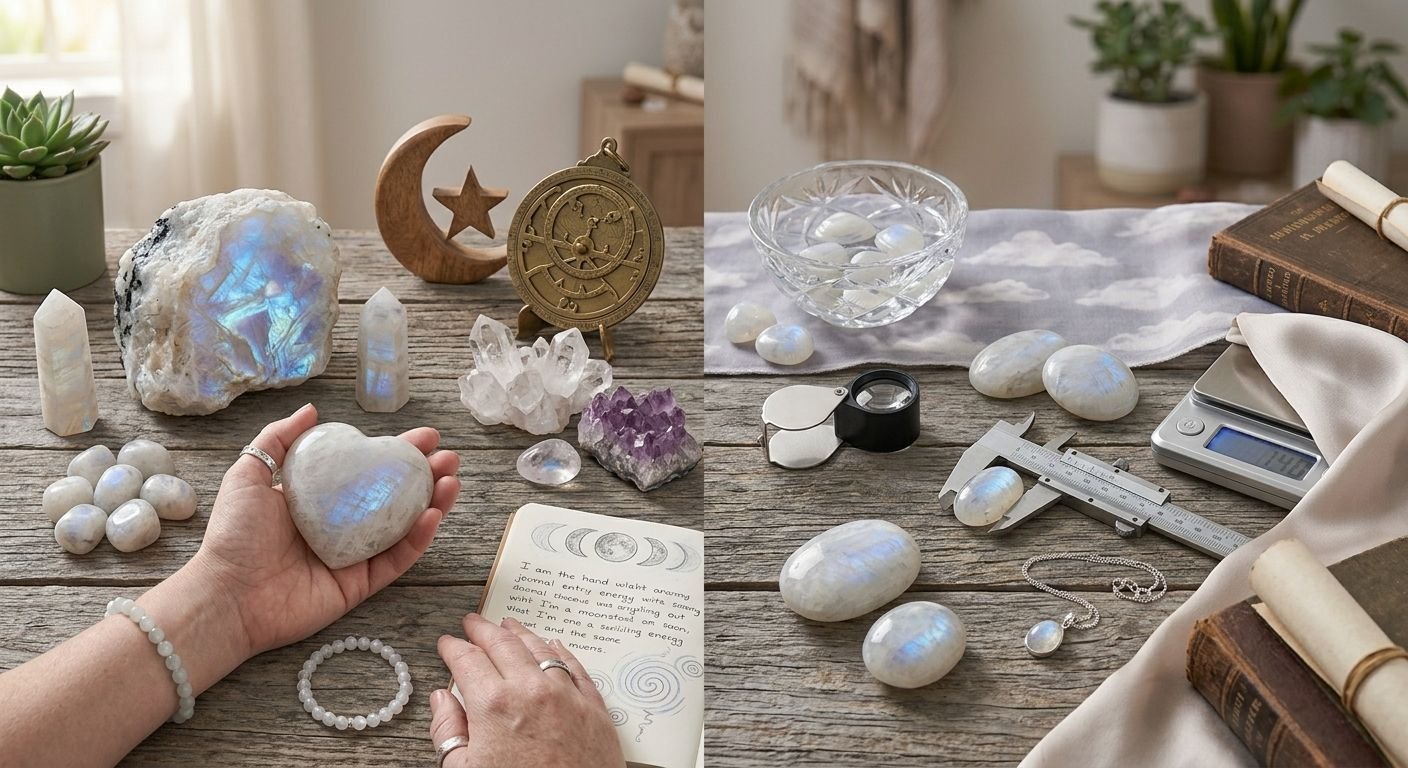
What Moonstone Actually Is
Moonstone is a sodium potassium aluminium silicate belonging to the feldspar group, specifically a variety of orthoclase feldspar. Its defining visual effect, called adularescence, produces that characteristic milky, billowing, bluish-white light that seems to float just below the stone's surface as it's turned under light. This effect happens because moonstone isn't a single uniform mineral structure — it's made of alternating microscopic layers of two different feldspar minerals, orthoclase and albite, which formed together as the stone cooled slowly within its host rock. Light entering the stone scatters and diffracts as it passes through these alternating layers, producing the soft, glowing schiller that gives moonstone its name.
The thinner and more regular these internal layers are, the stronger and bluer the adularescence tends to be. Thicker, less regular layering produces a weaker, whiter, less dramatic glow — which is a large part of why moonstone quality varies so noticeably from piece to piece even within the same general color.
Where Moonstone Actually Comes From
Sri Lanka has traditionally been considered the source of the finest blue moonstone, prized specifically for strong, vivid blue adularescence on a nearly colorless background. India is the largest global producer by volume today, supplying the bulk of commercially available moonstone, including the white and peach varieties most commonly seen in everyday jewellery. Additional deposits occur in Madagascar, Myanmar, Brazil, and the United States.
The Slow-Cooling Process Behind the Glow
The layered structure responsible for adularescence forms through a process called exsolution, where a single, originally uniform feldspar mineral gradually separates into two distinct minerals as the rock cools slowly over a long geological timescale. Faster cooling doesn't allow this separation to happen as cleanly, which is part of why well-formed, strongly adularescent moonstone is genuinely tied to specific, favorable geological conditions rather than occurring uniformly wherever feldspar forms.
Moonstone Meaning
Moonstone's meaning is tied directly to its name and its visual resemblance to captured moonlight, and that lunar association has produced a remarkably consistent set of themes across genuinely different cultures and eras. It's widely known as the "Stone of New Beginnings," reflecting the moon's own cyclical nature — waning, disappearing, and returning again — and by extension carrying associations with fresh starts, renewal, and navigating transitions.
The stone also carries a long-standing association with feminine energy and intuition, tied partly to the traditional linking of the moon with menstrual cycles and fertility across many historical traditions, and partly to its soft, receptive, inward-facing visual character as opposed to a bold, outward-facing stone like tiger's eye or citrine.
A Genuinely Old Reputation
Unlike some crystal meanings that trace back mainly to 20th-century Western crystal-healing frameworks, moonstone's association with lunar and protective symbolism has real historical depth — it appears in Roman mythology, tied to the goddess Diana, and in South Asian tradition, where it has long been considered a sacred, auspicious stone. This genuinely old, cross-cultural reputation gives moonstone's meaning a bit more historical weight than some more recently popularized crystals carry.
Moonstone Benefits
The Moonstone Benefits most consistently cited across different sources cluster around a handful of specific, closely related themes.
Emotional balance and calm is the benefit most frequently mentioned — moonstone is generally described as soothing, gently stabilizing mood swings and easing emotional reactivity rather than producing a single dramatic shift. This calming reputation lines up naturally with the stone's own soft, diffused visual character. Some sources specifically recommend it for reducing stress reactions during unpredictable or emotionally turbulent periods, treating its gentleness as a genuine strength rather than a limitation.
Intuition and inner clarity is a closely related Moonstone Benefit, tied to the stone's traditional feminine, receptive symbolism — it's a popular choice specifically for supporting trust in one's own instincts, treated as gently amplifying inner knowing rather than providing new information from outside. This makes it a fairly common choice specifically before a decision that depends more on gut feeling than on hard external data.
Support through transitions and new beginnings reflects the stone's core "Stone of New Beginnings" meaning directly — moonstone is commonly reached for during a significant life change, whether that's a new job, a move, a relationship shift, or any period where the old chapter has closed but the new one hasn't fully taken shape yet.
Hormonal and cyclical balance rounds out the most commonly cited benefits, drawing on moonstone's long-standing traditional association with the menstrual cycle and fertility. This is worth noting as traditional belief rather than a medical claim — moonstone is not a substitute for medical care around reproductive health, but the association is genuinely persistent across many independent traditions.
A Gentler Kind of Benefit
It's worth being upfront that moonstone's traditional benefits skew consistently toward gentle, gradual support rather than a single, dramatic effect. This is part of the stone's actual character rather than a shortcoming — for anyone specifically looking for an intense or fast-acting stone, moonstone likely isn't the right match, but for ongoing, background emotional steadiness, that same gentleness is precisely the point.
The Different Colors of Moonstone
Moonstone occurs in a genuinely wide color range — blue, grey, white, pink, peach, green, and brown, as well as fully colorless varieties — with the base color determined by trace elements and inclusions rather than the adularescence effect itself, which can occur on top of any of these base colors.
Blue moonstone is the most prized and traditionally valuable variety, showing a distinctly blue schiller against a colorless or pale grey background — this is the color most associated with the classic "finest" moonstone from Sri Lanka.
White and grey moonstone are the most commonly available varieties in everyday jewellery, showing a softer, whiter adularescence rather than blue, and generally priced more accessibly than blue moonstone of comparable clarity.
Peach and pink moonstone carry a warmer base tone, generally showing a subtler, less dramatic schiller than blue or white varieties, and are often chosen specifically for their gentler, warmer overall appearance rather than for a strong adularescent effect.
Rainbow Moonstone vs. Labradorite

This is genuinely one of the most common points of confusion in the entire crystal world, and worth clarifying directly. The gemstone commonly sold as "rainbow moonstone" is not, technically, moonstone at all — it's a colorless-to-white variety of labradorite, a different feldspar mineral entirely, whose flash shows a fuller spectrum of colors (blues, greens, golds, sometimes pinks) compared to true moonstone's more limited blue-to-white schiller.
The two are distinguished by their optical effect and its name: true moonstone shows adularescence, a soft, billowy, generally blue-to-white glow. Labradorite, including the variety sold as rainbow moonstone, shows labradorescence, a more vivid, multi-colored flash that shifts more dramatically and colorfully as the stone is turned. True moonstone also tends toward greater overall translucency, while rainbow moonstone/labradorite is often slightly more opaque with its flash concentrated at specific angles rather than diffused throughout.
This mislabeling is common enough, and old enough, that it's not really treated as deceptive by most sellers today — "rainbow moonstone" has become its own widely accepted trade name — but it's genuinely useful to know the actual mineralogy if you're specifically trying to buy one stone or the other rather than whichever the label happens to say.
A Practical Way to Tell Them Apart at a Glance
If you're standing in front of two pieces and need a quick, practical distinction: count the colors. A flash limited mostly to blue and white, moving softly and diffusely across the stone, points toward true moonstone. A flash showing multiple distinct colors — gold, green, and blue together, for instance — moving more sharply from specific angles, points toward labradorite sold as rainbow moonstone. Neither is inherently better; they're simply different stones with different traditional meanings, and the choice comes down to which effect and which meaning you're actually after.
What to Check Before You Buy
Quality varies enormously within moonstone specifically, more so than with many other crystals, which makes this worth covering in real detail rather than a quick note.
Check the Strength and Movement of the Adularescence
This is the single most important quality factor. Tilt the stone slowly under a single light source and watch how the glow moves and shifts across the surface. A high-quality piece shows a strong, clearly visible glow that moves fluidly as the angle changes; a lower-quality piece shows only a faint, static sheen with little movement, or the glow appears only from one narrow angle rather than shifting smoothly.
Check the Base Color and Transparency
The clearest, most colorless background generally showcases adularescence most effectively, since there's less competing body color to dull the effect. A cloudy, heavily included, or strongly colored background can mute even a genuinely present schiller, making the stone look flatter than its actual optical quality would otherwise produce.
Check for Visible Cracking or Chatter Marks
Moonstone has perfect cleavage, meaning it can develop fine internal fractures relatively easily during cutting or from impact. Small internal cracks, sometimes called "chatter marks," are common and don't necessarily ruin a piece, but a heavily fractured stone is both less visually appealing and more structurally fragile going forward — worth a close look under good light before buying.
Check Whether It's Genuine Moonstone or a Relabeled Substitute
Given the labradorite confusion covered above, and the existence of glass and synthetic imitations more broadly, ask directly what mineral you're actually being sold, particularly for anything marketed as "rainbow moonstone." A seller who can answer this clearly and consistently is generally a good sign; vague or shifting answers are worth treating with caution.
Check Weight and Temperature as a Basic Authenticity Test
As with most stone authenticity questions, genuine moonstone feels cool against the skin before warming and carries real mineral density for its size, compared to lightweight glass or plastic imitations, which warm quickly and feel noticeably less substantial.
Check How the Piece Is Cut for Its Specific Stone
Moonstone is typically cut as a smooth cabochon rather than faceted like a transparent gemstone, since faceting would interrupt and fragment the adularescent effect rather than showcase it. A well-cut cabochon has a smooth, evenly domed surface that lets the glow move cleanly across the stone as it's turned; a poorly shaped or unevenly polished piece can visibly disrupt this movement, making even genuinely decent rough material look less impressive in its finished form.
Buy From a Seller Willing to Show You the Stone in Motion
Because adularescence is fundamentally about movement and light, a single static photograph rarely does a piece justice, and a seller unwilling or unable to show the stone tilting under light, whether in person or via video, is worth treating with a bit more caution than one who demonstrates it readily.
Who Moonstone Benefits Suit Most
A few groups tend to find a particularly natural fit with this stone specifically.
Anyone navigating a significant life transition — a new job, a move, the end or start of a relationship — fits the stone's core "new beginnings" meaning especially directly.
People who want a gentle, calming stone with a softer, more intuitive character rather than something bold or outward-facing tend to find moonstone's receptive, inward-facing reputation particularly appealing.
Anyone drawn to working on trusting their own instincts fits the intuition-focused side of its meaning well, particularly during a decision that depends more on gut feeling than on hard external information.
Those who specifically want a stone with genuine historical depth rather than a purely modern crystal-healing invention may appreciate moonstone's much older, more geographically widespread traditional reputation compared to some newer additions to the crystal world.
How to Wear and Use It
Given its association with intuition and emotional balance, moonstone works well worn close to the body throughout the day — a bracelet or necklace kept on during ordinary activity suits its gentle, ongoing character better than a piece reserved only for specific occasions. Some traditions specifically recommend moonstone during the new moon or full moon, aligning its use with the lunar cycle its whole meaning is built around, though daily wear works just as well for anyone who prefers a simpler routine.
Because adularescence depends on light and movement to be visible at all, moonstone is also a stone genuinely worth handling and examining directly rather than only glancing at — tilting a piece slowly in natural light is both a quality check and, for many people, part of the appeal of owning it in the first place.
Real Moonstone at Alpine
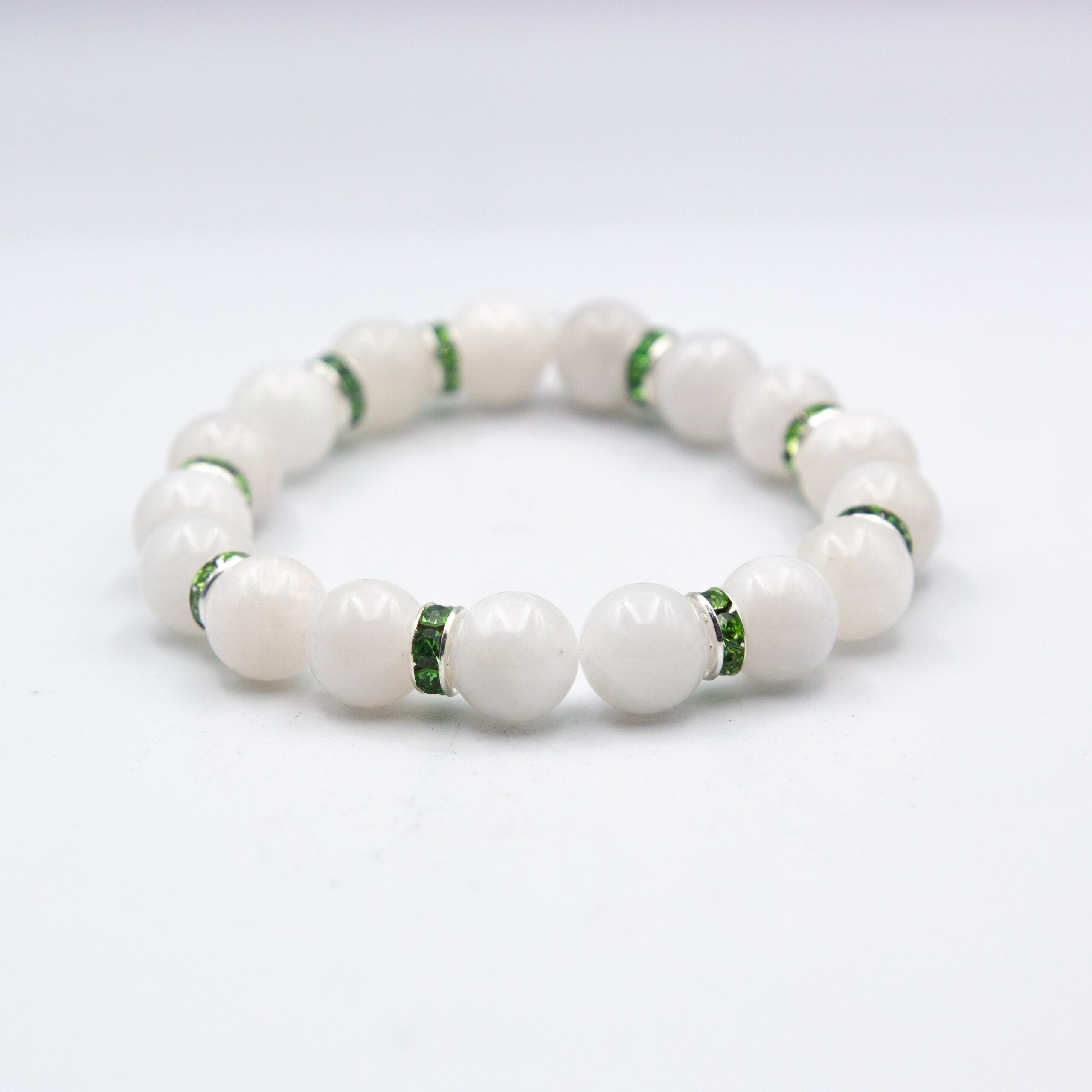
Our Moonstone Crystal Bracelet (10mm) is a genuine, natural piece worth handling in good light to see the adularescence move for yourself — a photo can only partly capture the effect that makes this stone worth owning in the first place.


If you're weighing it against labradorite or true rainbow moonstone, our labradorite bracelet is worth comparing directly, now that you know the actual difference between the two. Browse our wider bracelet collection for more options.
Basic Care
Moonstone sits at 6.0–6.5 on the Mohs hardness scale and has perfect cleavage, meaning it's more prone to fracturing from a sharp knock than harder, tougher stones like quartz varieties. Avoid ultrasonic cleaners entirely, keep it away from harsh chemicals, and clean with a soft, slightly damp cloth. Store it separately from harder stones that could scratch its surface during ordinary handling, and avoid prolonged, intense sunlight, which can gradually affect its color and clarity over time.
Want to see the adularescence move in real light?
Photos only capture so much of this stone. Message us and we'll walk you through it on a video call before you order.
Questions People Ask
What are the main Moonstone Benefits?
Emotional balance, intuition, support through transitions, and traditional associations with hormonal and cyclical balance are the Moonstone Benefits most consistently cited, tied to its reputation as the Stone of New Beginnings.
Is rainbow moonstone real moonstone?
Not technically. What's commonly sold as "rainbow moonstone" is usually a colorless variety of labradorite, showing labradorescence rather than true moonstone's adularescence. The name has become an accepted trade term, but the mineral is different.
What should I check before buying moonstone?
Check the strength and movement of the adularescent glow under light, the clarity of the base color, any visible internal cracking, and confirm with the seller exactly which mineral you're buying, especially for anything labeled "rainbow moonstone."
What causes the glow inside moonstone?
Adularescence, caused by light diffracting through alternating microscopic layers of two feldspar minerals, orthoclase and albite, that formed together within the stone.
Is moonstone durable enough for daily wear?
It's moderately durable at 6.0–6.5 on the Mohs scale, but has perfect cleavage, making it more prone to fracturing from a sharp knock than harder stones. It's fine for daily wear with reasonable care, but avoid ultrasonic cleaners and rough handling.
Why is moonstone usually cut as a smooth dome rather than faceted?
Faceting would fragment and interrupt the adularescent glow rather than showcase it. A smooth cabochon cut lets the light move cleanly across the stone's surface as it's turned, which is what displays the effect properly.
Which color of moonstone is considered the most valuable?
Blue moonstone, traditionally sourced from Sri Lanka, is generally considered the most prized variety, valued for showing a distinctly blue adularescent glow against a nearly colorless background.