

Green Aventurine: Meaning, Benefits and How People Actually Use It
What the sparkle inside this stone actually is, what green aventurine benefits are traditionally believed to be, and the practical ways people work it into daily life.
Green aventurine has a genuinely loyal following, and it's easy to see why once you understand what's actually happening inside the stone — that soft, glittery sparkle isn't a coating or a trick of polishing, it's a completely separate mineral embedded throughout the quartz itself. This guide covers what green aventurine benefits are traditionally rooted in, what the stone actually means, and — since a stone is only as useful as the way you actually use it — the practical, everyday ways people work it into their routines.
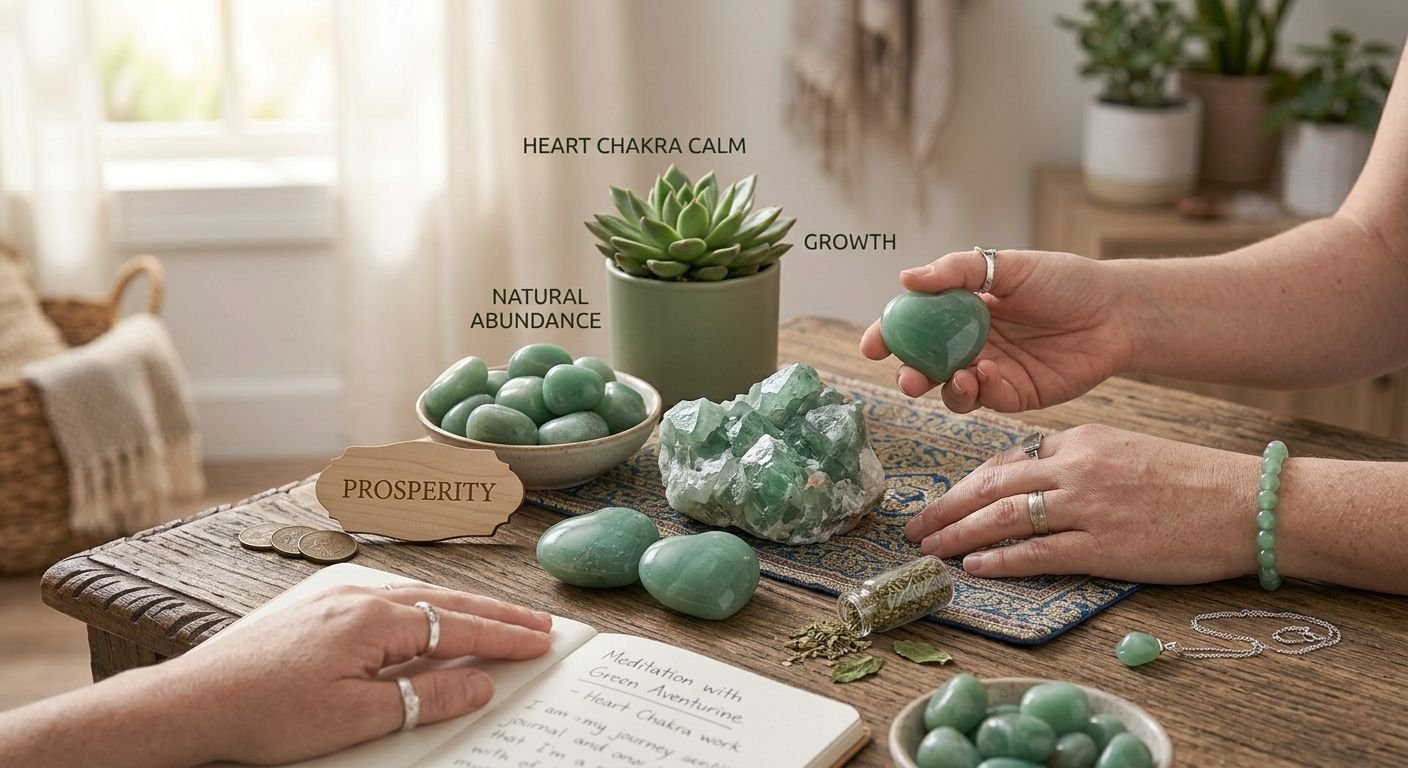
What Green Aventurine Actually Is
Green aventurine is a form of quartzite — a rock made up of tightly interlocked quartz grains — distinguished by its translucency and the presence of tiny, flat mineral inclusions that produce a shimmering, glittery effect called aventurescence. In green aventurine specifically, this sparkle comes from fuchsite, a chromium-bearing variety of mica, whose tiny reflective platelets are scattered throughout the stone and catch the light as it's turned.
This is worth being precise about, because it's a genuinely common point of confusion: green aventurine is technically a rock, not a single mineral crystal the way clear quartz or amethyst is. Its physical properties vary somewhat piece to piece as a result, and its hardness sits slightly below single-crystal quartz, at roughly 6.5 on the Mohs scale rather than quartz's usual 7. The name itself comes from the Italian "a ventura," meaning "by chance," a reference to the accidental 18th-century discovery of aventurine glass, a manufactured imitation that predates the mineral name being applied to the natural stone.
Where It Actually Comes From
India is the primary global source of green aventurine, with significant deposits also found in Brazil and China. The color intensity varies depending on how much fuchsite the stone contains — a higher concentration produces a deeper, more vividly sparkling green, while lower concentrations give a paler, more translucent, glassier stone.
Aventurine Comes in More Than One Color
While green is by far the most recognized and widely available color, aventurine also occurs naturally in orange, brown, yellow, blue, and grey, with the color shift driven by which mineral is doing the sparkling. Orange and brown varieties get their color from hematite or goethite inclusions rather than fuchsite, producing a warmer, metallic-looking shimmer rather than green aventurine's cooler, mossier sparkle. Blue aventurine is comparatively rare and tends to command more specialist interest than the widely available green variety.
A Note on the Crystal System
Aventurine belongs to the hexagonal crystal system, the same underlying structure shared by the broader quartz family it's part of. This is part of why, despite being technically a rock rather than a single crystal, aventurine still shares enough structural common ground with true quartz varieties to sit comfortably in the same general conversation as clear quartz, amethyst, and citrine.
Green Aventurine Meaning
Green aventurine's meaning centers consistently on luck, opportunity, and heart-centered emotional healing, making it one of the more optimistic, forward-looking stones in common use. It's frequently referred to as the "Stone of Opportunity," a reputation tied specifically to attracting favorable circumstances and helping the wearer notice and act on opportunities as they arise, rather than passively waiting for good fortune to appear on its own.
The heart-centered side of its meaning runs alongside this luck association rather than separately from it — green is the traditional color linked to the heart chakra across many crystal traditions, and aventurine's gentle, calming character is generally described as supporting emotional balance and openness alongside its more outward-facing reputation for luck and prosperity.
Why Green Aventurine's Meaning Feels So Consistent
Unlike stones with competing or region-specific traditional meanings, green aventurine's reputation is fairly uniform across the sources that discuss it, most of which trace back to 20th-century Western crystal-healing frameworks rather than an older, more geographically fragmented history. This gives it a genuinely consistent, easy-to-summarize meaning compared to a stone like turquoise or amber, whose traditional associations shift more noticeably depending on which cultural tradition is being referenced.
Green Aventurine Benefits
The green aventurine benefits most consistently cited across different sources cluster around a handful of specific, fairly practical themes.
Luck and manifestation is the benefit most closely tied to the stone's core reputation — green aventurine is a popular choice specifically for situations involving chance or new opportunity, from a job interview to a significant negotiation, treated as support for putting yourself in a position to get lucky rather than a substitute for effort. Some sources specifically describe it as useful before games of chance or competitive situations, extending the "opportunity" theme into fairly literal territory.
Emotional balance and calm is a closely related green aventurine benefit, tied to its heart chakra association — the stone is commonly described as gently soothing rather than intensely transformative, making it a popular everyday piece for managing ordinary stress rather than a stone reserved for acute emotional crises. This gentler quality is part of what distinguishes it from more intense heart-chakra stones like rose quartz, whose emotional focus leans more specifically toward romantic love and deep healing rather than general-purpose calm.
Compassion and emotional openness rounds out the heart-centered side of its reputation — green aventurine is frequently recommended for situations that call for approaching a relationship or a difficult conversation with more openness and less defensiveness, treated as support for genuine connection rather than emotional withdrawal.
General harmony and balance is the fourth theme worth mentioning — a slightly broader, less specific association that shows up across nearly every source discussing this stone, generally describing green aventurine as a stabilizing, harmonizing presence rather than one associated with a single dramatic effect.
A Reputation for Supporting Decisiveness Too
A less commonly cited but genuinely recurring theme is green aventurine's association with clearer perception and better decision-making, particularly around financial or opportunity-based choices. This connects naturally back to its core "opportunity" meaning — recognizing a good opportunity when it appears requires clear judgment as much as luck, and this benefit is often framed as the practical, clear-headed counterpart to the stone's more overtly optimistic reputation.
How People Actually Use It
Beyond simply wearing it as jewellery, green aventurine has a few genuinely specific, practical uses that come up repeatedly.
Kept With Money or in a Wallet
Given its strong association with luck and prosperity, a small tumbled piece of green aventurine kept directly in a wallet, cash drawer, or purse is a fairly common practice, treated as a small, physical reminder tied to the stone's core meaning rather than expected to work independently of any actual effort.
On a Desk or Workspace
A piece kept visibly on a desk or workspace is another common placement, particularly for anyone specifically hoping to stay open to new opportunities at work — a sales role, a job search, a business in its early stages — leaning into the stone's "Stone of Opportunity" reputation in a fairly direct, practical way.
Worn as a Bracelet for Daily, Ongoing Use
As a bracelet specifically, green aventurine is popular for genuinely everyday, ongoing wear rather than being reserved for specific occasions, given its gentle, calming character rather than an intense or situational one — it's a stone people tend to simply keep on rather than put on deliberately before a specific event.
Held Briefly During a Stressful Moment
Some people specifically hold a piece for a moment during acute stress or before a difficult conversation, using the physical object as a brief pause tied to the stone's calming, heart-centered reputation, similar to how other calming stones are used in the moment rather than only passively worn.
Paired With Clear Quartz
Green aventurine is frequently combined with clear quartz in the same piece, on the logic that clear quartz's amplifying reputation intensifies whatever intention aventurine is already associated with — a pairing genuinely common enough to show up regularly in ready-made bracelet combinations rather than being a niche practice.
Given as a Gift for New Beginnings
Because its meaning is so consistently tied to opportunity and fresh starts, green aventurine is a fairly popular gift specifically for someone beginning something new — a new job, a new business, a move to a new city. This gift-giving use draws directly on the same core meaning as the wallet and desk placements above, just directed toward someone else's new chapter rather than your own.
Green Aventurine vs. Jade
This comparison comes up constantly, and it's a genuinely reasonable point of confusion — both are green, translucent-to-opaque stones commonly used in similar jewellery formats, and at a glance, particularly in photographs, they can look remarkably alike.
The actual difference is mineralogical. Jade refers to either nephrite or jadeite, two entirely different mineral groups from aventurine's quartz-based composition, and jade typically has a smoother, more uniform, waxier appearance without aventurine's distinctive glittery sparkle. That sparkle — aventurescence — is really the most reliable visual tell between the two: genuine green aventurine should show a subtle shimmer as it catches the light, particularly under a strong light source or magnification, while jade's surface stays comparatively flat and uniform regardless of angle.
Meaning-wise, the two stones overlap somewhat, given both carry associations with luck and prosperity across different traditions, but jade's reputation in Chinese culture specifically carries a depth and historical significance that aventurine's meaning, more rooted in 20th-century Western crystal-healing tradition, doesn't share to the same degree.
Why This Confusion Persists Commercially
Part of why this mix-up is so common isn't purely visual — some sellers historically marketed green aventurine under names implying it was jade, a practice that muddied the waters for buyers trying to research either stone independently. This is worth knowing specifically if you're comparing prices between the two: genuine jade, particularly high-quality jadeite, commands considerably more than aventurine, so a suspiciously affordable "jade" piece is worth double-checking against the aventurescence test above before assuming it's genuinely jade rather than aventurine sold under a more marketable name.
Real Aventurine vs. Goldstone Imitations
Green aventurine has a specific imitation worth knowing about: goldstone, a manufactured glass containing metallic particles that produce a similar glittering effect. Goldstone is most commonly seen in its classic brown-orange form with copper particles, but a green variant — sometimes called green goldstone or chrome aventurine glass — exists specifically using chromium oxide particles to mimic the color and sparkle of genuine green aventurine.
Distinguishing the two takes a bit of attention but is fairly reliable once you know what to look for. Genuine aventurine's fuchsite inclusions are irregular in size and distribution, scattered somewhat randomly through the stone, while goldstone's glass-embedded particles tend to be more uniform, evenly distributed, and consistently sized throughout — a give-away under closer inspection, even if the overall color and general sparkle look convincing from a distance. Genuine aventurine also feels cool and carries real mineral density, while goldstone, being glass, tends to feel lighter and warms more quickly in the hand.
Goldstone Isn't Inherently Deceptive
It's worth noting that goldstone has its own long, legitimate history as a decorative material in its own right — the classic copper-flecked brown version was reportedly first produced in 17th-century Venice, and it remains popular as jewellery material specifically valued for what it is, rather than exclusively as an aventurine substitute. The concern isn't goldstone itself, but goldstone sold specifically as genuine aventurine without disclosure, which is where the checks above become genuinely useful.
Who Green Aventurine Benefits Suit Most
A few groups tend to find a particularly natural fit with this stone specifically.
Anyone starting something new — a job search, a business, a significant life change — fits the stone's core opportunity-focused meaning especially directly.
People who want a gentle, everyday calming stone rather than something intense or occasion-specific tend to appreciate aventurine's understated, low-key character, suited to ongoing daily wear rather than deliberate, situational use.
Anyone working on emotional openness in a relationship or friendship fits the heart-centered, compassion-focused side of its meaning particularly well.
Beginners to crystal work often gravitate toward green aventurine specifically because its gentle, broadly positive reputation makes it a genuinely low-risk, approachable first stone compared to something with a more specific or intense traditional meaning.
Real Green Aventurine at Alpine
A quick, honest note here: we currently carry green aventurine primarily in bracelet form, including our 10mm Natural Green Aventurine Bracelet and an 8mm version, as well as a combination piece — the Natural Himalayan Clear Quartz and Green Aventurine Bracelet — which pairs the two stones exactly as described in the pairing section above. We couldn't pull confirmed current photos for this specific range in time for this guide, so if you'd like to see the actual pieces before ordering, message us on WhatsApp and we'll send current photos directly.
Basic Care
Green aventurine sits at roughly 6.5 on the Mohs scale, slightly softer than single-crystal quartz, so treat it a touch more gently than you might a harder stone like clear quartz or amethyst. Avoid harsh chemicals and prolonged soaking, clean with a soft, slightly damp cloth for routine maintenance, and keep it out of prolonged, intense sunlight, since extended UV exposure can gradually fade its color over time.
Want to see current photos before you order?
Message us and we'll send you real, current photos of our green aventurine pieces directly.
Questions People Ask
What are the main green aventurine benefits?
Luck and manifestation, emotional balance, compassion, and general harmony are the green aventurine benefits most consistently cited, tied to its reputation as the "Stone of Opportunity" and its heart chakra association.
What's the difference between green aventurine and jade?
They're mineralogically different — aventurine is a quartzite with sparkly fuchsite inclusions, while jade is either nephrite or jadeite with a smoother, waxier, non-glittery appearance. Aventurine's shimmer, called aventurescence, is the clearest visual tell.
How do people actually use green aventurine day to day?
Common uses include keeping a small piece in a wallet or cash drawer, placing one on a desk or workspace, wearing it as an everyday bracelet, and pairing it with clear quartz to amplify its traditional intention.
How can I tell real aventurine from goldstone glass imitations?
Genuine aventurine's mica inclusions are irregular in size and scattered randomly, while goldstone's glass-embedded particles are more uniform and evenly distributed. Real aventurine also feels cooler and denser than lightweight glass.
Is green aventurine the same hardness as clear quartz?
No, slightly softer. Green aventurine sits at roughly 6.5 on the Mohs scale, compared to single-crystal quartz's usual 7, since it's technically a quartzite rock rather than a single quartz crystal.
Does aventurine only come in green?
No. Green is the most common and widely available color, but aventurine also occurs naturally in orange, brown, yellow, blue, and grey, with the color depending on which mineral produces the sparkle.
Is goldstone a fake version of aventurine?
Goldstone is a manufactured glass, not a natural mineral, and it becomes a concern only when sold as genuine aventurine without disclosure. On its own, goldstone has a long, legitimate history as a decorative material.