

Obsidian vs Black Tourmaline: Which Protection Stone Do You Actually Need?
Two black stones, two completely different origins, and two genuinely different jobs. Here's obsidian benefits, tourmaline benefits, and how to actually choose between them.
Obsidian and black tourmaline get lumped together constantly — both are black, both are marketed as "protection stones," and both show up in nearly every list of grounding crystals you'll find online. But they don't actually have much in common once you look past the color. One is volcanic glass that cooled in seconds. The other is a slow-grown crystalline mineral that can take millions of years to form. Their traditional meanings diverge in genuinely useful ways too, once you understand what each one is actually built from. This guide walks through obsidian vs black tourmaline properly — what each stone actually is, obsidian benefits, tourmaline benefits, how they differ in practice, and how to figure out which one actually fits what you're dealing with, rather than just grabbing whichever black bracelet is in stock.
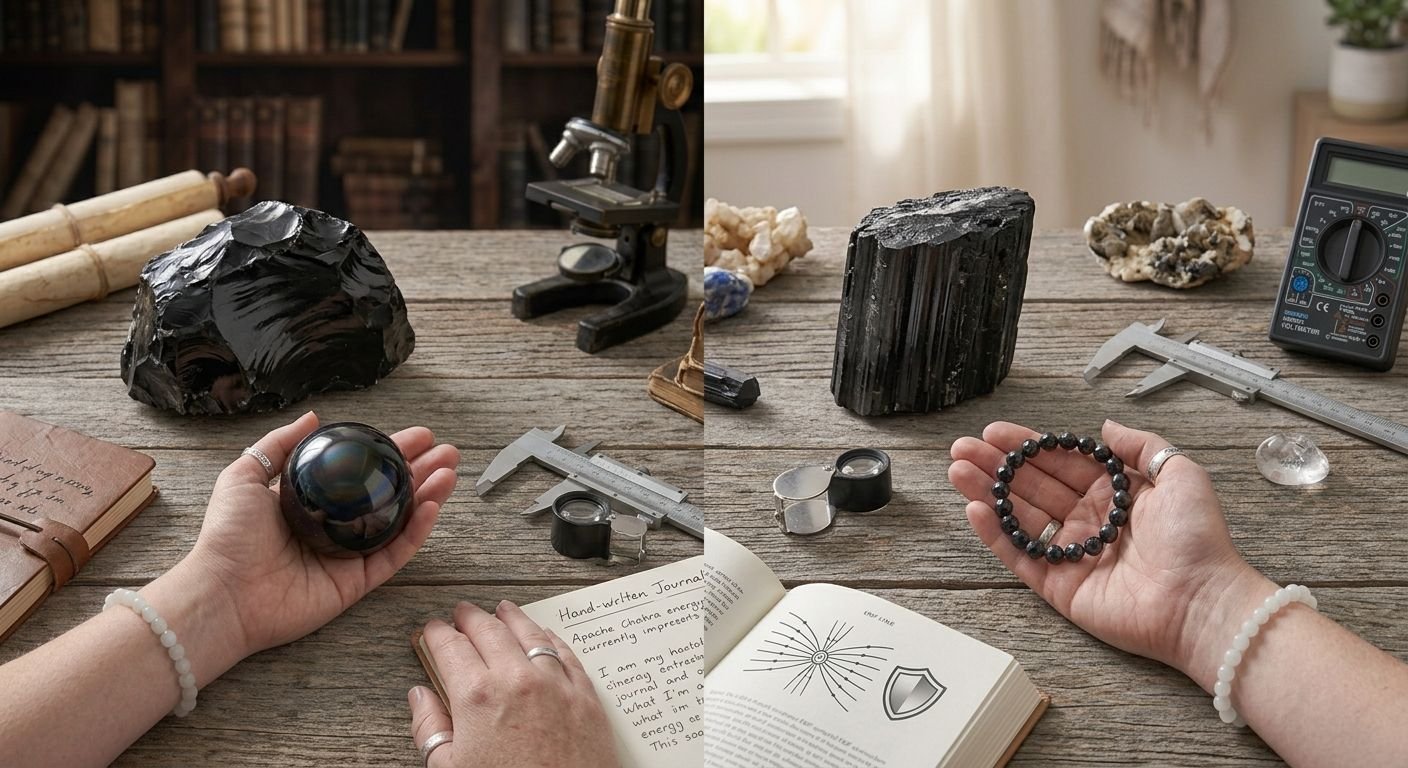
The Quick Answer
If you genuinely don't have time to read the full comparison: black tourmaline is generally considered the stronger, more absolute protective stone, associated with a hard shield against negative energy and EMFs, while obsidian is associated with a sharper, more revealing kind of protection — cutting through illusion and forcing honest self-reflection rather than simply blocking things out. If you want to feel shielded, tourmaline is the more traditional choice. If you want to understand what you're actually protecting yourself from in the first place, obsidian's reputation fits that job more specifically. Many people, as covered further down, use both together rather than choosing one over the other.
What Obsidian Actually Is
Obsidian is volcanic glass, not a crystal in the mineralogical sense at all. It forms when lava rich in silica cools so rapidly that its atoms don't have time to arrange into an ordered crystalline structure — the result is a natural glass, chemically similar to rhyolite, with a smooth, glassy fracture rather than the crystal faces you'd see in a mineral like quartz or tourmaline. This rapid-cooling origin is genuinely central to understanding obsidian's whole character: everything about it, physically and symbolically, traces back to being formed almost instantly under intense heat and pressure.
Because it's a glass rather than a crystal, obsidian has no defined crystal structure and technically isn't classified as a true mineral by strict geological definitions, though it's universally treated as a gemstone material in jewellery and lapidary contexts. It typically contains about 70% silica, with the remaining composition made up of trace minerals and dissolved gases that got trapped as the lava solidified.
The Different Types of Obsidian Worth Knowing
While black obsidian — colored by trace amounts of magnetite and hematite — is by far the most common and widely available variety, several other types exist, each with its own distinct appearance and traditional reputation. Snowflake obsidian contains white, radial clusters of cristobalite, a related mineral, scattered through the black glass, producing a mottled, snowflake-like pattern. Mahogany obsidian shows reddish-brown patches or bands caused by iron oxide inclusions. Rainbow obsidian displays a colorful, iridescent sheen caused by microscopic gas bubble inclusions aligned in layers, visible only at certain angles. Apache tears are small, rounded nodules of obsidian, typically translucent dark brown to black, formed when obsidian is partially protected from rapid cooling by surrounding rock, giving it a slightly different internal structure than typical obsidian.
Where Obsidian Comes From
Obsidian forms wherever silica-rich lava cools rapidly at the earth's surface, which happens in volcanically active regions worldwide. Significant deposits occur in the United States (particularly Yellowstone and the Pacific Northwest), Mexico, Iceland, Italy, Armenia, Turkey, Japan, and Peru. Because it fractures into extremely sharp edges when knapped correctly, obsidian has a genuinely long human history as a toolmaking material — it was used to make blades, arrowheads, and cutting tools by cultures across the world for tens of thousands of years before it became primarily known as a decorative and metaphysical stone.
The Ancient Mirror Connection
Obsidian's history as an actual reflective surface, not just a symbolic "mirror stone," is worth understanding in more detail, since it's genuinely central to why the stone carries the specific traditional meaning it does. The Aztecs and other Mesoamerican cultures polished obsidian into smooth, genuinely functional mirrors, used both for practical grooming and, more significantly, for divination and ceremonial purposes. One of the most famous surviving examples, a polished obsidian mirror once owned by the Elizabethan scholar John Dee, is held today in the British Museum, having reportedly been used for what Dee described as angelic scrying sessions in 16th-century England. This isn't a minor historical footnote — it's a genuinely documented, centuries-spanning tradition of using obsidian specifically as a tool for seeing something not immediately obvious, which lines up directly with its modern "reveals hidden truth" reputation rather than that reputation being a purely modern invention.
A Note on Hardness and Sharpness
Obsidian's conchoidal fracture — the same smooth, curved breaking pattern seen in other glasses — is what allowed ancient toolmakers to knap it into blades sharper than surgical steel at a microscopic level, a property still occasionally used in specialized modern surgical blades today. This genuine, extreme sharpness at the point of fracture is worth keeping in mind practically: raw or freshly broken obsidian edges can be genuinely hazardous to handle, quite unlike the smooth, rounded finish of polished jewellery-grade pieces.
Obsidian Benefits
The obsidian benefits most consistently cited across different sources cluster around a few specific, closely related themes, most of them tied directly to the stone's dramatic, sudden formation process.
Cutting through illusion and revealing hidden truth is the benefit most distinctively associated with obsidian, more so than almost any other black stone. It's frequently described as a "mirror stone," reflecting back what the wearer might otherwise avoid seeing about themselves or a situation — a reputation directly tied to its historical use as an actual mirror material by several ancient civilizations, most notably the Aztecs, who polished obsidian into genuine reflective surfaces used for both practical and ceremonial purposes.
Sharp, direct protection is a closely related obsidian benefit — where some protective stones are described as creating a gentle buffer, obsidian's reputation leans more toward a sharper, more active form of shielding, in keeping with its literal history as a cutting tool. This is frequently described as protection that requires the wearer to engage actively with what's happening around them, rather than a purely passive shield.
Processing and releasing deep emotional patterns rounds out obsidian's most commonly cited benefits — it's a popular choice specifically for working through old trauma, deeply ingrained habits, or patterns that have been avoided rather than actually addressed. This benefit connects directly to the "mirror" reputation above: obsidian's traditional role is to reveal what needs attention, and processing what's revealed is treated as the natural next step.
Grounding through intensity rather than calm is the fourth theme worth mentioning, and it's a genuinely important distinction from most grounding stones. Where smoky quartz or black tourmaline are generally described as calming, steady grounding influences, obsidian's grounding reputation is more intense and confrontational — less about feeling settled, more about facing something directly and dealing with it.
Supporting genuine self-honesty in decision-making is a fifth theme worth adding — obsidian is sometimes specifically reached for before a decision where self-deception has been a factor, treated as support for seeing a situation as it actually is rather than as you'd prefer it to be.
A Stone That Isn't for Everyone, and That's the Point
It's worth being upfront that obsidian's traditional reputation is genuinely more intense than most crystals discussed in casual crystal-healing content. Sources consistently describe it as a stone that can surface uncomfortable truths rather than provide pure comfort, and some specifically caution that it isn't the gentlest starting point for someone newer to working with crystals, or for someone going through an especially fragile period who needs stability rather than confrontation. This isn't a flaw in the stone — it's simply a different kind of tool for a different kind of situation, and knowing that upfront helps set the right expectation before buying.
Why the "Mirror" Framing Specifically Matters
It's worth dwelling briefly on why the mirror metaphor is treated as so central to obsidian's meaning, rather than being just one description among many. A mirror doesn't create anything new — it simply shows you what's already there, accurately and without flattering distortion. This is precisely the quality most consistently attributed to obsidian: not generating new insight from outside, but removing the distortion that keeps you from seeing your own situation clearly. That framing is part of why obsidian's benefits so consistently center on honesty and revelation rather than comfort or calm — a mirror's job was never to make you feel better, only to show you accurately.
What Black Tourmaline Actually Is
Black tourmaline, properly called schorl, is a genuine crystalline mineral — a member of the tourmaline group of borosilicate minerals, one of the most chemically complex mineral families in existence, with dozens of recognized color varieties depending on which trace elements are present during formation. Schorl specifically is by far the most common tourmaline variety, colored black by its iron content, and it typically grows as long, prismatic crystals with a distinctive triangular cross-section, often forming in radiating clusters or embedded within quartz or granite.
Unlike obsidian's near-instant formation, black tourmaline forms slowly within pegmatites — coarse-grained igneous rock that crystallizes gradually from mineral-rich fluids deep underground, typically over a much longer geological timescale than volcanic glass. This slow, structured crystal growth is part of why tourmaline develops the ordered, prismatic crystal habit that glass-forming obsidian never does.
A Genuinely Unusual Physical Property
Black tourmaline has a real, scientifically documented property that's worth knowing about specifically because it's part of where its "protective" reputation likely originates: it's both piezoelectric and pyroelectric, meaning it generates a small electrical charge when subjected to pressure or temperature change. This genuine physical characteristic — a crystal that responds to physical stress with measurable electrical activity — is a large part of why tourmaline developed such a strong association with energy and protection in mineral-collecting and metaphysical circles well before modern crystal-healing marketing existed. It's one of relatively few crystals where the traditional "energetic" reputation traces back to an actual, independently verifiable physical property rather than color or appearance alone.
Where Black Tourmaline Comes From
Schorl is found across a genuinely wide range of locations, including Brazil, the United States, Pakistan, Afghanistan, Nigeria, Madagascar, and parts of Europe. It's actually the most common tourmaline variety found in nature by a considerable margin, which is part of why it's more affordable and widely available than colored tourmaline varieties like rubellite or paraiba tourmaline, despite belonging to the same broader mineral family.
The Name's Origin and Historical Use
The word "tourmaline" derives from the Sinhalese term "turmali" or "thoramalli," used historically in Sri Lanka to describe mixed colored gemstones brought to market, since early gem traders often couldn't distinguish between different colored stones being sold together. Schorl itself has an even older documented name — it appears in German mineralogical records dating back centuries, originally referring to a village in Saxony near tin mining operations where black tourmaline was commonly found alongside tin ore, long before its metaphysical reputation developed. This gives black tourmaline a genuinely practical, working-mineral history in European mining contexts that predates its crystal-healing associations by a considerable margin.
Distinguishing Schorl From Other Tourmaline Colors
It's worth knowing that "tourmaline" as a mineral family covers an enormous color range — pink and red rubellite, green verdelite, blue indicolite, and watermelon tourmaline showing both pink and green in the same crystal, among others. Schorl's black color comes specifically from a higher iron content relative to these other varieties. This matters practically because "tourmaline" alone, without the word "black" or "schorl" attached, could refer to any of these considerably more expensive colored varieties — worth clarifying with a seller if you're specifically shopping for the black, protection-focused variety rather than a colored gemstone tourmaline.
Tourmaline Benefits
The tourmaline benefits most consistently cited across different sources build directly on black tourmaline's reputation as the strongest, most absolute protective stone in common use.
Powerful, comprehensive protection is the benefit most closely tied to black tourmaline's core reputation — it's consistently described as creating a strong, near-complete shield against negative energy, absorbing and deflecting rather than simply reflecting it back. This is generally described as a more absolute, all-encompassing form of protection compared to more selective or situational protective stones.
Grounding and emotional stability is a closely related tourmaline benefit — black tourmaline is one of the most consistently cited grounding stones across the entire crystal world, associated with calm, steady stability rather than the more intense, confrontational grounding style associated with obsidian.
Absorbing and transmuting negative energy rounds out tourmaline's most commonly cited benefits, closely related to its protective reputation but distinct from it — rather than simply blocking negativity, tourmaline is described as actively absorbing it and converting it into something more neutral, a theme that shows up specifically in the context of clearing spaces as well as personal protection.
Reducing anxiety and easing stress reactions is the fourth theme worth mentioning, tied to tourmaline's overall calming, stabilizing character — it's a fairly popular everyday choice specifically for managing ordinary stress rather than being reserved for acute or dramatic situations.
Protection specifically associated with electronic environments is a fifth theme worth adding, and one that traces fairly directly back to tourmaline's genuine piezoelectric properties covered above. It's frequently recommended specifically for people who spend long hours around computers, phones, and other electronics, tied to its traditional association with shielding against electromagnetic disturbance, distinct from the more general "negative energy" framing applied to most protective stones.
A More Universally Comfortable Stone
Compared to obsidian's more intense, confrontational reputation, black tourmaline's traditional character is consistently described as gentler and more universally suited to daily use — it's frequently recommended as a first protective stone for beginners specifically because its reputation leans toward steady, comfortable shielding rather than the more demanding, self-confronting character associated with obsidian. This makes it a genuinely different kind of tool even though both stones get filed under the same broad "protection" category.
Why the Piezoelectric Property Keeps Coming Up
It's worth returning briefly to tourmaline's genuine electrical properties, since they explain something that otherwise looks like coincidence: black tourmaline is consistently the specific stone recommended for placement near electronics, routers, and workspaces with heavy screen time, far more consistently than any other black or grounding stone. This isn't an arbitrary modern marketing choice — it traces back to a real, measurable physical property that predates the crystal-healing industry by centuries, and it's part of why tourmaline's reputation, more than almost any comparable stone, straddles the line between documented mineralogy and traditional metaphysical belief.
Obsidian vs Black Tourmaline: The Core Differences
With both stones covered individually, here's the direct obsidian vs black tourmaline comparison, side by side.
| Property | Obsidian | Black Tourmaline |
|---|---|---|
| Actual material | Volcanic glass (not a true mineral) | Crystalline mineral (schorl, a tourmaline variety) |
| Formation | Rapid cooling of silica-rich lava, seconds to minutes | Slow crystallization in pegmatites, over long geological time |
| Structure | Amorphous, no ordered crystal lattice | Prismatic crystals with triangular cross-section |
| Mohs hardness | 5 to 5.5 | 7 to 7.5 |
| Fracture | Conchoidal (glass-like, very sharp edges) | Uneven, typical of crystalline minerals |
| Special physical property | None comparable | Piezoelectric and pyroelectric |
| Traditional meaning style | Sharp, revealing, confrontational | Steady, absorbing, comprehensive shield |
| Best suited for | Facing something directly, deep pattern work | Daily, ongoing protection and stability |
The hardness difference is worth genuinely paying attention to beyond trivia — at 5 to 5.5 on the Mohs scale, obsidian is meaningfully softer and more prone to chipping or scratching than tourmaline's 7 to 7.5, which affects how each stone should realistically be worn and cared for day to day, covered in more detail further down.
Meaning and Energy: How They Actually Differ
Beyond the physical comparison, the traditional meaning gap between these two stones is genuinely more distinct than most "protection stone" roundups suggest, and it's worth understanding rather than treating the two as interchangeable.
Black tourmaline's traditional character is fundamentally defensive — a shield, a barrier, something that stands between you and negativity coming from outside. Its whole reputation is built around absorption and deflection, protecting you from something external.
Obsidian's traditional character is fundamentally revealing rather than purely defensive — less a wall and more a mirror. Its reputation centers on showing you something you might be avoiding, whether that's an uncomfortable truth about a situation, a pattern in your own behavior, or a feeling you've been suppressing. The "protection" obsidian offers is less about blocking external negativity and more about equipping you to see clearly enough to deal with whatever's actually going on, including things originating from within yourself rather than from outside.
This distinction matters practically. If the negativity you're dealing with is genuinely external — a difficult environment, draining people, a generally chaotic situation — black tourmaline's shielding reputation is the more directly relevant match. If what you're actually dealing with is more internal — a pattern you keep repeating, a truth you've been avoiding, a decision you know you need to make but haven't — obsidian's revealing, confrontational reputation fits that situation more specifically than a purely defensive stone would.
An Analogy Worth Keeping in Mind
A useful way to hold this distinction: think of black tourmaline as a security guard and obsidian as a truth-teller. A security guard's job is to stop trouble at the door, regardless of what's happening inside. A truth-teller's job is to tell you honestly what's actually happening, even when that's uncomfortable, so you can decide what to do about it yourself. Both roles are valuable, and a household might genuinely want both — but they're not doing the same job, and reaching for one when you actually need the other explains why some people report feeling like a "protection stone" isn't doing much for them: they may simply have the wrong one for what they're actually facing.
Which One Should You Actually Choose
Rather than a generic "it depends," here's a more specific breakdown based on what you're actually trying to address.
Choose black tourmaline if: you're dealing with a draining environment or people, you want steady, comfortable, everyday protection rather than something intense, you're newer to working with crystals and want a more universally gentle starting point, or you specifically want a stone for daily wear without much active engagement required.
Choose obsidian if: you're working through something you know you've been avoiding, you want a stone that actively prompts reflection rather than passive shielding, you're drawn to its sharper, more dramatic visual and symbolic character, or you're specifically doing deeper personal work rather than looking for general everyday protection.
Neither is objectively "better" — they're simply built for different jobs, in the same way a shield and a mirror serve entirely different purposes despite both being defensive tools in a loose sense. The right choice depends entirely on what you're actually trying to address, not on which stone is more popular or more expensive.
One More Practical Factor: Lifestyle and Handling
Beyond meaning alone, it's worth weighing the practical hardness difference covered earlier when making this decision. If your daily routine involves a lot of manual activity, sports, or rough handling — construction work, gym sessions, active parenting of small children — black tourmaline's superior durability makes it the more realistic everyday choice regardless of which traditional meaning appeals to you more. Obsidian can still be worn daily, but it rewards a slightly gentler lifestyle, or at least a willingness to remove it during activities likely to knock it against hard surfaces.
Using Both Together

A genuinely common practice, rather than choosing one over the other, is using obsidian and black tourmaline together, and the logic for doing so tracks directly from everything covered above. The two stones are frequently described as complementary rather than redundant: tourmaline provides the steady, comprehensive outer shield against external negativity, while obsidian handles the sharper, more internal work of revealing and processing what still needs attention despite that shield being in place.
In practice, this pairing shows up in a few common forms. Some people wear both simultaneously — a tourmaline bracelet on one wrist and an obsidian piece on the other, or both stones combined within a single bracelet or necklace design. Others keep one for daily, ongoing wear (typically tourmaline, given its gentler, more universal character) and reach for the other situationally — pulling out an obsidian piece specifically during a meditation session, a difficult decision, or a period of deliberate self-reflection, rather than wearing it passively all the time.
For home or workspace placement, the same complementary logic applies: tourmaline placed near an entryway or in the corners of a room for ongoing, passive protection, with obsidian kept somewhere more deliberate — a meditation space, a desk where difficult decisions get made — for more active, occasional use rather than constant background presence.
A Simple Way to Sequence Them
For anyone specifically interested in using both with intention rather than just wearing them together passively, a fairly common approach is sequencing: tourmaline first, worn or held while establishing a sense of safety and stability, followed by obsidian once that groundwork is in place, used specifically for the harder work of honest reflection. The reasoning behind this order is fairly intuitive — confronting something difficult, which is obsidian's whole traditional purpose, tends to go better from a position of felt stability rather than from a place of already feeling exposed or unprotected. Reversing the order isn't wrong, but this sequence is the one most consistently suggested across sources that discuss pairing the two stones deliberately.
When Not to Combine Them
It's worth adding one honest caveat: pairing isn't automatically better than using either stone alone. Someone who specifically wants a single, simple, low-maintenance piece for daily wear may find that adding a second stone with a very different traditional character just adds complexity without adding real value to their actual situation. Combining stones works best when there's a genuine reason for it — distinct external and internal concerns that map onto each stone's specific reputation — rather than simply because pairing is a popular practice.
Real or Fake: Checking Both Stones
Both stones have genuine authenticity concerns worth knowing before you buy, though the specific issues differ.
Obsidian Imitations
Because obsidian is a natural glass, it's occasionally confused with — or deliberately substituted by — man-made black glass, which is nearly impossible to distinguish by eye alone in some cases. The most reliable check is the presence of natural inclusions or subtle internal variation: entirely flawless, perfectly uniform black glass with zero internal characteristics is more likely manufactured, while genuine obsidian usually shows at least minor natural variation, occasional small internal fractures, or in the case of varieties like snowflake or rainbow obsidian, characteristic inclusion patterns that are difficult to convincingly fake. Rainbow and snowflake obsidian's specific optical effects are particularly hard to replicate artificially, making them somewhat more reliably "provable" than plain black obsidian on its own.
Black Tourmaline Imitations
Black tourmaline is less commonly faked outright compared to more expensive colored gemstones, since it's already relatively affordable, but it is sometimes confused with — or substituted by — black glass, dyed black quartz, or black onyx, particularly in lower-cost jewellery. Genuine tourmaline shows its distinctive prismatic crystal structure when in raw or semi-polished form, with visible striations running along the length of the crystal — a structural feature that's difficult to fake convincingly, since it comes from the mineral's actual internal growth pattern rather than surface treatment. Polished, tumbled tourmaline is harder to distinguish this way, so weight and hardness checks become more relevant: genuine tourmaline, sitting at 7 to 7.5 on the Mohs scale, should resist scratching from a steel point far more effectively than glass or softer imitation stones.
A Genuinely Useful Trick for Tourmaline Specifically
Because of its documented pyroelectric property covered earlier, there's a genuinely unusual authenticity check specific to tourmaline: gently warming a piece (body heat from holding it for a few minutes is generally enough) and then bringing it near very small, lightweight particles like bits of tissue paper or ash. A genuine tourmaline crystal, having generated a small electrical charge from the temperature change, may attract these particles briefly, similar to how a rubbed balloon attracts hair. This effect is subtle and works best on raw or semi-polished crystal points rather than small tumbled beads, and it isn't a foolproof test on its own, but it's a genuinely fun and scientifically real way to engage with the stone that most imitation materials simply cannot replicate.
How to Wear and Use Each
Given the hardness difference covered earlier, these two stones genuinely suit slightly different formats and handling.
Black tourmaline, at 7 to 7.5 on the Mohs scale, handles daily bracelet or ring wear comfortably, standing up well to ordinary bumps and scrapes without much concern. This durability lines up naturally with its "steady, everyday protection" reputation — it's genuinely built for constant, low-maintenance wear.
Obsidian, at 5 to 5.5, is more prone to chipping or developing small surface scratches with rough daily handling, particularly on sharp edges or points. This doesn't mean it can't be worn daily, but it's worth being a bit more deliberate with it — a pendant or a piece kept somewhere it won't be knocked around is often a better long-term fit than a bracelet worn during manual work or rough activity.
Matching the Format to the Purpose
Given everything covered about how these two stones are traditionally used, the jewellery format itself is worth choosing deliberately rather than defaulting to whatever's available. For tourmaline's steady, ongoing shielding role, a bracelet or ring makes practical sense, since the goal is constant, low-effort presence throughout the day. For obsidian's more deliberate, situational role, a pendant that can be consciously held or a standalone piece kept in a pocket or on a desk often suits its purpose better than a bracelet worn passively — since part of obsidian's traditional value comes from actively engaging with it during a specific moment of reflection, rather than simply having it present in the background.
Real Obsidian and Tourmaline at Alpine
We carry both stones in genuine, natural forms. Our Black Obsidian Crystal Bracelet combines polished obsidian beads with a pearl-accented design. On the tourmaline side, we offer the 8mm Square-Shaped Black Tourmaline Bracelet, a Black Tourmaline Ring with silver linings, and the Ganesh Himal Black Tourmaline Pendant Locket, handcrafted in Nepal with a sterling silver setting. If you're planning to pair both stones as covered above, message us and we can help put together a combination that works for your specific wrist size and format preference.
Basic Care for Both
Obsidian: Avoid harsh chemicals and prolonged water exposure, clean with a soft, dry cloth, and handle with a bit more care than a harder stone given its lower hardness and glass-like fracture. Avoid dropping it on hard surfaces, since sharp chipping is a genuine risk with this material specifically.
Black tourmaline: Genuinely low-maintenance given its hardness — avoid harsh chemicals and ultrasonic cleaners as a general precaution, but it tolerates ordinary daily wear and handling well. Clean with a soft, slightly damp cloth as needed.
Still not sure which one fits your situation?
Tell us what you're actually dealing with and we'll help you figure out whether obsidian, tourmaline, or both makes sense.
Questions People Ask
What's the main difference between obsidian and black tourmaline?
Obsidian is volcanic glass formed by rapid cooling, with no crystal structure, while black tourmaline (schorl) is a true crystalline mineral that forms slowly over geological time. Their traditional meanings differ accordingly — obsidian is more revealing and confrontational, tourmaline more of a steady, absorbing shield.
What are the main obsidian benefits?
Cutting through illusion, revealing hidden truth, sharp active protection, and processing deep emotional patterns are the obsidian benefits most consistently cited, tied to its history as an actual mirror material and its dramatic, rapid formation.
What are the main tourmaline benefits?
Powerful, comprehensive protection, grounding and emotional stability, absorbing negative energy, and reducing anxiety are the tourmaline benefits most consistently cited, reflecting its reputation as the strongest, most absolute protective stone in common use.
Can you use obsidian and black tourmaline together?
Yes, this is a genuinely common practice. The two are treated as complementary — tourmaline provides a steady outer shield, while obsidian handles sharper, more internal reflection and pattern work, either worn simultaneously or used situationally alongside daily tourmaline wear.
Which stone is more durable for daily wear?
Black tourmaline, sitting at 7 to 7.5 on the Mohs scale compared to obsidian's 5 to 5.5, handles daily bumps and scrapes considerably better. Obsidian is more prone to chipping and benefits from slightly more careful handling.
Is black tourmaline a better beginner stone than obsidian?
Generally, yes. Tourmaline's traditional reputation is gentler and more universally comfortable for everyday use, while obsidian's more intense, confrontational character is often better suited to someone specifically doing deeper reflective work rather than a first protective stone.
Does black tourmaline really protect against EMFs?
Tourmaline's traditional association with electronics and EMF protection traces back to a genuine, scientifically documented property: it's piezoelectric and pyroelectric, generating a small electrical charge under pressure or temperature change. This is why it's the specific stone most consistently recommended for placement near electronics.
Why is obsidian associated with mirrors specifically?
Ancient civilizations, most notably the Aztecs, polished obsidian into genuinely functional mirrors used for both practical and ceremonial purposes, including divination. This documented history is a large part of why obsidian's modern meaning centers on revealing hidden truth rather than simple protection.