

Raw Amethyst vs Polished Amethyst: Which One Should You Buy?
Neither one is the "real" version and the other a compromise — they're just built for different jobs.
This comes up constantly, and it's usually framed as a bigger decision than it needs to be — like picking raw amethyst somehow makes you more serious about your practice, and polished makes you a casual jewellery buyer. That's not really how it works. They're the same mineral in two different states, suited to two genuinely different purposes, and most people end up wanting both eventually rather than choosing one forever.
What Actually Separates Them
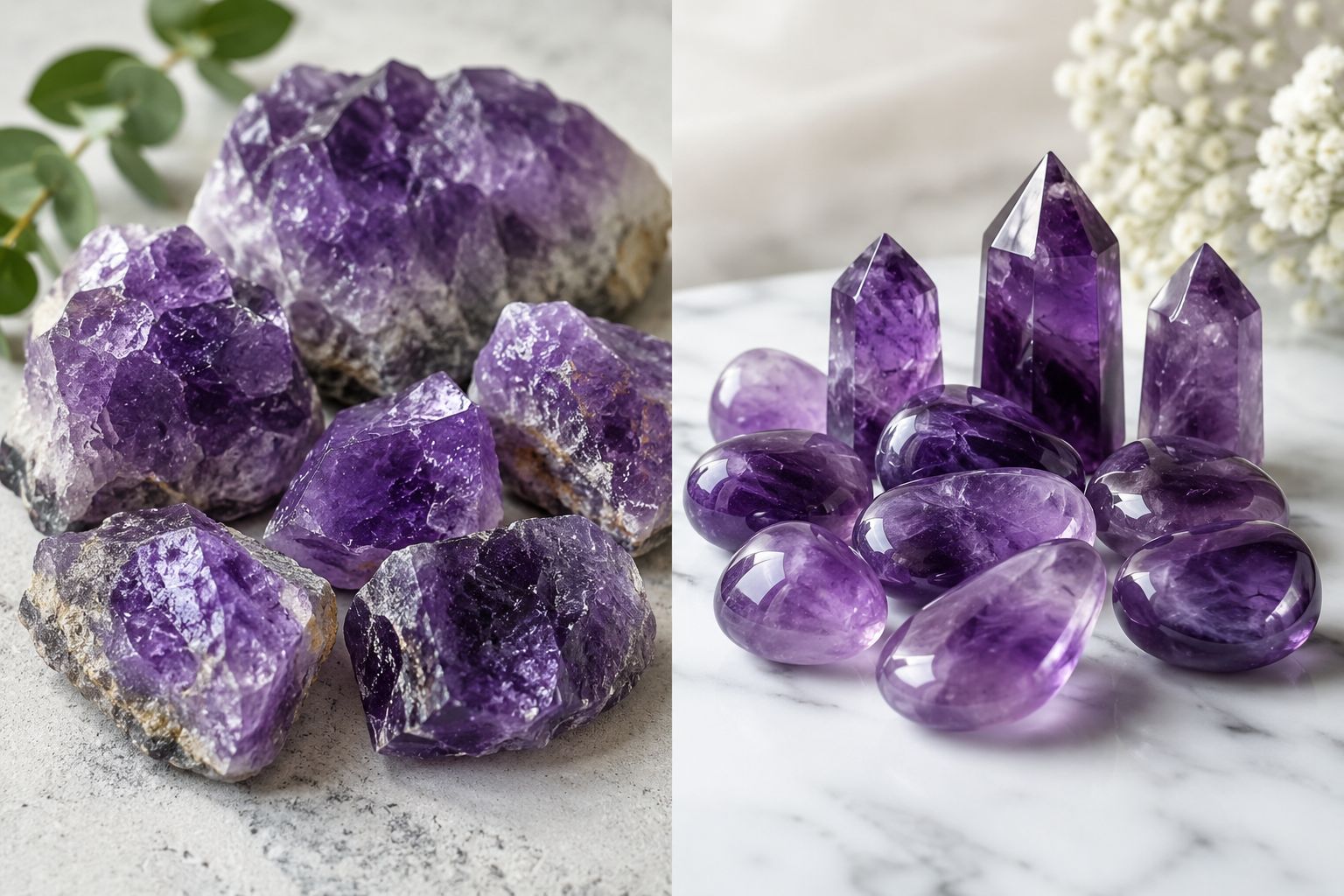
Raw amethyst is the stone in whatever state it was in when it came out of the ground — a point, a cluster of several points growing from a shared base, or a rough, unshaped chunk broken off a larger formation. Nothing's been reshaped; you're looking at the crystal's natural growth pattern, jagged edges and all.
Polished amethyst has gone through a mechanical tumbling or cutting process that smooths the surface into a rounded, glassy finish — this is what you're holding when you pick up a tumbled stone or a bead on a bracelet. The mineral itself hasn't changed at all; the outside has just been ground down and buffed until the natural roughness is gone.
That's genuinely the entire physical difference. Same iron content causing the same purple color, same hardness, same formation history up until the point someone decided to polish one and not the other.
The Case for Raw Amethyst
A lot of people specifically want the stone in its unaltered state, and the reasoning tends to fall into a couple of camps. Some feel that polishing removes a layer of the crystal's natural structure and, with it, some of its energetic integrity — a raw piece feels more "whole" to them in a way that's hard to fully articulate but genuinely matters to how they use it. Others simply prefer how it looks: a cluster with visible individual points catches light in a completely different way than a smooth, rounded surface, and it makes a far more dramatic visual object for a shelf, altar, or meditation space.
Raw pieces also tend to show off amethyst's natural color zoning more clearly — the pale-to-deep gradient bands that occur as the crystal grew — since a rounded, polished bead often gets cut in a way that evens this out or hides it within the shape. If you want to actually see how the stone formed, raw is the more honest version of that.
There's also a simpler, less spiritual reason people go for raw: it just looks more impressive as an object. A cluster of natural points catching afternoon light on a shelf reads as something genuinely pulled from the earth, in a way a smooth, machine-finished sphere never quite manages, regardless of how nice the polish is.
The Case for Polished Amethyst
Polished amethyst wins on practicality, plainly. A rounded, smoothed bead can actually be worn — strung into a bracelet, set into a ring — without snagging on clothing or chipping the moment it bumps against something, which a raw point genuinely will do if you try to wear it the same way. Our amethyst bracelet and amethyst ring are both this way — polished for exactly the reason that jewellery needs to survive being knocked around during an ordinary day.
Polishing also brings out clarity and depth of color that a rough surface tends to mute. Hold a polished piece up to light and you'll usually see straight through parts of it in a way a raw, matte-surfaced point simply won't show, since the smooth finish lets light travel through more cleanly.
There's also a durability argument that's easy to overlook: a raw point's natural termination — the pointed tip — is exactly where it's most likely to snap off if it's ever dropped or knocked. Polishing removes that vulnerable edge entirely, which is a big part of why anything meant to survive years of regular handling, not just occasional display, tends to be sold polished rather than raw.
Does Polishing Change the Energy?
Here's where we'd rather be straightforward than pretend there's a definitive answer, because there genuinely isn't one. Some practitioners are firm that raw, unaltered stone carries a fuller, less interrupted version of whatever energetic properties they associate with the crystal, and that grinding away the natural surface — however slightly — changes that. Others take the position that the mineral itself is what matters, full stop, and that a polished piece works exactly the same as a raw one because nothing about the actual crystal has fundamentally changed, just its shape.
Neither camp is wrong in any factual sense, because this isn't a question science has an answer to — it's a belief, and reasonable people land differently on it depending on their own practice. What we'd actually suggest is simpler: if the raw, unaltered state matters to how you personally connect with a stone, buy raw. If you're mainly interested in wearing it, seeing it clearly, or just prefer how a smooth piece feels in the hand, polished is not a lesser choice.
Why the Price Gap Isn't What You'd Expect
People generally assume raw stone is cheaper, since it's "less finished," and that's often true for small, rough chunks — but it flips once you're talking about a proper cluster or a large, well-formed point. A striking raw cluster with clearly defined individual points can cost considerably more than a polished piece of similar overall size, because large, undamaged natural formations are genuinely harder to find intact than smaller rough material that gets tumbled and sold in bulk. Polishing is a fairly quick mechanical process; finding a raw specimen worth selling as-is, without a single point snapped off in handling, is the harder part.
So the honest rule of thumb is: small polished pieces and simple tumbled stones tend to be the most affordable entry point, while both very large polished statement pieces and large, intact raw clusters sit at the higher end for different reasons — one for size and craftsmanship, the other for the rarity of finding it undamaged.
Matching the Form to What You're Actually Doing
If you're planning to wear it daily, polished is really the only practical option — a raw point in a pocket or on a wrist is asking for a chipped edge within a week. For meditation held in the hand, either works, though a lot of people find a smooth, rounded piece more comfortable to hold for an extended session than a pointed, angular one.
For a bedroom or meditation space, raw wins on presence — a cluster genuinely looks like a piece of the earth rather than a decorative object, and that visual weight is part of what people are buying it for. For gifting, it depends entirely on the person: a polished bracelet or ring is the safer, more universally wearable gift, while a raw cluster is the better choice for someone who already has a dedicated space for crystals and would appreciate something more visually striking than functional.
If you genuinely don't know the recipient's preference, polished jewellery is the lower-risk option — a bracelet gets worn, a raw cluster sitting in a box until they find a spot for it isn't quite the same immediate win.
Can You Just Own Both?
Genuinely, yes, and most people who get seriously into working with amethyst end up doing exactly this — a polished bracelet or ring for daily wear, and a raw piece kept somewhere fixed, like a nightstand or a meditation corner, for the moments when they want to sit with it more deliberately. There's no rule that says you have to pick a side permanently. They're doing different jobs, and there's nothing contradictory about wanting both.
A Quick Word on Buying Either Genuinely
Whichever form you go for, the authenticity questions are basically the same: does it feel cool and dense rather than light and warm, does the color show natural variation rather than looking dyed and unnaturally uniform, and can the seller actually tell you where it came from. We've gone into this in more depth in our guide on choosing the right raw amethyst for your practice, and our broader piece on amethyst's meaning and healing properties if you want the fuller background on the stone itself before deciding which form to buy.
If you're leaning raw, our raw healing crystals collection is the place to look. If you've decided polished suits you better, the bracelet and ring collections are both worth a look.
Questions People Ask
Is raw amethyst more powerful than polished amethyst?
That depends on personal belief rather than anything measurable. Some practitioners feel raw stone carries a fuller, unaltered energy, while others believe the mineral itself is what matters, regardless of finish.
Why is a raw amethyst cluster sometimes more expensive than a polished piece?
Large, intact raw clusters with undamaged points are genuinely harder to source than rough material that gets tumbled in bulk, which can make good raw specimens cost more than similarly sized polished pieces.
Can I wear raw amethyst as jewellery?
It's not ideal for daily wear, since the natural points and edges chip easily with regular handling. Polished amethyst is the more practical choice for anything worn as a bracelet or ring.
Should I buy raw or polished amethyst for meditation?
Either works. Some people prefer the smooth, rounded feel of polished amethyst for holding during longer sessions, while others prefer the raw, unaltered form for its natural structure. It's a matter of personal preference.
Do I have to choose just one?
No. Many people own both — a polished piece for everyday wear and a raw cluster kept in a fixed space for meditation or display.
Which one makes a better gift?
Polished jewellery is generally the safer, lower-risk gift, since it gets worn immediately. A raw cluster suits someone who already keeps crystals around their home and would appreciate a striking display piece.