

7 Chakra Bracelet Meaning: What Each Stone Does and How to Wear It
Seven stones, seven energy centers, one bracelet. Here's the real 7 chakra bracelet meaning, stone by stone, and exactly how to use and wear it.
A 7 chakra bracelet is one of the more genuinely thoughtful pieces in the crystal world, once you understand what it's actually built around — seven distinct stones, each traditionally matched to one of the seven main energy centers in the body according to a system with real, centuries-old roots. This guide covers the full 7 chakra bracelet meaning, stone by stone, the actual 7 chakra benefits people cite, and — since owning one and actually using it with intention are two different things — exactly how to wear and use it the right way.
Most guides on this topic either list the seven stones without any real explanation of where the underlying system comes from, or lean so heavily into the spiritual framing that the practical side — which stone goes where, how to actually use the thing day to day, how to tell a genuine one from a mass-produced imitation — gets lost. This guide tries to do both properly: real context on the chakra tradition itself, and genuinely practical guidance on the bracelet you can actually hold in your hand.
The Quick Answer
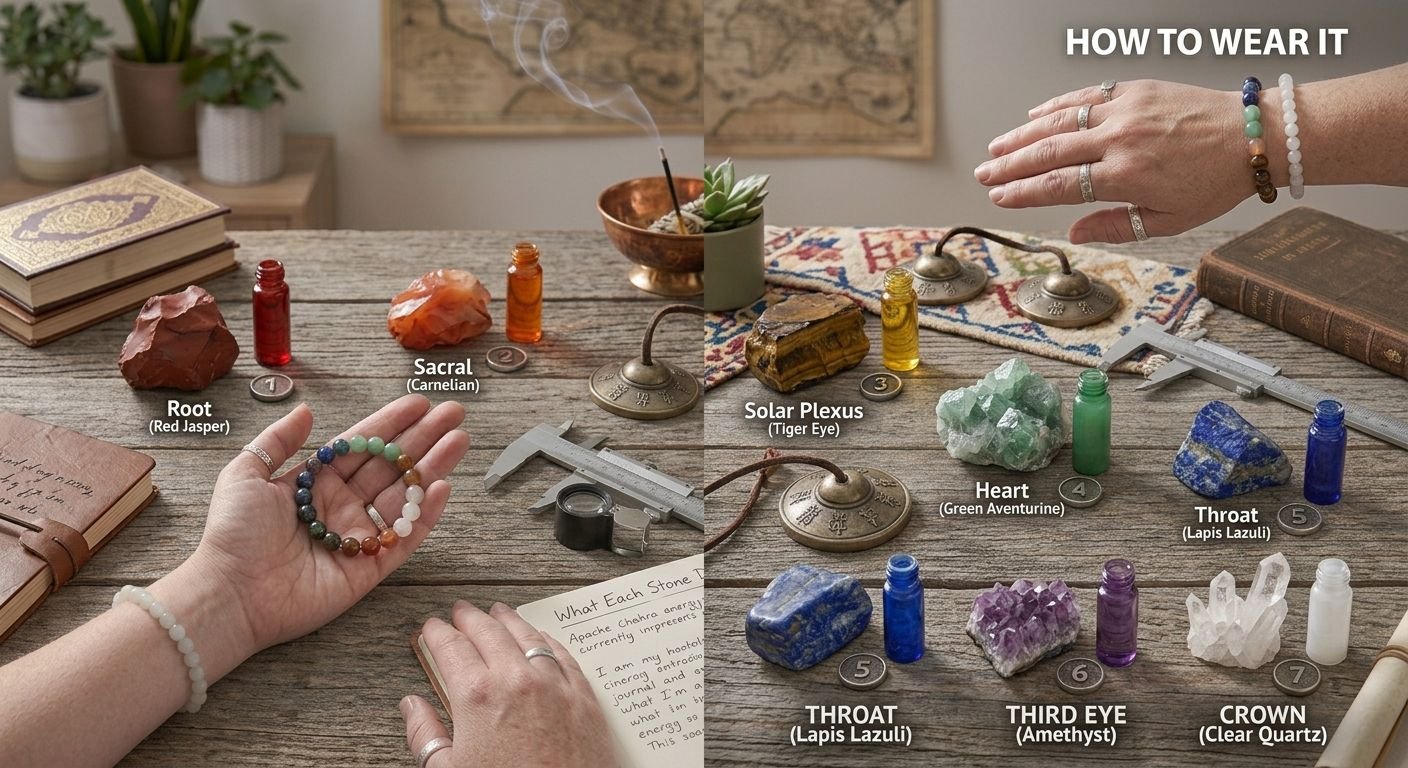
A 7 chakra bracelet strings together seven stones, each corresponding to one of the seven chakras from root to crown, typically following the traditional color spectrum: red or black at the root, orange at the sacral, yellow at the solar plexus, green or pink at the heart, blue at the throat, indigo or purple at the third eye, and white, clear, or violet at the crown. The bracelet's meaning is essentially cumulative — rather than focusing on one specific traditional benefit the way a single-stone bracelet does, it's meant to represent and support balance across the whole energetic system at once, worn as a daily reminder to stay aware of all seven areas rather than fixating on just one.
If you're shopping for one specifically, the practical checklist is short: confirm all seven stones are genuine minerals rather than dyed glass, check that the bead sequence actually follows the traditional root-to-crown order rather than being randomly arranged, and decide whether you want it for daily passive wear or as a more deliberate tool for a structured practice like the morning check-in or meditation approaches covered further down — since that decision affects which wrist and which format might suit you best.
What a 7 Chakra Bracelet Actually Is
A genuine 7 chakra bracelet is built from seven different natural gemstones, strung together in a specific order that corresponds to the traditional chakra sequence running from the base of the spine to the crown of the head. Unlike a single-stone bracelet, which carries one focused traditional meaning, a chakra bracelet is deliberately composite — its whole design is built around the idea of representing a complete, balanced system rather than emphasizing any one energy center over the others.
The specific stones used can vary somewhat between different makers, since more than one gemstone traditionally corresponds to several of the chakras, but the underlying color sequence stays consistent, since the color association is really the core organizing principle of the design.
Why the Bead Order Matters
A genuinely well-made chakra bracelet follows the traditional root-to-crown sequence in the physical arrangement of the beads themselves, rather than scattering the seven stone types randomly around the bracelet. This ordering isn't purely aesthetic — it's meant to visually and physically represent the ascending structure of the chakra system itself, so that looking at or handling the bracelet in sequence mirrors moving attention up through the seven traditional centers in the correct order. A bracelet with the right seven stones but a randomized arrangement still contains the right materials, but loses some of this structural, sequential logic that a properly ordered piece carries.
The Chakra System: A Quick, Respectful Primer
Before getting into the stones themselves, it's worth understanding where the chakra system actually comes from, since this context genuinely shapes how the bracelet's meaning should be understood. The chakra system originates in ancient Indian spiritual and religious traditions, most prominently within Hindu tantric philosophy, with roots going back well over a thousand years, and it also appears in related form within certain Buddhist traditions. The Sanskrit word "chakra" translates roughly to "wheel" or "disc," referring to specific points along the body understood as centers of subtle energy.
It's worth being clear that the specific practice of matching a particular gemstone color to each chakra is a considerably more recent development, layered onto the older tradition largely through 20th-century Western New Age and crystal-healing movements rather than being part of the original tantric system itself. This doesn't make the gemstone-matching practice invalid or meaningless — plenty of genuinely meaningful traditions develop through layered, evolving practice — but it's worth knowing the difference between the deep, genuinely ancient roots of the chakra concept itself and the comparatively modern practice of pairing it with specific crystals, rather than assuming the entire package is equally many centuries old.
The Seven Chakras, Briefly
The seven main chakras, in ascending order, are: Muladhara (root), Svadhisthana (sacral), Manipura (solar plexus), Anahata (heart), Vishuddha (throat), Ajna (third eye), and Sahasrara (crown). Each is traditionally associated with a specific location along the body's central axis, a particular color, and a specific set of qualities or life areas — themes that carry directly through into the meaning assigned to each corresponding stone in a chakra bracelet.
How the System Reached the West
The chakra system's introduction to Western audiences traces largely to translations and interpretations of Indian tantric texts beginning in the late 19th and early 20th centuries, with figures like Sir John Woodroffe, writing under the pen name Arthur Avalon, producing some of the earliest widely read English-language accounts of the system. From there, the concept was gradually absorbed into Western esoteric, yoga, and eventually New Age movements over the following decades, picking up new layers of interpretation — including the gemstone associations covered in this guide — along the way. This transmission history matters because it means today's popular understanding of the chakra system, gemstones included, is genuinely a blend: authentically ancient at its core, but shaped considerably by a century or more of cross-cultural interpretation and adaptation since.
7 Chakra Bracelet Meaning
The overall 7 chakra bracelet meaning is best understood as a meaning of balance and completeness rather than any single specific effect. Where a single-stone bracelet says something fairly focused — "confidence," "calm," "protection" — a chakra bracelet's meaning is closer to "awareness of the whole system," worn as a physical, wearable reminder to stay attentive to every area of life the seven chakras traditionally represent, from basic security and stability at the root through to spiritual connection and clarity at the crown.
This is part of why chakra bracelets are frequently recommended specifically for general wellbeing and balance rather than for one particular situation — the bracelet's whole design logic is built around covering all bases simultaneously rather than targeting one specific need the way a single stone typically does.
A Meaning That Works Differently From Most Crystal Jewellery
It's worth pausing on how genuinely different this is from how most single-stone crystal meanings function. A rose quartz bracelet says something specific about love and emotional healing; a tiger's eye bracelet says something specific about confidence. A chakra bracelet, by contrast, deliberately avoids saying just one thing — its entire meaning is built on the premise that no single area of life should be addressed in isolation from the others, and that true balance comes from attending to all seven simultaneously rather than over-focusing on whichever one feels most urgent at a given moment. This makes it less a targeted tool and more a kind of holistic reminder, which is worth keeping in mind when setting expectations for what the piece is actually meant to do.
Root Chakra: The Foundation Stone

The root chakra, Muladhara, sits at the base of the spine and is traditionally associated with basic survival, physical safety, stability, and a fundamental sense of security in the world. Its traditional color is red, though black stones are also commonly used in this position specifically for their grounding association. Red jasper, garnet, and black tourmaline are among the most common root chakra stones, each carrying a reputation for stability and a steady, secure physical foundation — the literal base the rest of the chakra system is traditionally understood to be built upon.
The logic of placing the root chakra first, both physically and in a chakra bracelet's typical bead sequence, reflects its foundational role in the whole system: without a basic sense of safety and stability, the traditional framework holds that the higher, more expansive chakras have a harder time functioning well, in much the same way a building needs a solid foundation before anything else can be reliably constructed on top of it.
Sacral Chakra: The Creativity Stone
The sacral chakra, Svadhisthana, sits just below the navel and is traditionally associated with creativity, passion, pleasure, and emotional flow. Its color is orange, and carnelian is by far the most commonly used stone in this position, carrying a reputation for supporting creative expression, motivation, and a healthy, uninhibited relationship with pleasure and enjoyment.
Svadhisthana translates roughly to "one's own place" or "sweetness," reflecting its traditional association with the pleasurable, flowing, and creative aspects of experience rather than the more structural, foundational themes of the root chakra directly below it. Where the root chakra's traditional concerns are fairly fixed and stable, the sacral chakra's are considerably more fluid — a distinction that shows up in the traditional element associated with each: earth for the root, water for the sacral.
Solar Plexus Chakra: The Confidence Stone

The solar plexus chakra, Manipura, sits in the upper abdomen and is traditionally associated with personal power, confidence, willpower, and self-esteem. Its color is yellow, and citrine and golden tiger's eye are the two stones most commonly used here — both carrying reputations closely tied to confidence and motivation independently of any chakra framing, which is part of why they map so naturally onto this specific position.
Manipura translates to "city of jewels" or "lustrous gem," a name that reflects its traditional association with inner radiance, personal will, and the sense of confident agency needed to actually act on ambitions rather than simply hold them internally. Its traditional element, fire, reinforces this active, energizing quality, distinguishing it from the more receptive, flowing themes of the two chakras below it.
Heart Chakra: The Connection Stone
The heart chakra, Anahata, sits at the center of the chest and is traditionally associated with love, compassion, emotional balance, and connection to others. Its color is green, though pink is also commonly used, reflecting the two-sided nature of the heart chakra's traditional meaning — green for balance and connection generally, pink specifically for romantic and self-love themes. Green aventurine and rose quartz are the two most common heart chakra stones, each covering one side of this dual association.
Anahata translates roughly to "unstruck" or "unhurt," a genuinely evocative name traditionally interpreted as referring to a place of connection and love that exists beneath or beyond ordinary hurt and conflict. The heart chakra's position at the literal midpoint of the seven-chakra sequence is also traditionally significant — it's treated as the bridge between the three lower, more physically and materially oriented chakras and the three upper, more spiritually oriented ones, making it a kind of pivot point for the entire system.
Throat Chakra: The Communication Stone
The throat chakra, Vishuddha, sits at the base of the throat and is traditionally associated with communication, self-expression, and speaking one's truth clearly and honestly. Its color is blue, and lapis lazuli, turquoise, sodalite, and blue lace agate all appear commonly in this position, each carrying an independent traditional association with honest, clear communication that maps directly onto the throat chakra's core meaning.
Vishuddha translates to "especially pure," traditionally interpreted as referring to purified, unfiltered expression — speech and communication free from the distortions of ego, fear, or dishonesty that so often complicate how people actually express themselves. This is part of why so many of the traditional throat chakra stones, lapis lazuli especially, carry meanings so tightly focused on truth specifically, rather than communication in a more generic sense.
Third Eye Chakra: The Insight Stone
The third eye chakra, Ajna, sits at the center of the forehead and is traditionally associated with intuition, inner wisdom, and perception beyond ordinary physical sight. Its color is indigo or deep purple, and amethyst is overwhelmingly the most common stone used in this position, given its own long-standing, independent association with intuition, spiritual insight, and calm mental clarity.
Ajna translates to "command" or "perceiving," and is traditionally understood as the chakra responsible for insight that goes beyond what the physical eyes can directly observe — pattern recognition, intuitive understanding, and a kind of inner knowing distinct from purely logical reasoning. Its position at the center of the forehead, roughly between the eyebrows, has led to it being commonly referred to simply as the "third eye," a term that has since become genuinely mainstream shorthand for intuition and inner perception well beyond specifically chakra-focused contexts.
Crown Chakra: The Clarity Stone
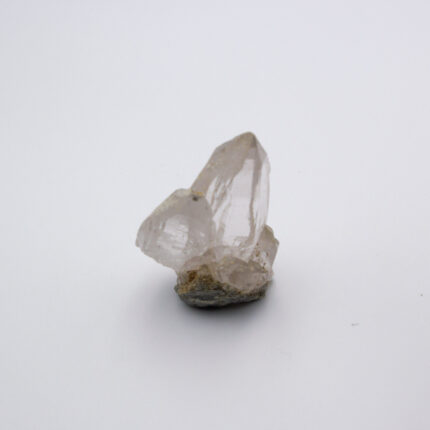
The crown chakra, Sahasrara, sits at the very top of the head and is traditionally associated with spiritual connection, higher consciousness, and overall clarity of thought and purpose. Its color is violet or white, though clear is also commonly used, reflecting the crown chakra's traditional association with transcending ordinary color and category altogether. Clear quartz and amethyst both appear frequently in this position — clear quartz specifically for its long-standing reputation as an amplifying "master healer" stone, fitting naturally with the crown chakra's role as the culmination of the whole system.
Sahasrara translates to "thousand-petaled," traditionally depicted as a lotus flower with a thousand petals, representing infinite, boundless awareness beyond the more specific, defined qualities of the six chakras below it. As the final chakra in the traditional sequence, it's generally understood not as one specific quality among the seven, but as the point where the individual qualities of the other six integrate into a single, unified sense of clarity and connection — which is precisely why a genuinely universal, amplifying stone like clear quartz fits this position so consistently across different chakra bracelet designs.
7 Chakra Benefits
The 7 chakra benefits most consistently cited draw on the combined, cumulative logic covered above rather than any single specific effect.
Overall balance across every area of life is the benefit most directly tied to the bracelet's whole design — rather than focusing on one specific need, a chakra bracelet's traditional benefit is framed as supporting balance across physical security, creativity, confidence, love, communication, intuition, and spiritual clarity simultaneously.
A daily reminder for self-awareness is a closely related 7 chakra benefit — many people specifically describe the bracelet's practical value less in terms of any single energetic effect and more as a simple, wearable prompt to periodically check in with themselves across all seven areas, functioning almost like a daily mindfulness cue built into a piece of jewellery.
A gentle, general-purpose entry point to crystal work rounds out the most commonly cited benefits — because a chakra bracelet touches on every major traditional theme in the crystal world at once, rather than committing to one specific, more intense meaning, it's frequently recommended as a comfortable, low-commitment way to begin exploring crystals generally, without needing to choose one specific stone and meaning upfront.
Identifying which specific chakra might need more attention is a fourth theme worth mentioning — some practitioners use the bracelet somewhat diagnostically, paying attention to which specific stone or bead draws their attention or feels most relevant on a given day, treating that as a loose indicator of which area of life might currently need more focus.
A Visual Benefit Worth Naming Too
Beyond the more traditionally framed benefits above, it's worth acknowledging the simpler, purely visual appeal that draws plenty of people to chakra bracelets in the first place: the rainbow-like progression of colors is genuinely striking as a piece of jewellery, independent of how deeply someone engages with the underlying chakra meaning. This isn't a lesser reason to own one — plenty of meaningful jewellery is chosen first for its appearance and only later becomes something the wearer engages with more intentionally, and a chakra bracelet works perfectly well either way.
7 Chakra Use: How to Actually Use the Bracelet
Beyond simply wearing it passively, there are a few genuinely common, more deliberate approaches to 7 chakra use worth knowing.
Daily Wear as a General Practice
The simplest and most common approach is straightforward daily wear, treating the bracelet's cumulative, balance-oriented meaning as something that works best through consistent, ongoing presence rather than situational use. This suits the bracelet's whole "overall balance" framing better than reaching for it only during specific moments, and it's genuinely the lowest-effort of the approaches covered here, requiring no additional ritual or routine beyond simply putting it on.
A Brief Morning Check-In
A more deliberate practice some people use is a brief morning check-in: looking at or touching each stone in sequence from root to crown, spending a moment considering each corresponding life area — security, creativity, confidence, connection, communication, intuition, clarity — before starting the day. This takes only a minute or two but turns the bracelet from a passive accessory into something closer to a structured daily practice.
During Meditation
For a more focused session, some people hold the bracelet during meditation, moving attention through each stone in order, spending slightly longer on whichever chakra feels most relevant that day rather than treating all seven equally every time. This is a more time-intensive version of the same basic practice as the morning check-in above.
Noticing Which Stone Draws Your Attention
As mentioned briefly above, a genuinely popular, low-effort practice is simply noticing which specific bead or stone catches your eye or attention on a given day, treating that as a loose, informal signal about which area of life might currently need more focus — worth acting on with actual reflection or action in that specific area, rather than treating the noticing itself as the complete practice.
Pairing the Bracelet With a Journaling Practice
For anyone who already keeps a journal or a similar reflective habit, a chakra bracelet pairs naturally with a simple weekly structure: briefly noting, chakra by chakra, how each area of life currently feels — stable or shaky at the root, flowing or blocked at the sacral, confident or uncertain at the solar plexus, and so on through the sequence. This turns the bracelet's symbolic seven-part structure into an actual organizing framework for reflection, rather than a purely passive or occasional practice.
Which Wrist to Wear It On
Given that a chakra bracelet is designed around balance across the whole system rather than one specific directional intention — unlike, say, a stone specifically associated with outward confidence or inward calm — the traditional left-receiving, right-giving wrist convention applies less decisively here than it does for single-stone bracelets. Most sources treat either wrist as equally appropriate for a chakra bracelet specifically because its meaning is inherently balanced rather than one-directional. If you'd still like to apply the general convention, the left wrist is sometimes suggested specifically to support receiving and internal balance, while the right supports actively bringing that balance outward into daily life — but this is a much softer, more optional guideline here than it is for a single-intention stone.
A Practical Consideration Beyond Tradition
Beyond the symbolic wrist question, it's worth considering a purely practical factor: a chakra bracelet's varied bead colors and sizes make it a genuinely visible, attention-drawing piece, more so than a single-color bracelet. Some people specifically choose to wear it on their non-dominant hand simply to reduce wear and tear from daily activity, given that it combines several different stone hardnesses, some of which are softer and more prone to scuffing than others, as covered in the care section below.
Real vs. Cheap Imitation Chakra Bracelets
This is genuinely worth covering, since chakra bracelets specifically are among the most commonly mass-produced, lower-quality crystal items on the market, given their popularity and relatively simple, colorful design.
Dyed Glass and Plastic Beads
The most common issue isn't outright fraud so much as low-quality material sold without clear disclosure — dyed glass or plastic beads in the right colors, rather than genuine gemstone beads. These are usually identifiable by unnaturally uniform color and pattern across every single bead, a complete lack of any natural variation, and a noticeably lighter weight and warmer initial touch compared to genuine stone. A magnifying glass or strong close-up light often reveals another tell: dyed glass beads frequently show tiny embedded air bubbles from the manufacturing process, something genuine mineral beads never contain.
Inconsistent or Incorrect Stone Substitutions
A second, more subtle issue is genuine stones substituted with cheaper look-alikes that happen to be the right color but don't actually carry the traditional association for that position — a generic dyed quartz standing in for genuine amethyst at the third eye position, for instance. This is harder to catch without specifically asking, since the substitute may still be a genuine mineral, just not the specific one traditionally associated with that chakra. This matters more than it might first appear: a chakra bracelet's whole meaning depends on each position carrying its own specific, independently-earned traditional association, so a substituted stone quietly undermines the logic of the entire piece even while looking correct at a glance.
What to Actually Check
Look for natural variation in color and pattern across the beads — genuine stone beads are never perfectly, mechanically uniform the way dyed glass or plastic tends to be. Ask the seller to confirm exactly which stone is used at each position rather than assuming from color alone. And apply the same basic weight and temperature checks used for any stone authenticity question: genuine mineral beads feel cool and carry real density compared to lightweight glass or plastic imitations.
Why Chakra Bracelets Specifically Attract Lower-Quality Production
It's worth understanding why this particular style is so commonly affected, since it isn't random. A chakra bracelet's whole visual identity depends on hitting seven specific colors in sequence, which is considerably easier and cheaper to achieve with dyed glass or plastic than sourcing seven genuinely different natural minerals to a consistent standard. This economic reality is part of why chakra bracelets specifically, more than most single-stone jewellery, show up so frequently as low-cost, mass-produced items — the format itself creates a strong incentive toward imitation material that a simpler, single-stone piece doesn't face in the same way.
Who Should Wear a 7 Chakra Bracelet
A few groups tend to find a particularly natural fit with this specific format.
Anyone newer to crystal work who doesn't want to commit to one single stone and meaning upfront often appreciates the chakra bracelet's broad, balanced coverage as a comfortable starting point.
People specifically interested in the chakra system itself — through yoga, meditation, or broader interest in the underlying tradition — tend to find the bracelet a natural, wearable extension of a practice they're already engaged with.
Anyone going through a period that touches multiple areas of life at once — a major transition affecting work, relationships, and general stability simultaneously — may find the bracelet's all-encompassing meaning more relevant than a single-stone piece focused on just one of those areas.
Those who simply enjoy the colorful, varied visual style tend to appreciate the bracelet for its rainbow-like appearance alone, independent of how deeply they engage with the underlying meaning.
Anyone looking for a single meaningful gift that doesn't require guessing a specific need often finds the chakra bracelet a genuinely practical choice — since it covers such a wide range of traditional themes at once, it sidesteps the guesswork involved in picking one narrowly-focused stone for someone whose specific situation you might not know in detail.
Real 7 Chakra Bracelet at Alpine
Our Seven Chakra Beads with Clear Quartz Bracelet is sourced from Ganesh Himal in Nepal, combining genuine stones across the traditional seven-chakra color sequence. This particular piece is currently out of stock as demand has been strong — message us on WhatsApp and we'll let you know as soon as it's back, or help you put together an equivalent combination from our individual chakra stones in the meantime, several of which are featured throughout this guide.
If you'd rather build toward a full set gradually instead of waiting for restock, starting with the individual chakra stones covered in this guide — a tiger's eye bracelet for the solar plexus, a clear quartz piece for the crown, a black tourmaline piece for the root — is a genuinely reasonable alternative approach, letting you assemble a personal, meaningful collection at your own pace rather than needing all seven at once.
Basic Care
Because a chakra bracelet combines several different stones with different hardness levels — from softer stones like turquoise or lapis lazuli through to harder ones like amethyst and clear quartz — care it for the softest stone present rather than the hardest. Avoid harsh chemicals, ultrasonic cleaners, and prolonged water exposure, clean with a soft, dry cloth, and keep it out of prolonged, intense sunlight, which can fade some of the softer, more color-sensitive stones over time.
Restringing and Long-Term Maintenance
Given that a chakra bracelet typically combines seven different bead types on a single elastic or threaded cord, it's worth checking the cord's condition periodically, particularly if the bracelet is worn daily over an extended period. Elastic cord naturally loses elasticity over months or years of regular wear and stretching, and a bracelet that's begun to feel noticeably looser than when it was new is a reasonable candidate for restringing rather than risking losing individual beads if the cord eventually gives way. This is a normal part of owning any beaded elastic bracelet, chakra or otherwise, rather than a sign of poor quality specifically.
Want to know when it's back in stock?
Message us and we'll notify you the moment our Seven Chakra bracelet is available again, or help you build a similar combination now.
Questions People Ask
What is the 7 chakra bracelet meaning?
A 7 chakra bracelet meaning centers on balance and completeness rather than one specific effect, with each of its seven stones traditionally corresponding to one of the seven chakras from root to crown, representing awareness across the whole energetic system.
What stone is used for each chakra?
Common pairings include red jasper or black tourmaline for the root, carnelian for the sacral, citrine or tiger's eye for the solar plexus, green aventurine or rose quartz for the heart, lapis lazuli or turquoise for the throat, amethyst for the third eye, and clear quartz for the crown.
What are the main 7 chakra benefits?
Overall balance across life areas, a daily reminder for self-awareness, a gentle entry point to crystal work, and a loose way to notice which area of life might need more attention are the 7 chakra benefits most consistently cited.
How do you actually use a 7 chakra bracelet?
Common approaches include simple daily wear, a brief morning check-in moving attention through each stone from root to crown, holding it during meditation, or noticing which specific stone draws your attention on a given day.
Which wrist should I wear a chakra bracelet on?
Either wrist is generally considered appropriate, since the bracelet's meaning is inherently balanced rather than one-directional, unlike a single-stone bracelet with a specific giving or receiving intention.
How can I tell if a chakra bracelet uses real stones?
Look for natural variation in color and pattern across the beads, since genuine stone is never perfectly uniform the way dyed glass or plastic tends to be. Genuine beads also feel cooler and carry more real density than lightweight imitations.
Does the chakra system come from crystal healing?
No. The chakra system itself originates in ancient Indian spiritual traditions, particularly Hindu tantric philosophy, with roots going back over a thousand years. Matching specific gemstones to each chakra is a considerably more recent practice, layered on through 20th-century Western crystal-healing movements.
Can I wear a 7 chakra bracelet if I'm not spiritual?
Yes. Many people wear a chakra bracelet primarily for its colorful, rainbow-like visual appeal, independent of how deeply they engage with the underlying chakra meaning, and that's a perfectly reasonable way to enjoy the piece.
How many stones does a genuine 7 chakra bracelet have?
Seven distinct stone types, one for each chakra from root to crown, though the exact number of individual beads per stone varies depending on the bracelet's overall bead size and wrist-length design.