

Crystal Bracelet Size Guide: How to Measure Your Wrist Properly
One strip of paper, one ruler, two minutes. Here's how to measure your wrist properly, how bead size changes the fit, and how to choose a bracelet that stays comfortable for years.
This crystal bracelet size guide exists because sizing is the one thing that decides whether a bracelet gets worn every day or ends up in a drawer. The stone can be perfect, the bead quality flawless, and it still won't matter if the bracelet pinches your wrist or slides halfway to your knuckles. The good news is that measuring your wrist properly takes about two minutes and nothing more than a strip of paper and a ruler. The part most guides skip is what happens after you have that number — how bead size quietly changes the fit, why a "19 cm bracelet" from one shop isn't the same as a 19 cm bracelet from another, and why buying too tight is the most common (and most expensive) mistake people make.
Crystal Bracelet Size Guide: The Quick Answer
Wrap a strip of paper around your wrist just below the wrist bone, mark where it overlaps, and measure the length flat against a ruler. That's your wrist size. For a comfortable everyday fit on an elastic crystal bracelet, most people add around 1 to 2 cm — leaning toward the smaller end for 6mm beads and the larger end for 10mm and 12mm beads, because bigger beads take up more room on the inside of the bracelet. If you land between two sizes, go up rather than down. A bracelet that's slightly loose is comfortable; one that's slightly tight keeps the elastic under constant strain and tends to snap much sooner.
That's the short version. The rest of this guide explains why each of those steps matters, so you can size confidently for yourself, for a stack, or for someone else as a gift.
Why Bracelet Size Matters More Than You'd Think
It's easy to treat bracelet size as a minor detail — close enough is good enough. With crystal bracelets in particular, it's worth getting right for three practical reasons.
Comfort Decides Whether You Actually Wear It
A crystal bracelet is usually bought to be worn daily, often as a quiet personal reminder of whatever the stone means to you. A bracelet that leaves marks on your skin, catches on everything, or constantly needs pushing back into place stops being worn within a week or two. Correct sizing is really about making the piece easy to forget you're wearing — which is exactly when people wear them most consistently.
Tight Bracelets Wear Out Their Elastic Early
Most beaded crystal bracelets are strung on stretch cord. That cord is designed to stretch when you roll the bracelet on and off, then relax. A bracelet that's too small for your wrist keeps the cord under tension every minute you wear it, and elastic under permanent tension loses its recovery and eventually fails. When crystal bracelets break, it's almost never the stone — it's the cord, and an undersized bracelet is the fastest way to get there.
Getting It Right Before Ordering Saves Hassle
For hygiene and handling reasons, many crystal sellers — including us — can't take bracelets back simply because the size wasn't right, so measuring before you order genuinely matters. If you're unsure, it's far easier to message and ask about a specific piece's inner size than to guess and hope.
What You Need to Measure
You almost certainly already have everything required. Any one of these three methods works well:
A soft tape measure — the flexible kind used for sewing or tailoring. This is the most direct method, since you read the number straight off the tape.
A strip of paper or piece of string, plus a ruler — the most common method, and just as accurate as a tape if done carefully. Paper is slightly better than string because it doesn't stretch; if you use string, choose something non-elastic like cotton thread or dental floss rather than yarn.
A bracelet you already own that fits well — often the most useful method of all, because it captures how you actually like a bracelet to feel rather than just the raw size of your wrist. Lay it flat in a circle and measure across the inside, or measure the inside circumference with a soft tape.
How to Measure Your Wrist, Step by Step

Step 1: Find the Right Spot on Your Wrist
Measure just below the wrist bone — the small, rounded bone on the outer edge of your wrist, on the little-finger side. This is where a bracelet naturally sits during the day, and it's usually the narrowest comfortable point. Measuring directly over the bone or further up the forearm gives a larger number that doesn't reflect where the bracelet will actually rest.
Step 2: Wrap Snugly, Not Tightly
Wrap the paper, string, or tape around your wrist so it sits flat against the skin — close enough that it doesn't gap, but not pulled tight enough to press in. Keep it level all the way round rather than spiralling. A tilted wrap is one of the most common sources of an inaccurate reading.
Step 3: Mark or Read the Overlap
If you're using a tape, read the number where the end meets the tape. If you're using paper or string, mark the exact point where it overlaps with a pen, then unwrap it.
Step 4: Measure Flat Against a Ruler
Lay the paper or string straight along a ruler and read the length up to your mark. This number is your wrist circumference. Centimetres are easier and more precise to work with for beaded bracelets, since bead sizes are measured in millimetres anyway.
Step 5: Measure Twice (and Check Your Other Wrist)
Repeat the measurement at least once. If the two readings differ by more than a few millimetres, measure a third time and use the most consistent number. It's also worth measuring the wrist you actually plan to wear it on — many people find their dominant wrist is slightly larger. If you might switch wrists, size for the larger one.
Step 6: Add Your Fit Allowance
Your wrist measurement is not your bracelet size. Add an allowance based on how you like a bracelet to sit and which bead size you're buying — both explained in the next two sections.
Snug, Comfort or Loose: Choosing Your Fit
Once you have your wrist measurement, the next decision is personal: how do you like a bracelet to sit? Across the industry, fit is usually described in three rough bands.
Snug fit sits close to the skin and barely moves. It suits people who find loose jewellery distracting, or who wear a bracelet under a fitted cuff. The trade-off is less room for the elastic and less comfort if your wrist swells slightly during the day.
Comfort fit is the one most people end up happiest with. The bracelet moves a little, rotates freely, and doesn't leave marks, but it won't slide far down your hand. For everyday crystal bracelets this is the safest default.
Loose fit drapes and slides a bit further toward the hand. Some people prefer this look, especially with chunky 10mm or 12mm beads, or when wearing a bracelet alongside a watch.
A quick practical test for your preference: put on a bracelet or watch you already like and see how much room it leaves. If you can slip one finger under it comfortably, you're a comfort-fit person. If it's hard to get a finger under, you prefer snug. If two fingers fit, you like loose.
How Bead Size Changes the Fit
This is the part of bracelet sizing that catches most people out, and it's worth understanding properly because it explains why two bracelets of the "same length" can feel completely different on the same wrist.
The Inside of a Bracelet Is Smaller Than Its Length
A beaded bracelet's length is usually quoted along the centre of the beads — essentially bead count multiplied by bead diameter. But your wrist doesn't touch the centre line of the beads; it touches the inside edge. Because the beads have thickness, the inside of the loop is always smaller than the quoted length. The geometry works out neatly: the inside circumference is shorter than the centre-line length by roughly pi (about 3.14) multiplied by the bead diameter.
In practical terms, that means the inside of a bracelet is roughly:
| Bead Size | Inside Is Smaller Than Quoted Length By About | What It Means |
|---|---|---|
| 6mm | 1.9 cm | Small difference; fits close to quoted length |
| 8mm | 2.5 cm | The everyday baseline most guides assume |
| 10mm | 3.1 cm | Feels noticeably snugger at the same length |
| 12mm | 3.8 cm | Needs the most extra length for comfort |
This is a geometric approximation — real bracelets flex, wrists are oval rather than perfectly round, and soft tissue gives a little — so treat it as a guide to the direction and scale of the effect rather than an exact prescription. But the direction is completely reliable: at the same quoted length, a 10mm bracelet will always feel tighter than an 8mm one, and a 12mm bracelet tighter still.
Why Bigger Beads Also Feel Stiffer
There's a second effect on top of the geometry. A bracelet made of fewer, larger beads behaves less like a smooth circle and more like a polygon with fewer, chunkier "corners." It bends at fewer points, sits slightly further from the skin, and doesn't conform to the shape of your wrist as easily as a bracelet made from many small beads. That's another reason larger beads usually need a little more allowance to feel comfortable.
Why "19 cm" Doesn't Mean the Same Thing Everywhere
Some sellers quote bracelet size as the centre-line length, some quote the inner circumference, and some quote the wrist size the bracelet is intended to fit. Those three numbers can differ by several centimetres for the same physical bracelet. Before ordering from anywhere, it's worth checking — or simply asking — which one a shop means. It's the single most useful question in bracelet sizing, and most buyers never think to ask it.
Crystal Bracelet Size Chart
Putting the fit allowance and bead size together, here's a practical crystal bracelet size chart. The numbers are the recommended inside circumference of the bracelet — the space your wrist actually sits in — based on a comfort fit. These are guideline ranges drawn from common sizing practice, not rigid rules; if you prefer snug, go toward the lower end, and if you prefer loose, go a little above the upper end.
| Your Wrist | 6mm Beads | 8mm Beads | 10mm Beads | 12mm Beads |
|---|---|---|---|---|
| 14 cm | 15–15.5 cm | 15–16 cm | 15.5–16 cm | 16–16.5 cm |
| 15 cm | 16–16.5 cm | 16–17 cm | 16.5–17 cm | 17–17.5 cm |
| 16 cm | 17–17.5 cm | 17–18 cm | 17.5–18 cm | 18–18.5 cm |
| 17 cm | 18–18.5 cm | 18–19 cm | 18.5–19 cm | 19–19.5 cm |
| 18 cm | 19–19.5 cm | 19–20 cm | 19.5–20 cm | 20–20.5 cm |
| 19 cm | 20–20.5 cm | 20–21 cm | 20.5–21 cm | 21–21.5 cm |
| 20 cm+ | Add 1–2 cm to your wrist, and ask the seller about extra-length options | |||
If a shop quotes the centre-line length rather than the inside, add the bead-size difference from the earlier table to these figures. For example, someone with a 16 cm wrist wanting a comfortable 8mm bracelet would look for roughly 17–18 cm on the inside — which works out to around 19.5–20.5 cm measured along the centre of the beads.
Converting to Inches
If you're used to inches, divide centimetres by 2.54. As rough reference points, a 15 cm wrist is about 5.9 inches, 16 cm about 6.3 inches, 17 cm about 6.7 inches, 18 cm about 7.1 inches, and 19 cm about 7.5 inches.
6mm, 8mm, 10mm or 12mm: Which Looks Right?
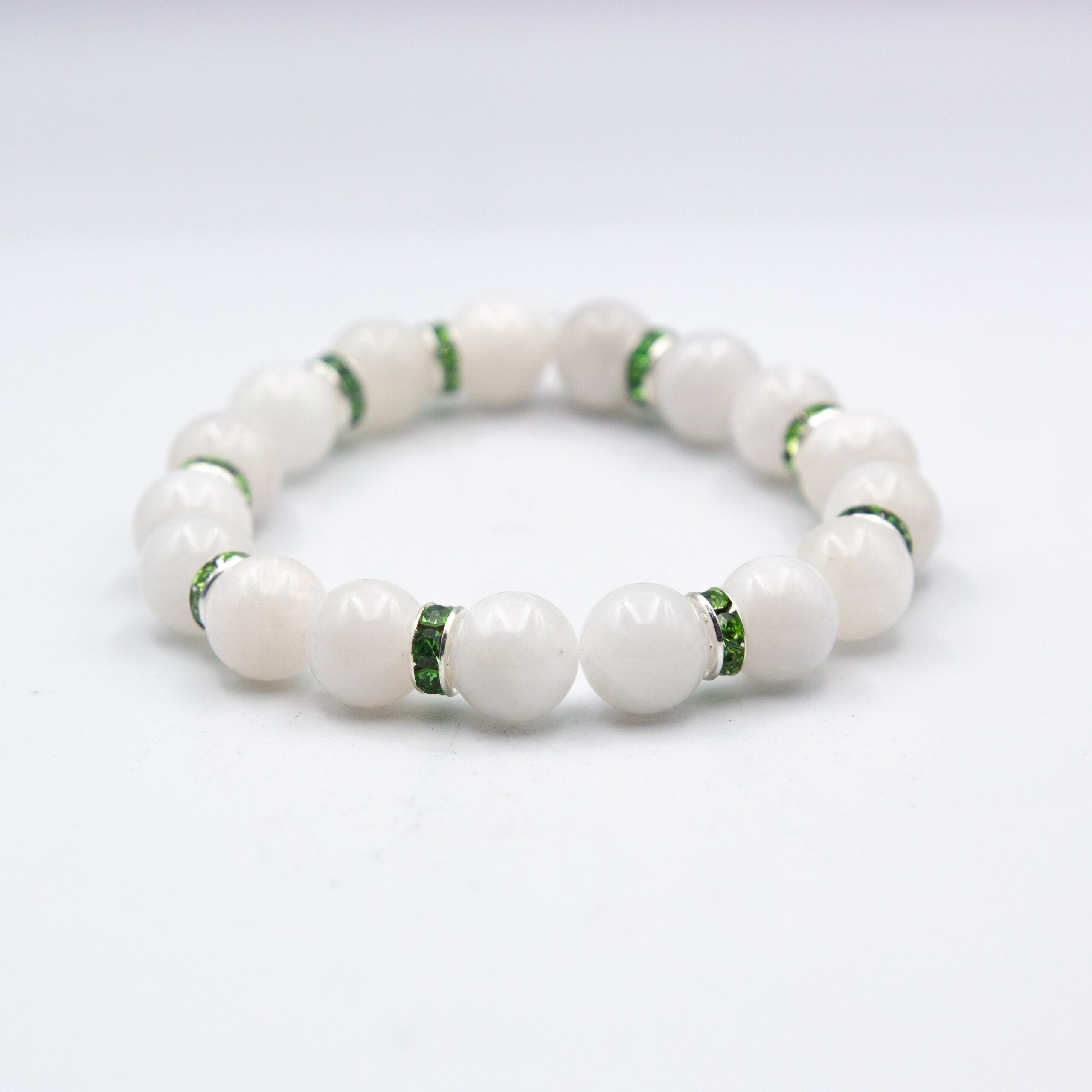
Bead size affects more than fit. It changes how the bracelet reads on your wrist, how much of the stone's pattern you actually see, and how well it plays with other jewellery. There's no correct answer here, only what suits your wrist and your style.
6mm: Delicate and Stackable
Small, light, and discreet. 6mm beads suit smaller wrists, people who prefer understated jewellery, and anyone planning to stack several bracelets together, since they don't build up bulk quickly. The trade-off is that the stone's pattern and colour are less visible — a 6mm tiger's eye bead shows far less of its shimmering band than a 10mm one.
8mm: The Everyday Standard
8mm is the size most crystal bracelets are made in, and for good reason — it's large enough to show the stone clearly and small enough to feel light and wearable on most wrists. If you're unsure, 8mm is the safest starting point.
10mm: Visible and Confident
10mm beads make a clear statement and show off stones with interesting internal character — the glow in moonstone, the flash in labradorite, the banding in tiger's eye. They suit medium-to-larger wrists especially well, and they're a popular choice for anyone who wants the bracelet to be noticed rather than blend in.
12mm and Above: Bold
Large, weighty, and dominant on the wrist. 12mm beads can look striking on larger wrists but may overwhelm a slender one. They also need the most extra length for comfort, as covered in the bead size section above.
Matching Bead Size to Wrist Size
A loose rule of proportion: smaller wrists tend to look balanced with 6mm or 8mm beads, average wrists suit 8mm or 10mm, and larger wrists carry 10mm and 12mm comfortably. Plenty of people break this rule deliberately — a single chunky bracelet on a slim wrist can look intentional and striking — so treat it as a starting point, not a restriction. The same goes for the idea that some bead sizes are "for men" or "for women." In practice, bead size is a matter of wrist proportion and personal taste far more than anything else.
Common Measuring Mistakes
Most sizing problems come from a handful of predictable errors. Avoid these and you'll get it right the first time.
Using your wrist measurement as your bracelet size. This is the most common mistake by far. A bracelet exactly the size of your wrist will be tight, hard to roll on, and hard on the elastic. Always add an allowance.
Pulling the tape too tight. If the tape or paper presses into your skin, the reading will come out small, and so will the bracelet. Snug against the skin is right; compressed is not.
Measuring in the wrong place. Measuring over the wrist bone or up on the forearm adds length you don't need. Measure just below the bone, where the bracelet actually sits.
Using stretchy string. Wool, yarn, and elastic thread all stretch slightly as you wrap them, giving an inaccurate reading. Use paper, cotton thread, or a proper tape.
Ignoring bead size. Choosing the same length for an 8mm and a 12mm bracelet will leave the 12mm one noticeably tighter, as explained above.
Not checking how the shop measures. Inside circumference, centre-line length, and "fits wrist size" are three different numbers. Confirm which one you're looking at.
Rounding down when between sizes. When in doubt, size up. A little extra room is comfortable; too little is the fastest route to a snapped cord.
Sizing for UAE Heat and Everyday Wear
If you live somewhere hot, it's worth factoring climate into your choice. Many people notice their hands and wrists feel slightly fuller on hot days or after being outdoors, and a bracelet that felt fine in an air-conditioned room in the morning can feel tight by the afternoon. For year-round wear in the UAE, the comfort fit — rather than snug — is the more forgiving choice.
Heat also affects the bracelet itself. Sweat, sunscreen, body lotion, and perfume oils can all work their way into the stretch cord over time. It's a good habit to put perfume and lotion on before your bracelet rather than after, and to take the bracelet off for swimming, the gym, or long spells in intense heat. A bracelet that fits with a little room also sits away from the skin slightly more, which makes it easier to keep clean and dry.
Sizing for Stacking

If you plan to wear several bracelets together — something we cover from the stone-pairing side in our guide to crystal bracelet combinations — sizing needs a little extra thought.
Bracelets in a stack sit higher up the wrist as more are added, because they physically push each other along your arm. The wrist gets wider as you move toward the forearm, so the bracelets furthest from your hand need slightly more room than the one closest to it. A common approach is to size the bracelet nearest your hand at your normal comfort fit and allow roughly an extra half-centimetre for bracelets further up the stack.
Mixing bead sizes also changes how a stack sits. One larger bracelet paired with one or two smaller ones tends to look deliberate and balanced, while several large bracelets together build bulk quickly and can feel heavy. If you're stacking three or more, smaller beads usually wear more comfortably.
Buying as a Gift Without Knowing the Size

Crystal bracelets make thoughtful gifts, but you rarely get the chance to measure the recipient's wrist without spoiling the surprise. Gifting is also where this crystal bracelet size guide earns its keep, because a well-chosen size is the difference between a gift worn daily and one politely put away. A few practical workarounds:
Borrow a bracelet or watch they already wear. If you can quietly measure a piece that fits them well, you'll get a far better answer than any guess. Measure the inside of a bracelet, or the length of a watch strap on the hole they use.
Ask someone close to them. A partner, sibling, or friend may know their size or be able to borrow a piece for a quick measurement.
Go for a medium comfort size. If you genuinely have no information, a bracelet with an inside circumference of around 17–18 cm suits a wide range of average adult wrists, and stretch cord adds a little extra forgiveness. For someone with a noticeably slim or large frame, adjust a size down or up.
Choose an adjustable style. Bracelets on adjustable sliding threads remove the sizing question almost entirely, covered in the next section.
Choose 8mm beads. When sizing is uncertain, a medium bead size is the most forgiving on the widest range of wrists — neither too delicate on a large wrist nor too heavy on a slim one.
Elastic vs. Adjustable Thread Bracelets
Most crystal bracelets are one of two construction types, and they size very differently.
Elastic Stretch Bracelets
The most common type. Beads are strung on stretch cord in a continuous loop that rolls over your hand. They're simple, secure, and have no clasp to break or catch, but they're a fixed size — which is exactly why measuring properly matters. They can be restrung to a different size if needed, though that's a job for someone with the right cord and tools rather than a home repair.
Adjustable Thread Bracelets
These are strung on a cord with a sliding knot or pull-through closure, so the wearer tightens or loosens them to fit. They're very forgiving on sizing, easy to take on and off, and a smart choice for gifts. Our green aventurine bracelet with threads is an example of this adjustable style. The trade-off is that the cord itself is visible and will show wear over time, especially with daily contact with water, sweat, and perfume.
Putting On and Taking Off Without Damage

Even a perfectly sized elastic bracelet will wear out early if it's handled roughly, so it's worth building a gentle habit from the first day.
Roll it on, don't pull it. Bring your fingers and thumb together to make your hand as narrow as possible, then roll the bracelet over your knuckles rather than stretching it wide and yanking it over. Reverse the same motion to take it off.
Don't stretch it to "test" it. Pulling a bracelet wide between two hands to check the elastic stretches the cord far more than normal wear ever does.
Take it off before water and exercise. Swimming, showering, and the gym expose the cord to chlorine, soap, sweat, and repeated strain. It's also a good moment to remember that different stones have different care needs — softer stones need gentler handling than quartz-family stones.
Watch for signs of wear. If a bracelet starts feeling looser than when you bought it, or you can see small gaps opening up between beads, the elastic is tiring. Restringing at that point is much better than waiting for it to break and scattering beads across the floor.
A Note on Children
If you're buying for a child, size carefully so the bracelet can't slip off easily, and keep beaded bracelets away from very young children altogether. Loose beads from a broken bracelet are a genuine choking hazard for toddlers.
Shop With the Right Size in Mind
Once you know your size, choosing the stone is the enjoyable part. Our bracelets come in several bead sizes — including 8mm pieces like the golden tiger's eye bracelet and the black tourmaline bracelet, and 10mm pieces like the moonstone bracelet. If you'd like to know more about what each stone traditionally represents before deciding, our guides to tiger's eye bracelet benefits and which wrist to wear it on, moonstone meaning, and 7 chakra bracelet meaning are good places to start.
Because natural beads vary slightly from piece to piece, the most reliable approach is simply to message us with your wrist measurement and the bracelet you're interested in. We'll tell you the inside size of that specific piece and whether it's likely to suit your preferred fit — before you order, not after.
Not sure which size to order?
Send us your wrist measurement and the bracelet you like. We'll confirm the fit before you buy.
Questions People Ask
How do I measure my wrist for a crystal bracelet?
Wrap a strip of paper or a soft tape measure around your wrist just below the wrist bone, snug but not tight. Mark where it overlaps, measure the length against a ruler, then add a fit allowance — usually around 1 to 2 cm for a comfortable everyday fit.
How much should I add to my wrist size for a bracelet?
For a comfort fit, most people add around 1 to 2 cm to their wrist measurement, using the lower end for small beads and the higher end for 10mm and 12mm beads. Add less for a snug fit, more for a loose one.
Why does a 10mm bracelet feel tighter than an 8mm one of the same length?
Bigger beads take up more space on the inside of the loop. The inside of a beaded bracelet is smaller than its quoted length by roughly pi times the bead diameter, so at the same length a 10mm bracelet leaves less room for your wrist than an 8mm one.
Should a crystal bracelet be tight or loose?
Slightly loose is usually best. A bracelet that moves a little is more comfortable and puts less constant strain on the stretch cord, which helps it last much longer than a tight one.
What bead size should I choose?
8mm suits most people and is the most common size. 6mm works well for smaller wrists and stacking, while 10mm and 12mm make a bolder statement and show more of the stone's natural pattern.
What size bracelet should I buy as a gift?
If you can't measure, borrow a bracelet or watch they already wear, or ask someone close to them. Without any information, a medium comfort size with an inside of around 17 to 18 cm and 8mm beads fits a wide range of adult wrists, and adjustable thread bracelets remove the guesswork entirely.
Can an elastic crystal bracelet be resized?
Yes, by restringing it with beads added or removed. It's best done by someone with the right cord and tools, since stretch cord needs proper knotting to hold securely.
Which wrist should I measure?
Measure the wrist you plan to wear the bracelet on. Many people's dominant wrist is slightly larger, so if you might switch between wrists, size for the larger one.