

Firoza (Turquoise) Stone: Benefits, Meaning and How to Spot a Real One
One of the oldest treasured stones in the world - and one of the most imitated. Here's what firoza really is, what it has meant across cultures, and how to tell genuine turquoise from the rest.
Few stones carry as much history as firoza. Known in English as turquoise, it has been worn by Egyptian pharaohs, set into Persian palaces, woven into Tibetan jewellery, and carried by travellers across the Silk Road for thousands of years. Today, firoza stone benefits are still widely sought - for protection, calm, clear communication, and good fortune - especially across the Gulf, Iran, Pakistan, and India. But turquoise is also among the most frequently faked and treated gemstones on the market. This guide covers both sides properly: what firoza means and the benefits tradition attributes to it, and then a practical, honest guide to telling real turquoise from dyed howlite, plastic, and reconstituted stone - including which popular "home tests" will quietly damage a genuine piece.
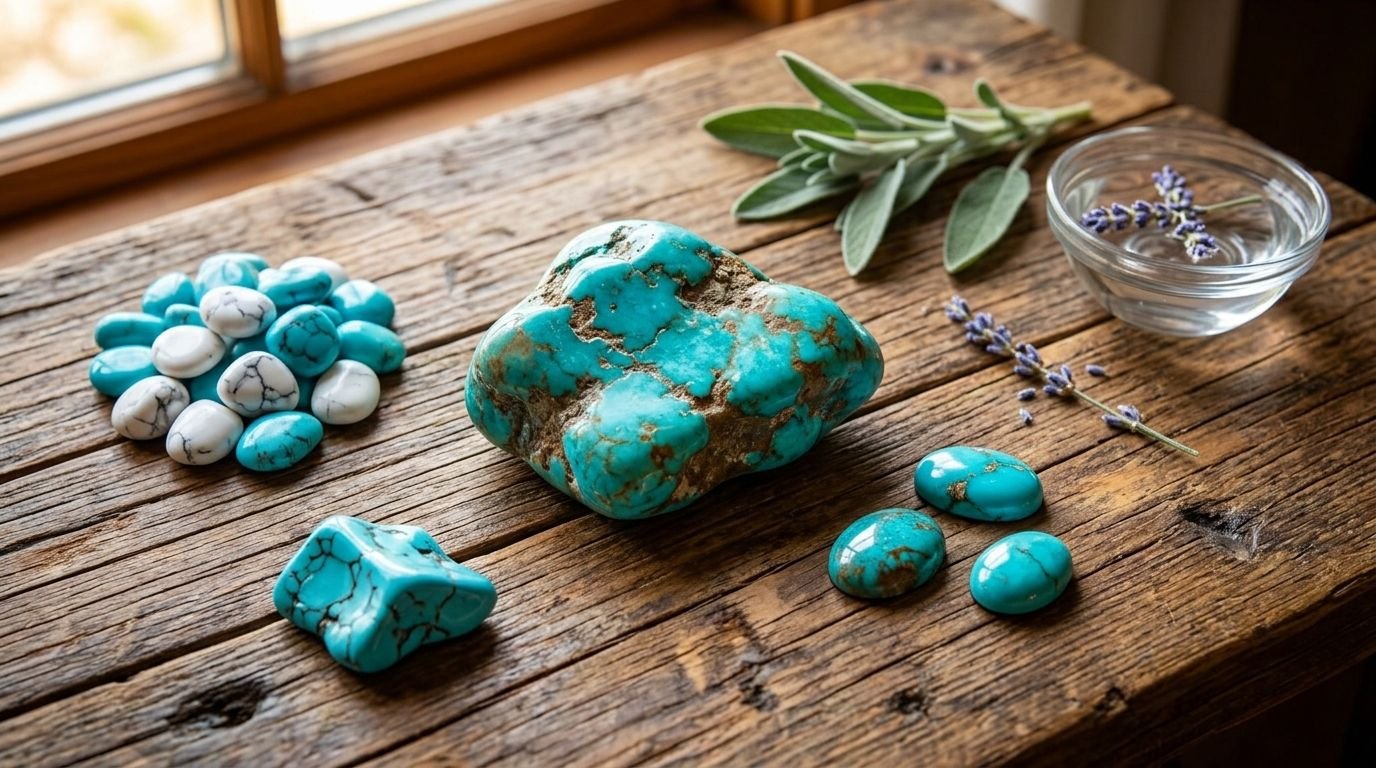
Firoza Stone Benefits: The Quick Answer
Firoza is the Persian, Urdu, and Hindi name for turquoise, an opaque blue-to-green mineral made of copper, aluminium, and phosphate. Traditionally, firoza stone benefits include protection from harm and the evil eye, calm and emotional balance, confident and honest communication, safe travel, and good fortune. To spot a real one, look for natural colour variation and an irregular brown or black matrix that you can feel slightly with a fingernail, a cool touch, and a slightly waxy lustre. Be wary of perfectly uniform colour, grey web-like veins (often dyed howlite), and very low prices. Most turquoise sold today is genuine but stabilised with resin, so the most important question to ask any seller is: "Is it natural, stabilised, dyed, or reconstituted?"
What Firoza Actually Is
Turquoise is a hydrated phosphate of copper and aluminium. It forms when water filters down through rock containing copper, aluminium, and phosphorus, slowly depositing the mineral in cracks, veins, and cavities - usually in dry, arid regions, often near copper deposits. That's why the world's most famous turquoise sources are in deserts and high, dry plateaus.
Where the Colour Comes From
Copper is responsible for turquoise's blue. Iron shifts the colour toward green. Stones with more copper and less iron tend toward the prized sky-blue or "robin's egg" blue, while stones with more iron move through blue-green to apple green. Neither is "fake" - both are genuine turquoise with different chemistry - though the pure sky-blue has traditionally been most valued, particularly in Persian and South Asian markets.
The Matrix
Many turquoise stones contain thin veins or patches of the host rock they formed in, called the matrix. It can appear as fine brown, black, or golden lines - sometimes forming a delicate "spiderweb" pattern - or as larger patches. Matrix is a natural feature, not a flaw. Some buyers prefer clean, matrix-free blue; others value a distinctive spiderweb pattern.
A Soft, Porous Stone
Turquoise sits at roughly 5 to 6 on the Mohs hardness scale - softer than quartz - and it's naturally porous. That porosity is central to everything about turquoise: it's why the stone can absorb oils and change colour over time, why so much of it is stabilised with resin, and why it needs more careful handling than most crystals. Keep this in mind, because it explains the care and authenticity advice later in this guide.
Firoza, Feroza, Turquoise: Where the Names Come From
The many spellings - firoza, feroza, firoja, phiroza, and the Persian firouzeh - all come from the same Persian root, generally understood to mean victory or triumph. That meaning runs through the stone's whole history as a talisman of success and protection, and it's why "firoza" remains the name used across Iran, Pakistan, India, Afghanistan, and much of the Gulf.
The English word "turquoise" has a different story. It comes from the French pierre turquoise, meaning "Turkish stone" - not because the stone came from Turkey, but because European traders bought Persian turquoise in Ottoman markets and assumed it was Turkish. So firoza and turquoise are exactly the same stone; the names simply reflect two different routes the stone took into world culture.
A Stone With 6,000 Years of History
Turquoise is one of the first gemstones known to have been mined. Its long human history is a large part of why its traditional meanings are so consistent across cultures.
Ancient Egypt mined turquoise in the Sinai Peninsula thousands of years ago, using it in jewellery, amulets, and royal burial objects.
Persia produced what became the world's most celebrated turquoise, from mines near Nishapur in north-eastern Iran, which have been worked for many centuries. Persian turquoise decorated palaces, mosques, daggers, and jewellery, and "Persian turquoise" became the benchmark for colour and quality.
Tibet and the Himalayas have treasured turquoise for centuries. It appears in traditional Tibetan and Nepali jewellery, headdresses, and ritual objects, often paired with coral and silver - a combination you can still see in Himalayan craftsmanship today.
The Americas have their own deep turquoise tradition among Native American peoples of the Southwest, where the stone is associated with protection, sky, and water.
The Ottoman world and wider Middle East carried turquoise along trade routes, set it into horse tack, weapons, and jewellery, and wove it into protective traditions - including the long association between blue stones and protection against the evil eye.
Firoza Stone Meaning
Across these very different cultures, the meaning of turquoise is remarkably consistent, which is unusual for a gemstone. The recurring themes are:
Protection. The most widespread meaning of all. Turquoise has been worn as a protective talisman for travellers, warriors, and riders, and as a guard against misfortune and the evil eye.
Victory and success. Built into the Persian name itself, firoza has long been associated with triumph, good fortune, and favourable outcomes.
Calm and balance. Its colour - the blue of open sky and clear water - links it with serenity and emotional steadiness.
Communication and truth. In modern crystal practice, turquoise is associated with the throat chakra, and with clear, honest, confident self-expression.
Friendship and goodwill. In many traditions, turquoise is considered especially meaningful when given as a gift, symbolising friendship and good wishes.
Firoza Stone Benefits
These are the firoza stone benefits most consistently described across traditional and modern sources. They're presented here as traditional beliefs - turquoise is not a substitute for medical, financial, or professional advice, and we'd gently encourage caution with any seller promising it will cure illness or guarantee wealth.
1. Protection and Safe Travel
The oldest and most consistent benefit. Turquoise has been carried by travellers for centuries as a protective stone, and many people still wear it for journeys, new ventures, or simply as a daily guard against negativity and envy.
2. Calm and Emotional Balance
Turquoise is widely associated with soothing anxious or restless energy and supporting emotional steadiness - a gentle, everyday stone rather than an intense one.
3. Confident, Honest Communication
Often called a "speaker's stone," turquoise is traditionally worn by people who want to express themselves more clearly and confidently - in meetings, presentations, or difficult conversations. This links it closely with lapis lazuli, another throat chakra stone, which we cover in our lapis lazuli guide.
4. Good Fortune and Success
True to its name, firoza is associated with victory, prosperity, and favourable outcomes. In Vedic astrology, it is often linked with Jupiter and recommended according to a person's birth chart - an astrological practice some people follow and others don't.
5. Friendship and Goodwill
Turquoise is traditionally considered an especially meaningful gift, symbolising loyalty and good wishes - and some traditions hold that it's most auspicious when received rather than bought for oneself.
6. Wisdom and Clarity
In Tibetan and Himalayan traditions, turquoise has long been associated with wisdom, good health, and good fortune, and its blue is often linked to the sky and the higher realms.
A December Birthstone
Turquoise is one of the modern birthstones for December, which makes it a popular birthday gift for people born in that month.
Firoza in Faith and Tradition
Firoza holds a special place for many people in the Muslim world, particularly in Persian, South Asian, and Gulf cultures, where firoza rings have been worn for generations. Within some Islamic traditions - particularly among Shia Muslims - there are narrations recommending the wearing of a firoza ring. As with many traditions involving gemstones, scholars differ on the authenticity of some of these narrations and on how they should be understood, and many Muslims emphasise that protection and success ultimately come from Allah rather than from any object.
If the religious dimension of wearing firoza matters to you, a trusted scholar from your own tradition is the right person to ask. We discuss similar questions around another treasured stone in our Aqeeq stone guide, and around protective stones more broadly in our guide to crystals and the evil eye.
Irani, Tibetan, American: Types of Turquoise

Turquoise is mined in several countries, and origin affects colour, matrix, and price.
Irani (Persian) firoza is the most famous and traditionally prized, known for its even sky-blue colour, often with little or no matrix. "Irani firoza" is a sought-after name in Gulf and South Asian markets - which also means it's a label that's sometimes applied to stones that aren't from Iran at all. Origin claims are hard to verify by eye; a reputable gem lab report is the only reliable confirmation.
Tibetan and Himalayan turquoise is often slightly greener, with more visible matrix, and is closely tied to traditional Tibetan and Nepali jewellery and craft.
American turquoise, from the south-western United States, is known for a wide range of colours and distinctive matrix patterns, including the prized spiderweb types.
Chinese turquoise is now a major source of turquoise on the world market and comes in a wide range of qualities.
No origin is automatically "real" or "fake." What matters far more for most buyers is whether the stone is natural, stabilised, dyed, or reconstituted - covered next.
How to Spot a Real Firoza Stone
This is where turquoise needs more care than almost any other stone. There isn't just "real" and "fake" - there's a spectrum, and understanding it will protect you far better than any single test.
The Five Categories You'll Actually Encounter
1. Natural, untreated turquoise. Genuine turquoise, cut and polished with nothing added. Only harder, higher-grade material is stable enough to use this way, so natural untreated turquoise is relatively rare and priced accordingly.
2. Stabilised turquoise. Genuine turquoise that has been impregnated with clear resin to fill its pores, harden it, and deepen and lock in its colour. This is by far the most common form on the market - a large share of the turquoise sold worldwide is stabilised. It is real turquoise, it's legitimate, and it's often more durable for everyday wear. It should simply be disclosed and priced as treated.
3. Dyed turquoise. Genuine but pale or low-grade turquoise that has been dyed to a more desirable blue. Still turquoise, but worth considerably less, and the colour may fade or rub off over time.
4. Reconstituted (or "block") turquoise. Turquoise powder or tiny fragments mixed with resin, often dyed, and pressed into blocks that are then cut. It contains some real turquoise, but it's essentially a manufactured material and worth far less than solid stone.
5. Imitations. Materials that aren't turquoise at all - most commonly dyed howlite or dyed magnesite, both white stones that take blue dye easily, plus glass, plastic, and resin.
Visual Signs of Genuine Turquoise
Natural colour variation. Even high-grade turquoise usually shows subtle shifts in tone across the stone. Perfectly flat, uniform colour - especially an intense, electric blue - is a warning sign of dye, plastic, or reconstituted material.
A matrix that's part of the stone. In genuine turquoise, the matrix is usually brown, black, or golden-brown, irregular, and sits within the stone. Running a fingernail lightly across it, you may feel a very slight texture difference where the matrix meets the turquoise, because the two materials polish differently. A painted-on or perfectly smooth "web" that you can't feel at all is a warning sign.
The right kind of veining. Dyed howlite and magnesite usually show grey veins in a thin, web-like pattern - quite different from turquoise's brown and black matrix. Grey veining on a vividly blue stone is one of the most reliable signs of dyed howlite.
Dye pooling. Look closely at cracks, pits, and drill holes. In dyed stones, colour often collects more deeply in these crevices. If a bead's drill hole reveals a white or much paler core, the stone has been dyed.
A waxy lustre. Polished natural turquoise typically has a soft, slightly waxy sheen. Plastic and heavily resined material can look glossier or more "plastic-like."
Temperature and weight. Genuine stone feels cool to the touch at first and has a reassuring weight. Plastic and resin feel warmer and noticeably lighter.
Practical Signs That Have Nothing to Do With the Stone
Price. Natural, high-grade turquoise - especially anything claimed to be Irani firoza - is not cheap. A large, perfectly blue "Irani firoza" at a very low price is almost certainly treated, reconstituted, or imitation.
Disclosure. A trustworthy seller should tell you plainly whether a stone is natural, stabilised, or dyed. Vague answers, or "all natural, no treatment" claims on inexpensive, uniformly coloured stones, deserve scepticism.
Certification for significant purchases. For a high-value stone, a report from a recognised gemmological laboratory is the only reliable way to confirm both authenticity and treatment.
Real vs Treated vs Fake: Comparison Chart
| Type | Is It Turquoise? | Typical Look | Key Clue | Relative Value |
|---|---|---|---|---|
| Natural untreated | Yes | Subtle colour variation, waxy lustre | Higher price, seller can back it up | Highest |
| Stabilised | Yes (treated) | Rich, even colour, slightly glossier | Very common; should be disclosed | Moderate |
| Dyed turquoise | Yes (treated) | Intense, sometimes uneven blue | Colour pooling in cracks and holes | Lower |
| Reconstituted | Partly | Very uniform colour and texture | Too perfect; may look like compressed powder | Low |
| Dyed howlite / magnesite | No | Bright blue with grey web veins | Grey veining, white core in drill holes | Very low |
| Plastic / glass / resin | No | Glossy, uniform, lightweight | Warm to touch, too light | Very low |
At-Home Tests: Which Are Safe, Which Damage the Stone
Many websites recommend aggressive home tests for firoza. Some of them can permanently damage genuine turquoise - and several don't even work reliably, because most real turquoise is stabilised. Here's an honest breakdown.
Safe Tests
Visual inspection with a magnifier for colour variation, matrix, grey veining, and dye pooling. This is the most useful test of all.
Fingernail test on the matrix - gently feeling whether it sits slightly differently from the surrounding turquoise.
Temperature and weight - real stone feels cool and substantial.
Checking drill holes on beads for a white or paler core.
Tests That Risk Damage - Avoid on Stones You Want to Keep
Acetone or nail polish remover. A cotton swab with acetone can lift some dyes, which is why it's popular. But acetone can also dull or damage the resin in stabilised turquoise - which is genuine turquoise - and harm polished surfaces. Use it, if at all, only on a hidden spot of an inexpensive piece.
Hot needle test. Touching a heated needle to the stone to smell for burning plastic is genuinely destructive. It can scorch or mark stabilised turquoise, which contains resin, and it can crack natural turquoise. A "plastic" smell doesn't distinguish imitation from legitimately stabilised real turquoise.
Scratch tests. Scratching with a knife or other hard object will mark genuine turquoise, which is relatively soft. It may help tell howlite from turquoise in expert hands, but it permanently damages whatever you test.
Water absorption test. Some sites suggest putting water on the stone to see if it absorbs. Water can discolour natural turquoise, and since most turquoise is stabilised, it won't absorb water anyway - so the test tells you very little while risking the stone.
Burning tests. Exposing turquoise to flame will damage or destroy it. There's no reason to do this to a stone you own.
The bottom line: for a stone you care about, rely on visual signs, a trustworthy seller, and - for valuable pieces - a lab report, rather than tests that can ruin it.
How to Wear Firoza

Ring
The firoza ring is the most traditional form across Iran, the Gulf, and South Asia. In many traditions it's worn on the ring finger or little finger, and in Vedic astrology the finger and day of first wearing are often chosen according to the person's chart. Silver is the classic setting, both for its look and its long pairing with turquoise in Persian and Himalayan craft.
Pendant
Worn near the throat, a turquoise pendant aligns naturally with the stone's modern association with the throat chakra and communication. Pendants are also gentler on the stone than rings, since they're less exposed to knocks, water, and hand lotions.
Bracelet
Beaded turquoise bracelets are an easy, everyday way to wear the stone, and pair well with lapis lazuli, coral, and silver. Because bracelets are close to hands that get washed often, they need a little extra care to protect the stone from water and soap.
As a Gift
Given its long association with friendship and goodwill, turquoise is one of the most traditional gemstone gifts - a fitting choice for a friend starting a journey, a new job, or a new chapter.
Caring for Turquoise (Especially in UAE Heat)
Because turquoise is soft and porous, it's one of the most care-sensitive stones you can own. A few simple habits will keep it looking its best for decades.
Keep it away from oils, perfume, and lotion. Natural turquoise can absorb oils from skin, cosmetics, perfume, and oud or attar oils, which can gradually shift its colour toward green. Put on perfume and lotion first, let them dry, then put on your turquoise.
Avoid water and chemicals. Remove turquoise jewellery before washing hands, showering, swimming, or cleaning. Never soak it, and keep it away from detergents and chlorine.
Protect it from heat and strong sun. Prolonged heat and direct sun can dry, fade, or discolour turquoise. Don't leave it in a parked car, on a sunny windowsill, or on a balcony - all real risks in a UAE summer, which we cover in detail in our guide to looking after crystals in UAE heat.
Clean gently. Wipe with a soft, dry cloth after wearing. If needed, use a barely damp cloth, then dry immediately. Avoid ultrasonic and steam cleaners entirely.
Store it separately. Harder stones and metal can scratch turquoise. Keep it in a soft pouch or its own compartment.
Skip water-based rituals. If you cleanse or charge your crystals, avoid water, salt, and moon water for turquoise. Dry methods such as sound or resting it on clear quartz are safer - see our guide to charging crystals in moonlight for which stones to keep dry.
A Note on Colour Change
Some people believe that turquoise changing colour is a sign it has absorbed negativity or that its owner's luck is turning. Physically, colour change in natural turquoise is usually caused by absorbing oils, sweat, or moisture, or by exposure to heat and sun. Stabilised turquoise is much more resistant to this. Either way, good care makes it far less likely.
Real Turquoise at Alpine
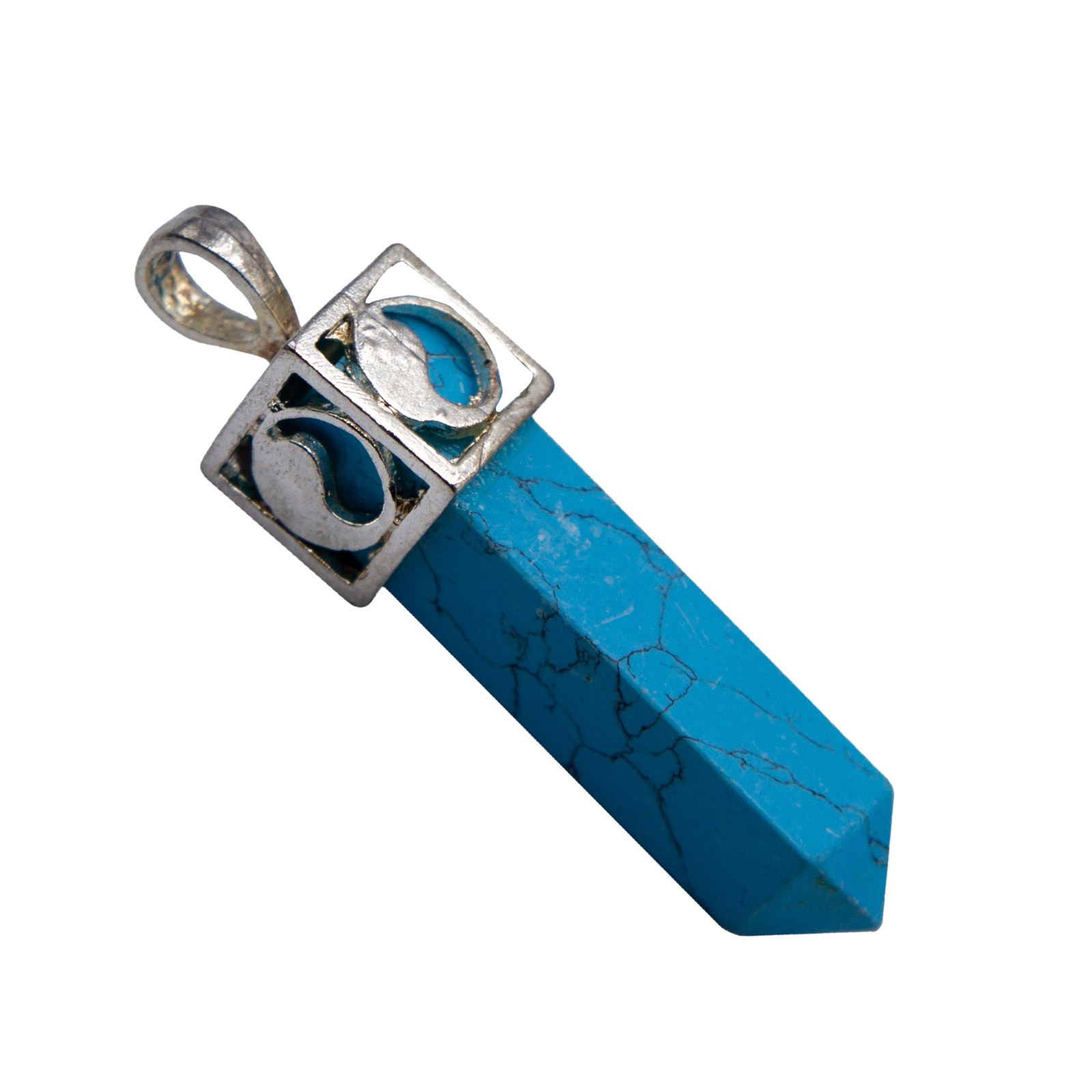
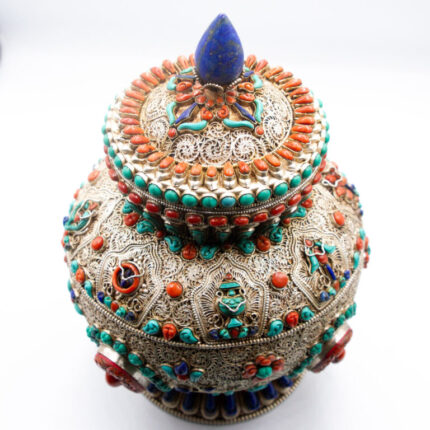
Our turquoise comes from the Himalayan craft tradition, where the stone has been treasured for centuries. You can find it in our Himalayan Natural Turquoise Crystal Pendant and our Natural Turquoise and Lapis Lazuli Bracelet - please check the product page for current availability, as this piece sells out regularly. For a statement piece, our pure silver filigree pot with turquoise, coral and lapis lazuli showcases the traditional Himalayan pairing of turquoise with silver and coral.
If you'd like to know exactly what you're buying - natural or stabilised, and how to care for it - just ask. We'd always rather answer the question before you buy than after.
Questions about a firoza piece?
Ask us about any turquoise item - origin, treatment, care, or current stock - and we'll answer honestly.
Questions People Ask
What are the benefits of firoza stone?
Traditionally, firoza is worn for protection, safe travel, calm and emotional balance, confident communication, good fortune, and friendship. These are long-standing traditional beliefs rather than proven effects, and firoza is not a substitute for medical or professional advice.
Is firoza the same as turquoise?
Yes. Firoza (also spelled feroza or firouzeh) is the Persian, Urdu, and Hindi name for turquoise. The Persian name is generally understood to mean victory, while "turquoise" comes from the French for "Turkish stone."
How can I tell if firoza is real?
Look for natural colour variation, a brown or black matrix that sits within the stone, a waxy lustre, and a cool, solid feel. Grey web-like veins, perfectly uniform colour, colour pooling in cracks, and white cores in drill holes suggest dyed howlite or treated material. For valuable pieces, a gem lab report is the only reliable confirmation.
Is stabilised turquoise real?
Yes. Stabilised turquoise is genuine turquoise treated with resin to harden it and lock in its colour. It's the most common form on the market and is legitimate, but it should be disclosed and priced as treated rather than natural.
Should I do the hot needle or acetone test?
Not on a stone you want to keep. Both can damage genuine turquoise, especially stabilised turquoise, and neither reliably separates imitation from legitimately treated real stone. Visual inspection, a trusted seller, and a lab report for valuable pieces are safer.
Why did my turquoise change colour?
Natural turquoise is porous and can absorb skin oils, sweat, perfume, and moisture, which can shift its colour toward green. Heat and strong sun can also fade or discolour it. Keeping it dry and away from oils and sun helps prevent this.
What is Irani firoza?
Irani (Persian) firoza is turquoise from Iran, historically from the Nishapur region, traditionally prized for its even sky-blue colour. Because the name is so valued, it's sometimes used loosely for stones from elsewhere, so origin claims should be backed by a reputable lab report.
Can I wear firoza every day?
Yes, with care. Remove it before washing, swimming, applying perfume or lotion, and long periods in the sun, and wipe it with a soft dry cloth after wearing. Stabilised turquoise is generally more durable for daily wear.