

Lapis Lazuli: Meaning, Benefits and How to Spot Dyed Stone
What's actually inside that deep midnight-blue stone, what lapis lazuli benefits are traditionally believed to be, and exactly how to tell lapis lazuli real or fake before you buy.
Lapis lazuli has been mined and treasured for roughly nine thousand years, which puts it among a genuinely small handful of stones with a continuous, documented human relationship stretching back that far. This guide covers what lapis lazuli meaning is actually rooted in, what lapis lazuli benefits are traditionally believed to be, and — because this is one of the most commonly faked blue stones on the market — exactly how to tell lapis lazuli real or fake before you spend money on a piece.
What Lapis Lazuli Actually Is
Lapis lazuli is not a single mineral but a metamorphic rock, composed primarily of lazurite — the deep blue mineral responsible for its signature color — combined with calcite, which produces the white veining or patches often visible within a piece, and pyrite, whose small golden flecks are frequently mistaken for actual gold. This combination is part of what gives high-quality lapis lazuli its distinctive appearance: a rich, saturated blue scattered with tiny metallic gold flecks, sometimes described as resembling a night sky full of stars.
The finest, most historically significant lapis lazuli has always come from the Sar-i-Sang mines in Afghanistan's Badakhshan province, a source that has been worked continuously since at least the 7th millennium BC, making it one of the oldest continuously mined gemstone deposits anywhere in the world. Additional deposits exist in Chile, Russia, and smaller quantities in Pakistan, Italy, Mongolia, the United States, and Canada, though Afghan material is still generally regarded as the benchmark for color and quality.
Grading Lapis by Its Actual Color
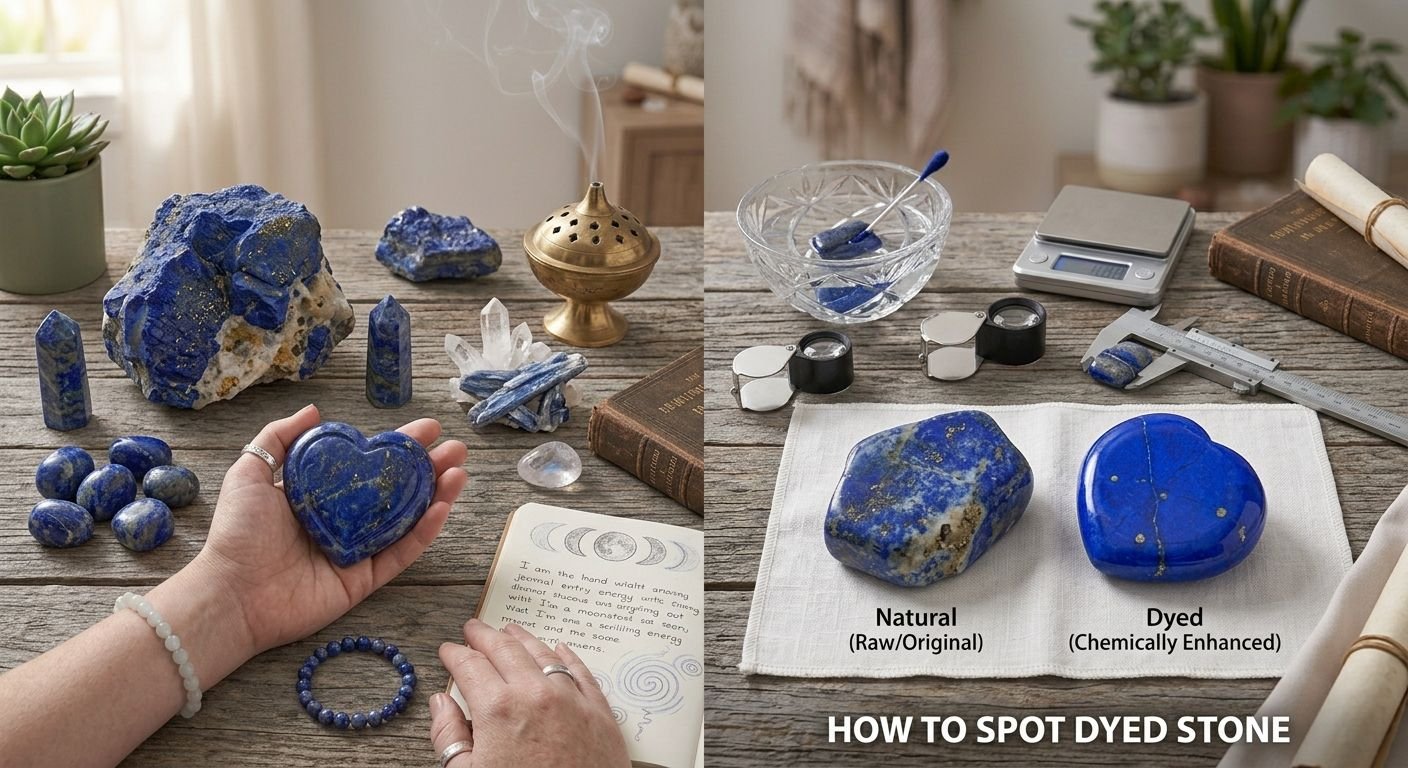
Quality within lapis lazuli varies considerably based on the ratio of lazurite to the other minerals present. The most prized material shows a deep, saturated, relatively uniform royal blue with only small, evenly scattered pyrite flecks and minimal calcite. Lower-grade material shows more visible white calcite veining or a lighter, less saturated blue, which affects both appearance and value considerably even though it's still entirely genuine lapis lazuli.
A Genuinely Rare Mineral Component
Lazurite itself, the mineral primarily responsible for lapis's color, is worth knowing a bit more about — it's a member of the sodalite group of minerals, and genuinely pure lazurite specimens are rare enough that most of what mineralogists classify as lapis lazuli's blue component is technically a related, sulfur-rich mineral called haüyne rather than lazurite in the strictest sense. In practice, the trade name "lapis lazuli" refers to the rock as a whole regardless of this technical distinction, and it doesn't affect the stone's appearance, durability, or traditional meaning in any practical way — but it's a genuinely interesting bit of mineralogical nuance most consumer guides skip entirely.
Historical Use Beyond Jewellery
Before it was primarily known as a gemstone, ground lapis lazuli served a second, historically significant purpose: as the source of ultramarine, the most prized and expensive blue pigment available to painters for centuries, used extensively in Renaissance religious art specifically for depicting the robes of the Virgin Mary. This pigment was so costly that its use was often reserved specifically for the most important figures in a painting, a genuinely interesting parallel to the stone's own long-standing association with royalty and divinity in jewellery form.
Lapis Lazuli Meaning
Lapis lazuli meaning is unusually well documented for a stone this old, thanks to its extensive use across some of history's most thoroughly studied civilizations. In ancient Egypt, lapis lazuli was closely associated with royalty, divinity, and the heavens — it was used extensively in the funeral mask of Tutankhamun and in countless other royal and religious artifacts, reflecting a belief that the stone carried genuine spiritual and protective significance rather than serving as purely decorative material.
Across Mesopotamian, Persian, and later Islamic traditions, lapis lazuli similarly carried associations with wisdom, truth, and communication with the divine. Its name itself reflects this deep linguistic and cultural footprint: "lapis" is Latin for stone, while "lazuli" derives from the Persian lāžward, the same root that eventually gave English the word "azure."
The "Stone of Truth"
Across many of these traditions, lapis lazuli carries a consistent thread specifically tied to truth, honest communication, and clear self-expression — themes that have carried through into its modern meaning largely intact. This consistency across genuinely independent ancient cultures, rather than a meaning invented recently and applied backward, is part of what gives lapis lazuli's traditional symbolism more historical weight than some more recently popularized stones.
Trade Routes and Cultural Spread
Part of why lapis lazuli's meaning developed so consistently across such geographically distant cultures traces back to genuinely ancient trade networks. Because Afghanistan's Sar-i-Sang mines were, for millennia, essentially the only significant source of fine lapis lazuli anywhere in the world, the stone traveled enormous distances along early trade routes, reaching Egypt, Mesopotamia, and eventually the Indus Valley civilization well before more modern trade infrastructure existed. This single-source scarcity is part of why lapis carried such consistently high status wherever it appeared — it was, quite literally, one of the most well-traveled luxury materials of the ancient world.
Lapis Lazuli Benefits
The lapis lazuli benefits most consistently cited across different sources build directly on this long-standing "truth and wisdom" meaning.
Honest, clear communication is the benefit most frequently associated with lapis lazuli — it's a popular choice specifically for situations requiring difficult but necessary honesty, treated as support for speaking clearly and truthfully rather than avoiding an uncomfortable conversation. This is often the specific reason people choose lapis lazuli jewellery for a negotiation, a hard conversation with a partner, or any situation where clarity matters more than diplomacy.
Self-awareness and inner wisdom is a closely related lapis lazuli benefit, tied to the stone's ancient reputation for connecting the wearer with deeper insight and self-knowledge, rather than knowledge gained purely from external sources.
Confidence in expressing your authentic self rounds out the communication-focused side of its meaning — lapis lazuli is frequently recommended for anyone working on expressing their genuine opinions or creative voice more openly, particularly if they tend toward self-censorship or holding back.
Mental clarity and focus is the fourth theme worth mentioning, drawing on lapis lazuli's long-standing association with wisdom and clear thinking, making it a fairly popular choice specifically for study, focused work, or any task requiring sustained mental clarity.
Why These Benefits Cluster So Tightly
It's worth noticing that, unlike some crystals whose traditional benefits span a fairly wide and loosely related range of themes, lapis lazuli's benefits stay remarkably focused around communication, truth, and clarity specifically. This tight clustering likely reflects just how consistently the stone's ancient meaning centered on these exact themes across so many independent cultures — there was less room for the meaning to drift or diversify over the centuries, since the underlying "truth and wisdom" association was already so well established early on.
Lapis Lazuli and the Third Eye
Lapis lazuli is traditionally associated with the third eye chakra, positioned at the center of the forehead and linked to intuition, insight, and inner vision, as well as the throat chakra, associated with communication and self-expression. This dual association lines up directly with the themes already covered — the third eye connection reflects the stone's link to wisdom and inner knowing, while the throat chakra connection reflects its reputation for honest, clear communication. Practitioners working on either center specifically sometimes hold or place lapis lazuli at the corresponding point during meditation, though wearing it as a pendant near the throat is the more practical everyday version of the same idea.
Lapis Lazuli Real or Fake: How to Spot Dyed Stone
This is genuinely important to cover in detail, because lapis lazuli is one of the more commonly imitated blue stones on the market, and the fakes are often convincing enough to fool a casual buyer.
Dyed Howlite and Dyed Magnesite
The most common lapis lazuli imitation is dyed howlite or dyed magnesite, both naturally white, porous minerals that take dye readily. Dyed howlite is genuinely widespread across the jewellery market generally, most often used to imitate turquoise, but blue-dyed howlite sold as lapis lazuli is also common. The giveaway is usually in the pattern: howlite's natural grey veining, once dyed blue, tends to look more web-like, irregular, and grey-toned compared to lapis's cleaner white calcite patches and golden pyrite flecks. Dyed material also often shows color concentrated in cracks and pores rather than evenly throughout the stone, and can sometimes transfer slight color onto a damp cloth when rubbed, which genuine lapis will not do.
Dyed Jasper — "Swiss Lapis"
A specific, commercially significant imitation is dyed blue jasper, historically marketed under the deliberately misleading trade name "Swiss lapis," despite having no connection to Switzerland and no lazurite content whatsoever. This remains one of the more convincing imitations, since jasper's natural density and hardness feel closer to genuine lapis than lighter materials like howlite. The most reliable tell is the complete absence of genuine pyrite inclusions — dyed jasper may include artificial gold-colored specks meant to imitate pyrite, but these tend to look flatter, more uniform, and more metallic-shiny than lapis's natural, irregularly scattered pyrite flecks.
Reconstituted or Pressed Lapis
Another imitation worth knowing about is reconstituted lapis — genuine lapis lazuli powder or small fragments mixed with a binding resin and pressed into a uniform shape. This material is technically "real" in that it contains actual lapis lazuli content, but it lacks the natural mineral structure of genuine solid lapis and is generally valued far lower. Reconstituted material often shows an unnaturally uniform color and texture throughout, without the natural variation in calcite veining and pyrite distribution that solid lapis shows.
A Simple Set of Checks
Putting this together, a few practical checks catch most imitations. Look closely at any gold-colored flecks — genuine pyrite is irregular, metallic, and scattered unevenly, while imitation gold flecking tends to look flatter and more mechanically uniform. Check whether the color sits evenly throughout the stone or seems concentrated in cracks and surface pores, a sign of dye rather than natural mineral color. Feel the weight — genuine lapis carries real mineral density compared to lighter imitation materials. And when in doubt, ask the seller directly what they're representing the stone as and where it's sourced from; a seller confident in genuine material will typically answer clearly and consistently.
A Simple Water Test, Used Carefully
One additional, low-risk check some buyers use is lightly dampening a cotton swab or soft white cloth and rubbing it gently against an inconspicuous part of the stone. Genuine lapis lazuli's lazurite color is mineral-based and won't transfer. Dyed imitations, particularly dyed howlite or magnesite, will sometimes leave a faint blue tint on the cloth, especially on newer, less-worn pieces where the dye hasn't fully set. This test isn't perfectly reliable on its own, since some dyes are more color-fast than others, but a visible color transfer is a fairly strong sign of an imitation.
Why Sellers Sometimes Genuinely Don't Know
It's worth adding a note of fairness here: not every seller offering a fake is being deliberately deceptive. Blue jasper sold as "Swiss lapis" has been in the market long enough, and traded through enough hands, that some sellers genuinely inherited the mislabeling from their own suppliers without independently verifying it. This doesn't change the practical advice above, but it's worth keeping in mind that a seller giving you an inaccurate answer isn't necessarily lying to you directly — it's still worth doing your own checks regardless of how confident or well-intentioned the seller seems.
Lapis Lazuli vs. Sodalite and Azurite
Beyond outright fakes, lapis lazuli is also genuinely confused with a couple of other naturally occurring blue minerals, worth distinguishing honestly rather than treating interchangeably.
Sodalite is a legitimate, naturally blue mineral in its own right, and actually belongs to the same broader mineral family as lazurite. It's generally a more uniform, slightly duller blue without lapis's characteristic golden pyrite flecks, and typically shows white veining rather than the combination of white calcite and gold pyrite that defines genuine lapis. Sodalite is a real, valuable stone on its own terms — the concern is specifically when it's sold as lapis lazuli rather than under its own name.
Azurite is another naturally blue mineral, often found alongside malachite, showing a deeper, more intensely saturated blue than either lapis or sodalite, generally without pyrite inclusions and often displaying a distinctly different crystalline or banded structure rather than lapis's more uniform, speckled appearance.
Why This Distinction Matters for Value, Not Just Accuracy
Beyond simple correctness, this distinction genuinely matters for pricing. Sodalite is generally less expensive than fine lapis lazuli, so a piece sold at lapis prices but actually made of sodalite represents a real financial difference, not merely a technical one. This is a separate issue from outright dyed fakes covered above — sodalite is a genuine, naturally blue mineral, simply a different and generally less costly one than true lapis lazuli.
Who Should Wear Lapis Lazuli
A few groups tend to find a particularly natural fit with this stone specifically.
Anyone working on speaking up more honestly or confidently — in a relationship, at work, in a creative practice — fits the stone's core communication-focused meaning especially directly.
People drawn to stones with genuine, well-documented ancient history rather than purely modern crystal-healing associations tend to appreciate lapis lazuli's unusually deep, cross-cultural historical footprint.
Anyone who wants a bold, richly colored statement piece tends to appreciate lapis lazuli simply for how it looks — its deep, saturated blue reads as a genuine style statement in most jewellery formats.
Students, writers, and anyone doing sustained focused work may find the stone's traditional association with mental clarity and wisdom particularly relevant to their daily routine.
How to Wear and Use It
Given its association with communication, lapis lazuli is commonly worn as a pendant or necklace specifically, keeping it near the throat where it aligns naturally with its traditional throat chakra connection. Some people specifically hold or touch a piece briefly before a conversation or situation that calls for honesty and clarity, using the stone as a small, deliberate pause rather than only wearing it passively throughout the day.
As a bracelet or ring, lapis lazuli also works well for genuinely everyday, ongoing wear, though given its comparative softness, it's worth being somewhat more careful with daily bracelet wear than you might be with a harder stone like quartz or amethyst.
Real Lapis Lazuli at Alpine
We currently carry lapis lazuli in three genuine formats: our Himalayan Natural Lapis Lazuli Crystal Pendant, a Natural Lapis Lazuli Crystal Bracelet (10mm), and a Natural Lapis Lazuli Crystal Ring set in 925 pure silver. Given how often this specific stone gets faked, as covered above, we're happy to walk you through the piece on a video call before you order, showing the pyrite flecking and calcite veining up close so you can see exactly what you're buying.
Basic Care
Lapis lazuli sits at roughly 5 to 5.5 on the Mohs hardness scale, meaningfully softer than quartz-family stones, so it's more prone to scratching and requires a bit more care during daily wear. Avoid harsh chemicals, ultrasonic cleaners, and prolonged water exposure, since lapis is somewhat porous and can absorb liquids that affect its color over time. Clean with a soft, dry cloth, store it separately from harder stones to prevent scratching, and keep it out of prolonged, intense sunlight, which can gradually dull its color.
Want to see the pyrite flecking up close first?
Given how often lapis gets faked, we're happy to show you the actual piece on a call before you order.
Questions People Ask
What is lapis lazuli meaning rooted in?
Lapis lazuli meaning centers on truth, wisdom, and honest communication, a consistent theme across ancient Egyptian, Mesopotamian, and Persian traditions that used the stone for its perceived spiritual and protective significance.
What are the main lapis lazuli benefits?
Honest communication, self-awareness, confidence in self-expression, and mental clarity are the lapis lazuli benefits most consistently cited, tied to its long-standing reputation as a stone of truth and wisdom.
How can I tell if lapis lazuli is real or fake?
Check for genuine, irregularly scattered pyrite flecks rather than flat artificial gold specks, confirm color sits evenly throughout rather than concentrated in cracks, and feel for real mineral density. Common fakes include dyed howlite, dyed jasper, and reconstituted lapis.
What's the difference between lapis lazuli and sodalite?
Sodalite is a legitimate, naturally blue mineral related to lazurite, but it's generally a more uniform, duller blue without lapis's characteristic golden pyrite flecks and white calcite patches.
Is lapis lazuli durable enough for everyday jewellery?
It's moderately durable at 5 to 5.5 on the Mohs scale, softer than quartz-family stones, so it benefits from a bit more care during daily wear, particularly avoiding harsh chemicals and prolonged water exposure.
What is "Swiss lapis" and is it real?
"Swiss lapis" is a misleading trade name for dyed blue jasper. It has no connection to Switzerland and contains no lazurite, making it a common imitation of genuine lapis lazuli rather than a legitimate variety of it.
Where does the finest lapis lazuli come from?
The Sar-i-Sang mines in Afghanistan's Badakhshan province have produced the most prized lapis lazuli for millennia and remain the historical benchmark for color and quality, though Chile and Russia also produce meaningful quantities.