

Natural vs Synthetic Crystals: What's the Difference?
Synthetic isn't the same thing as fake — and conflating the two is where most of the confusion starts.
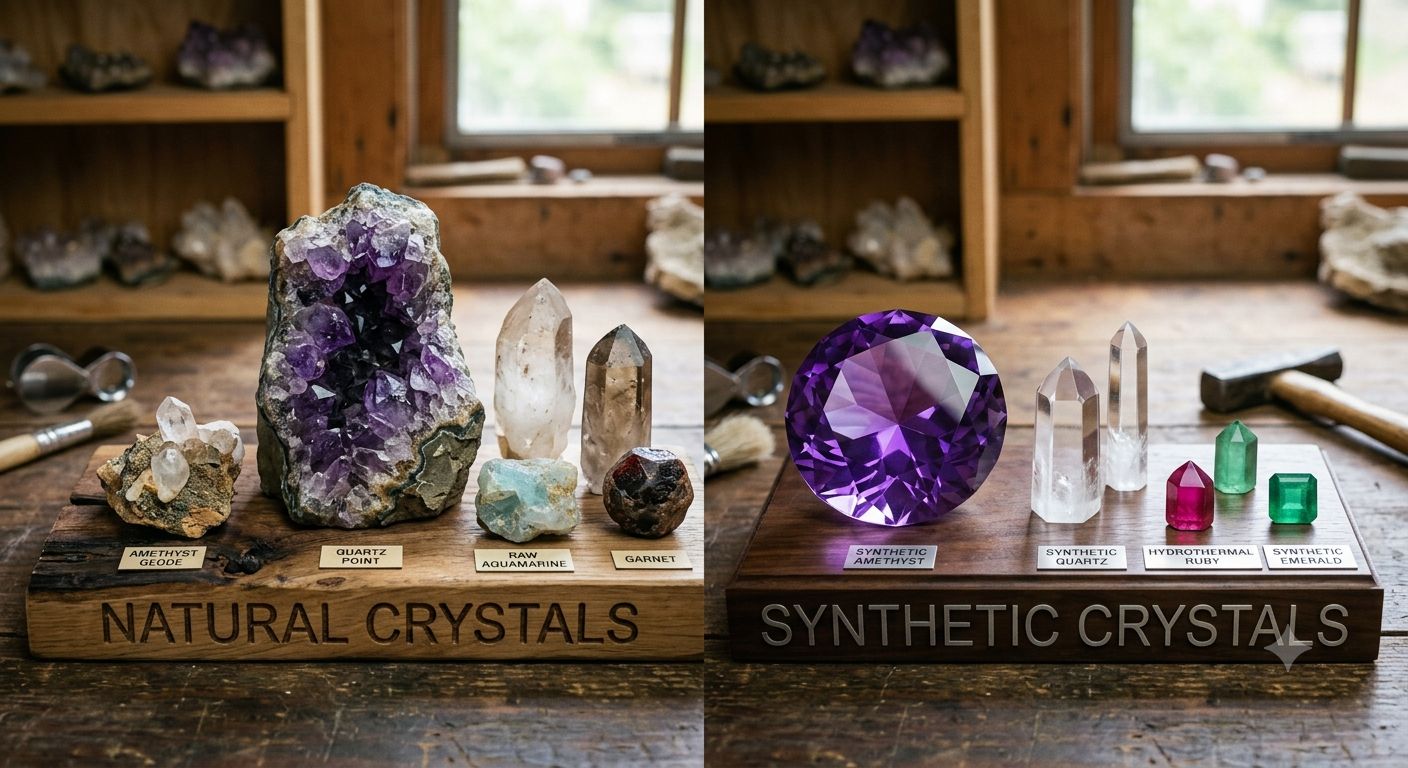
People use "synthetic" and "fake" interchangeably, and that's genuinely the wrong starting point for this whole topic. A fake crystal is glass, resin, or plastic dressed up to look like stone — a different material entirely, pretending to be something it isn't. A synthetic crystal is actually the mineral it claims to be, grown in a laboratory instead of underground. Same chemical formula, same hardness, same optical properties in most cases. The difference isn't what it's made of — it's how long the process took and where it happened.
That distinction matters more than it sounds like it should, and it's worth actually working through rather than just repeating "buy natural, avoid synthetic" as a blanket rule, because the honest answer is more complicated than that.
Synthetic Doesn't Mean Fake
Lab-grown quartz has existed industrially since long before anyone was selling it as jewellery — it's been used in watches, electronics, and precision instruments for decades, specifically because manufacturers needed a completely consistent, flaw-free source of quartz that natural mining couldn't reliably guarantee. The crystal healing market is actually a fairly late arrival to something that was already a mature industrial process.
This is different territory from cubic zirconia or glass, which are entirely different materials chosen because they resemble a gemstone visually. Lab-grown quartz genuinely is quartz. Lab-grown emerald genuinely is beryl with chromium in it, same as a natural emerald. The chemistry doesn't care whether the crystal formed over ten thousand years in a mountain or over ten weeks in a pressurized tank.
The gemstone industry has actually dealt with this question for far longer than the crystal healing world has. Lab-grown rubies and sapphires have been produced since the early 1900s, well before "healing crystal" was a phrase anyone used commercially, and jewellers have had decades to work out disclosure standards and pricing conventions around them. The crystal and wellness market is really just catching up to a conversation the fine jewellery trade already had.
How a Lab Actually Grows a Crystal
Most synthetic quartz is produced through a process called hydrothermal growth, which is essentially a fast-forwarded version of what happens in nature. A small seed crystal is suspended in a sealed container with a silica-rich solution, then the whole thing is heated and pressurized so the solution deposits new crystal layers onto the seed, growing it outward over weeks rather than millennia. It's a genuinely clever bit of materials science, and the industrial version of this process is precise enough to produce crystals with almost no internal flaws at all — which is exactly what a watch manufacturer wants, and exactly the opposite of what a natural-stone collector is usually looking for.
Why Telling Them Apart Is Genuinely Hard
This is where synthetic crystals differ completely from glass or dyed imitations, and it's worth being upfront about it: the basic tests that catch a fake — checking if it's cool to the touch, checking the weight, scratching it with a coin — won't reliably catch a synthetic, because it's the same mineral with the same physical properties. A lab-grown quartz bead will feel just as cool and just as hard as a natural one, because chemically, it is exactly that hard, exactly that dense.
The tell, when there is one, tends to be visual rather than physical. Natural crystal almost always carries some evidence of its slow, chaotic formation — subtle color zoning, tiny fractures, faint cloudy patches, or included minerals trapped inside. Lab-grown material, precisely because the growing conditions are so tightly controlled, tends to come out unnaturally uniform and close to flawless. Occasionally a very faint "seed line" is visible under magnification, a subtle boundary where the original seed crystal meets the newly grown material, but this isn't something you'll spot with the naked eye in a finished, polished bead.
What to Actually Look For
Given that the usual physical tests don't apply cleanly here, the practical approach shifts toward a few different signals. Flawless, completely even color across every single bead in a bracelet is a stronger clue than any single physical test — natural stone almost always shows at least slight variation from bead to bead, since no two pieces of rock form under identical conditions. A price that seems too low for the claimed rarity of the stone is worth questioning too, since lab-grown material is cheaper to produce at scale than sourcing and cutting natural rough stone, even before you account for markup.
Beyond that, honestly, the most reliable check is the seller. Someone who can tell you specifically where a natural stone was mined, or who openly discloses that a piece is lab-grown because some buyers specifically want the lower price point, is giving you real information to work with. Someone who dodges the question entirely, regardless of which way the answer would go, is the actual red flag — more so than the stone itself.
Why Natural Still Costs More for the Same Mineral
If the chemistry is identical, why does natural stone command a premium? Mostly scarcity and labor. Mining, sorting, and cutting natural rough stone is slower and less predictable than running a controlled hydrothermal process — some mined material is unusable, quality varies wildly between deposits, and the whole supply chain involves far more human handling than a factory tank does. Natural stone is also, by definition, non-renewable on any human timescale, while a lab can produce as much synthetic quartz as there's demand for.
There's also a less tangible factor: a lot of people specifically want the stone that took thousands of years to form underground, not because it performs any differently, but because that history is part of what they're actually paying for. That's a completely reasonable thing to value, even if it's not something you can measure with a hardness test.
To put it in concrete terms: a small natural amethyst point with visible color zoning and a few natural inclusions might sell for roughly the same price as a much larger, flawless lab-grown piece of the same mineral. Neither price is "wrong" — one is paying for scarcity and geological history, the other for volume and consistency. Knowing which one you're actually buying just means the price makes sense to you either way.
Does It Matter for Meditation and Energy Work?
This is genuinely contested territory, and we'd rather be honest about that than pretend there's a settled answer. Some practitioners feel strongly that a crystal's formation history — the slow geological process, the specific place it came from — is central to whatever energetic properties they believe it carries, and that a lab-grown stone, however chemically identical, simply doesn't carry the same thing. Others take the position that the mineral is the mineral, the intention brought to the practice matters more than the crystal's backstory, and a synthetic stone works exactly the same as a natural one for meditation or chakra work.
We're not going to tell you which of those views is correct, because it isn't a question with a factual answer — it's a matter of personal belief, and reasonable people land in different places on it. What we'd say is this: if the formation story matters to you, it's worth paying for natural stone and asking sourcing questions before you buy. If it doesn't, a disclosed synthetic piece is a perfectly reasonable, more affordable way to get the same mineral in your hand.
The Citrine Complication
Citrine is worth a specific mention here because it muddies the natural-versus-synthetic conversation in a slightly different way. Most citrine sold commercially, including a lot of what shows up in jewellery, isn't lab-grown at all — it's natural amethyst or smoky quartz that's been heat-treated to shift its color toward yellow and orange. That's a different process entirely from growing a crystal from scratch in a lab, but it produces a similar practical result: a stone that's technically been altered from its original natural state, sold under a name that doesn't always disclose that.
Naturally occurring, untreated citrine does exist, but it's genuinely rarer and tends to have a paler, more understated yellow than the deep orange most people picture when they hear "citrine." Neither heat-treated nor lab-grown material is fake, exactly — but both are worth knowing about if the specific origin story matters to you.
What This Means When You're Actually Buying
In practice, this comes down to a short list of things worth doing. Ask directly whether a piece is natural or lab-grown — a seller who's genuinely transparent about their stones should be able to answer this without hesitation, whichever way it goes. Treat suspiciously perfect, completely uniform color as a signal to ask more questions rather than a reason to be reassured. And decide for yourself, honestly, whether the formation history matters to your own practice or whether you're mainly buying for the look and the meaning associated with the stone — both are legitimate reasons to buy a crystal, and they don't need to be treated as morally different choices.
It's also worth remembering that this whole conversation applies almost entirely to a handful of specific crystals — quartz varieties mainly, since those are the ones with an established, commercially viable lab-growing process. Plenty of the stones in a typical collection, things like turquoise, lapis lazuli, or tiger's eye, simply don't have a widely available synthetic version on the market, so this particular question doesn't come up for them the way it does for amethyst, citrine, or clear quartz.
If you want the deeper version of the authenticity conversation — specifically how to catch glass and dyed imitations rather than lab-grown material — our guide on how to choose an authentic Himalayan crystal covers that side of it in more detail, and our piece on choosing genuine clear quartz specifically goes through the same questions for the single most commonly imitated stone in the whole category.
Questions People Ask
Is a synthetic crystal the same thing as a fake crystal?
No. A synthetic crystal is genuinely the same mineral, grown in a lab instead of underground. A fake crystal is an entirely different material, like glass or resin, made to resemble stone it isn't.
Can you tell natural and synthetic quartz apart just by looking?
Sometimes, but it's harder than spotting glass. Natural stone usually shows subtle inclusions or color variation, while lab-grown material tends to be unusually flawless and uniform, which is the main visual clue to look for.
Why is natural crystal more expensive if the mineral is identical?
Mostly scarcity and labor. Mining and sorting natural stone is slower and less predictable than growing it in a controlled lab process, and natural material is non-renewable on any practical timescale.
Does a synthetic crystal still work for meditation or energy work?
That depends on personal belief rather than a factual answer. Some practitioners feel formation history matters; others focus on the mineral itself and the intention brought to the practice. Both views are reasonable.
Is all citrine natural?
No. Most commercial citrine is actually heat-treated amethyst or smoky quartz, not lab-grown, but still altered from its original natural color. Untreated natural citrine exists but is rarer and paler than most people expect.
Which crystals actually have a synthetic version on the market?
Mainly quartz varieties like clear quartz and amethyst, along with some emerald and corundum gems like ruby and sapphire. Many popular crystals, such as turquoise, lapis lazuli, and tiger's eye, don't have a widely available lab-grown equivalent.
Browse our raw healing crystals or crystal bracelet collection, and if you've got a specific piece you're unsure about, message us on WhatsApp and we'll give you a straight answer.