

My Crystal Bracelet Broke - What It Means and What to Do Next
Beads on the floor and a question in your head. Here's the honest crystal bracelet broke meaning, the practical reasons it happens, and exactly what to do with the pieces.
If you're reading this, there's a good chance you've just heard the small, sharp snap and the scatter of beads across the floor. The first question most people ask is what a crystal bracelet broke meaning might be — is it a sign, a warning, bad luck? This guide answers that honestly, without drama. It covers what the break actually tells you, the real physical reasons bracelets snap, what different traditions believe it means, and — most usefully — what to do next so you don't lose a single bead, and so the next bracelet lasts longer.
First: What to Do in the Next Five Minutes
Before thinking about meaning, deal with the practical part while it's fresh, because beads travel further than you'd expect.
Stop moving and look down first. Beads roll under furniture, into rugs, and down drains surprisingly fast. Stay where you are and gather what's visible around your feet before walking anywhere.
Check the obvious hiding places. Under sofas and beds, along skirting boards, in shoe treads, inside sleeves and pockets, and in the folds of clothing. A torch held low to the floor makes round beads cast shadows and catch the light, which makes them much easier to spot.
Cover any drains. If it broke in a bathroom or kitchen, put the plug in or cover the drain before searching.
Keep everything together. Put all the beads, the broken cord, and any spacer or charm pieces in a small bowl, pouch, or zip bag. Don't throw away the old cord yet — its length is a useful guide if you restring.
Count what you have. If you know how many beads the bracelet had, or can count them from an old photo, you'll know whether any are still missing.
Crystal Bracelet Broke Meaning: The Honest Answer
Here's the straight answer most guides avoid: in the overwhelming majority of cases, a crystal bracelet breaks because the cord holding it together wore out. Stretch cord has a limited lifespan, and daily wear, heat, water, lotion, perfume, and the repeated stretch of rolling it on and off all shorten it. When the cord reaches the end of that lifespan, it snaps. That's the physical crystal bracelet broke meaning, and it's true regardless of what else you believe.
Alongside that, many crystal traditions do attach a symbolic meaning to a bracelet breaking — most commonly that the stone has "done its job," absorbed as much as it could, or marked the end of a chapter. Whether you hold those beliefs is entirely personal. The two explanations aren't in competition: the cord can wear out for ordinary physical reasons, and you can still choose to treat the moment as a meaningful prompt to reflect.
What a broken bracelet is not is a reliable sign of bad luck or something terrible coming. There's no good reason to feel frightened or guilty because a piece of elastic reached the end of its life. If anything, the most practical message a broken bracelet sends is simply: this cord needed replacing.
Why Crystal Bracelets Actually Break

Understanding the physical causes is the most useful part of this whole guide, because every one of them can be reduced or avoided with the next bracelet.
1. The Elastic Simply Aged
Stretch cord loses its elasticity gradually. Each time it stretches, it recovers a tiny bit less. After months of daily wear, the cord becomes thinner, weaker, and more brittle, until one ordinary stretch is one too many. This is the single most common reason bracelets break, and it isn't a fault — it's normal wear.
2. The Bracelet Was Too Tight
An undersized bracelet keeps the cord under tension every minute it's worn, which ages it far faster than a bracelet with a little room. If your bracelet felt snug or left marks on your skin, sizing was very likely a factor. Our crystal bracelet size guide explains how to measure so the next one fits with the right amount of ease.
3. How It Was Put On and Taken Off
Stretching a bracelet wide and pulling it over the hand strains the cord much more than rolling it on and off with the fingers held together. Doing this twice a day adds up quickly.
4. Water, Sweat, and Chemicals
Showering, swimming, handwashing, and exercise expose the cord to water, soap, chlorine, and sweat. Perfume, body lotion, sunscreen, and hand sanitiser can all break down elastic over time. In hot climates like the UAE, where sweat and sunscreen are part of daily life for much of the year, this effect is especially noticeable.
5. Heat
Leaving a bracelet in a hot car, on a sunny windowsill, or near a heat source can degrade stretch cord. Heat is one of the quieter reasons elastic becomes brittle.
6. Sharp Bead Holes
The inside edge of a drilled bead hole can sometimes be slightly rough. With constant movement, that edge rubs against the cord like a tiny file until the cord frays through at that point. If your cord snapped at one clean spot next to a particular bead, this may be why.
7. A Knot That Gave Way
Sometimes the break isn't the cord itself but the knot that joins the two ends. If the break is right at the knot, the knot may have loosened or been weakened when tied.
8. A Snag or Impact
Catching the bracelet on a door handle, bag strap, or piece of clothing puts a sudden spike of force through the cord. A bracelet with already-aged elastic may snap on the first snag it meets.
What Tradition Says a Broken Bracelet Means
For people who work with crystals spiritually, a breaking bracelet is often seen as meaningful. It's worth knowing the most common interpretations — presented here as beliefs held within crystal traditions, not as established facts.
It has absorbed all it can. The most widespread belief is that a protective stone takes on negativity on the wearer's behalf, and breaks when it has reached its limit. People who hold this view often treat the break as a sign the bracelet did its job.
A cycle has completed. Another common interpretation is that the bracelet marks the end of a chapter — the intention it was chosen for has been fulfilled, or you've grown past the need it served.
It's a prompt to reassess your intention. Many practitioners suggest using the moment to ask whether the stone still fits where you are now. Your circumstances may have changed since you first chose it.
It's a reminder to rely on yourself. Some see the break as a nudge to recognise that the real work — the habits, choices, and effort — comes from you, with the stone as a reminder rather than a replacement.
If any of these resonate, they can be a genuinely useful way to pause and reflect. If they don't, that's fine too. A break is also just a break. The most balanced approach is to honour the meaning if it's meaningful to you, and still fix the physical cause either way.
Broken Bracelet Meaning by Stone
People often search for what it means when a specific stone breaks. Traditional interpretations usually follow each stone's general reputation:
| Stone | Traditional Reputation | What a Break Is Often Taken to Mean |
|---|---|---|
| Black Tourmaline | Protection, grounding | It shielded you through a difficult period |
| Obsidian | Revealing truth, strong protection | Something hidden has been faced or released |
| Tiger's Eye | Confidence, courage | A challenge you needed nerve for has passed |
| Rose Quartz | Love, self-compassion | An emotional chapter has closed; time for renewal |
| Amethyst | Calm, intuition | A stressful stretch has run its course |
| Citrine | Abundance, positivity | A goal has been reached; set a new intention |
| Moonstone | New beginnings, transitions | A transition is complete |
| 7 Chakra | Overall balance | A good moment to check which area of life needs attention |
These readings reflect how the stones are generally described within crystal traditions. They're a starting point for reflection, not predictions. You can read more about individual stones in our guides to tiger's eye bracelet benefits, obsidian vs black tourmaline, and 7 chakra bracelet meaning.
When an Evil Eye Bracelet Breaks
This deserves its own section because it's one of the most common versions of the question in the Middle East, Turkey, South Asia, and the Mediterranean. In the folk traditions around the nazar or evil eye charm, a breaking evil eye bracelet is widely believed to mean the charm "took the hit" — it absorbed envy or harmful attention that was directed at the wearer. The traditional response is usually to replace it rather than repair it.
It's worth noting respectfully that views on protective charms and amulets differ, and within Islam in particular there is a long-standing scholarly discussion about whether such items are appropriate. Many Muslims prefer to rely on prayer and recitation for protection rather than objects. If this question matters to you, a trusted religious scholar is the right person to ask, rather than a jewellery shop. We cover this topic more fully in our guide to crystals and the evil eye.
Practically, evil eye bracelets break for exactly the same physical reasons as any other beaded bracelet — cord wear, tension, water, and snags — so the prevention advice further down applies equally.
Did the Cord Break or the Stone?

Before deciding what to do next, look closely at what actually broke. It changes your options.
Only the cord snapped. This is by far the most common outcome, and the best one. The beads are intact and can simply be restrung. Nothing is lost except a few centimetres of elastic.
A bead cracked or chipped. Less common, and usually the result of an impact — the bracelet hitting a hard surface as it fell or when it snapped. Check every bead under good light for cracks, chips, or sharp edges. A chipped bead can still be restrung if it isn't sharp, but a sharp edge can cut into the new cord and cause another break, so it's often best set aside.
A bead split in two. Rare, but possible with softer stones or beads with natural internal fractures. Split beads are usually retired rather than restrung.
A metal charm or spacer broke. Sometimes the weak point is a metal component. These can usually be replaced with a matching spacer.
If you've lost or retired one or two beads, the bracelet can still be restrung slightly shorter — but check the size first, since even one fewer 10mm bead removes a centimetre of length.
Your Four Options: Restring, Repurpose, Retire or Replace
1. Restring It
If the beads are intact and you still love the bracelet, restringing is the simplest and most sustainable choice. It gives the same stones a fresh cord and a fresh start. The step-by-step method is below.
2. Repurpose the Beads
Not every broken bracelet needs to become a bracelet again. Loose beads can be kept in a small dish on a desk or bedside table, carried in a pouch, added to a plant pot, or strung into something else — a keyring, a bag charm, or a pair of earrings. Some people like keeping one bead from each bracelet they've worn as a small collection.
3. Retire Them Respectfully
If you feel the bracelet's time is over, some people like to "retire" the beads deliberately — returning them to the earth by burying them in a garden or plant pot, or placing them somewhere outdoors. Others prefer to keep them somewhere meaningful. Both are personal choices; there's no rule that broken beads must be disposed of in a particular way.
4. Replace It
Sometimes a break is simply the moment to choose again — a new stone for a new phase, or the same stone in a better size or format. If you're replacing it, this is an ideal time to fix whatever caused the break, especially sizing.
How to Restring a Crystal Bracelet
Restringing a simple elastic bead bracelet is very manageable at home with a few inexpensive supplies. If your bracelet has knotted silk, metal wire, or complex charms, a jeweller is the better option.
What You'll Need
Clear stretch cord in a thickness that fits comfortably through your bead holes (for most 8mm and 10mm beads, a medium-thick cord works well — thicker cord lasts longer, as long as it passes through the holes). You'll also need sharp scissors, a small clip or piece of tape to stop beads sliding off the end, a bead reamer or thin needle if holes are tight, and a small dab of jewellery glue or clear nail varnish for the knot.
Step 1: Lay the Beads Out
Arrange the beads in the order you want on a folded towel or cloth so they can't roll away. If the original had a particular pattern — a chakra sequence, or a focal bead — check old photos to recreate it.
Step 2: Pre-Stretch the Cord
Cut a piece of cord roughly 10 to 15 cm longer than your finished bracelet, then gently stretch it a few times. Pre-stretching removes the initial "give" so the bracelet doesn't loosen noticeably after the first few days of wear.
Step 3: Secure One End and Thread
Clip or tape one end so beads can't slide off, then thread the beads on in order. If a hole feels tight, don't force it — ease it open gently with a reamer rather than fraying the cord.
Step 4: Check the Size
Before tying, wrap the strung beads around your wrist to check the fit. This is the moment to add or remove a bead if the old bracelet was too tight or too loose.
Step 5: Tie a Surgeon's Knot
Bring the two ends together and tie a surgeon's knot — like the first step of tying a shoelace, but pass the end through twice instead of once, then repeat with another double pass. Pull it firmly tight. This knot grips elastic cord far better than a simple double knot.
Step 6: Seal and Hide the Knot
Add a small dab of glue or clear nail varnish directly on the knot and let it dry fully. Trim the ends, leaving a few millimetres, then gently slide the knot inside a neighbouring bead hole so it's hidden and protected from rubbing.
Step 7: Let It Rest
Leave the bracelet flat, unworn, for several hours or overnight so the glue sets completely before the cord takes any strain.
Cleansing the Beads (Without Damaging Them)

Many people like to cleanse beads after a break before restringing or storing them, as a way of marking a fresh start. If that's part of your practice, choose a method that suits the stone — because some popular cleansing methods can genuinely damage certain crystals.
Sunlight can fade some stones over time, including amethyst, rose quartz, citrine, and smoky quartz. If you cleanse with light, moonlight or brief indirect light is the safer choice.
Water and salt aren't suitable for every stone. Softer or porous stones — moonstone, lapis lazuli, turquoise, and others — can be affected by soaking or salt. Harder quartz-family stones handle a brief rinse better, but avoid salt soaks for mixed or unknown bead types.
Gentle, stone-safe alternatives include resting beads on a larger clear quartz or selenite piece, smoke from incense, or sound, such as a singing bowl. These have no physical contact with the beads, so they're safe for any stone.
Whatever you choose, make sure the beads are completely dry before restringing, since trapped moisture inside bead holes doesn't help new cord last.
If Your Tasbih Broke

Prayer beads break for the same physical reasons as bracelets — cord wear, frequent handling, and moisture — and daily use means the cord works harder than on most jewellery. The most important thing is recovering every bead, because a tasbih's count matters. Check that you have all 33 or 99 counting beads, plus the dividers and the imam (head) bead and tassel.
Most crystal tasbih are strung on thread or cord rather than elastic, so restringing is slightly different from a stretch bracelet — the markers need to go back in their correct positions. If you're unsure of the arrangement, our guide on how to use tasbih prayer beads (33 vs 99) covers the structure, or a local prayer bead maker can restring it properly. Many people prefer to have a tasbih restrung rather than replaced, especially if it has personal or family significance.
How to Stop It Happening Again
Every cause listed earlier has a simple fix. Build these into your routine and your next bracelet should last much longer.
Get the size right. A bracelet with a little room puts far less strain on the cord than a tight one. If in doubt, size up.
Roll it, don't pull it. Hold your fingers and thumb together and roll the bracelet over your hand, on and off.
Take it off for water. Remove it before showering, swimming, washing up, or the gym.
Perfume and lotion first, bracelet second. Let products absorb or dry before putting your bracelet on, and avoid spraying perfume near it.
Take it off to sleep. Night-time movement and pressure put extra stress on the cord.
Keep it away from heat. Don't leave it in a car, on a windowsill in direct sun, or near a heater.
Store it flat. Lay it flat in a dish or pouch rather than hanging it or keeping it stretched over something.
Watch for warning signs. If the bracelet feels looser than it used to, the cord looks cloudy or thin, or small gaps appear between beads, restring it before it breaks. Many people who wear a bracelet every day simply restring it once a year as routine maintenance.
Replacing Your Bracelet
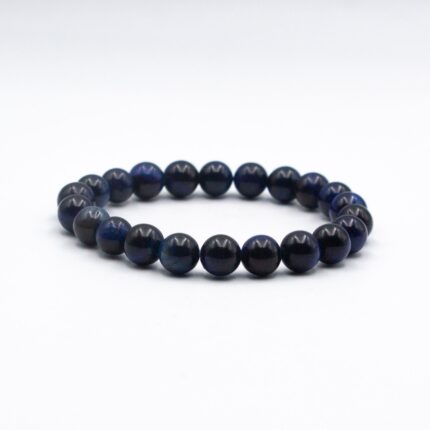
If you'd like to replace your bracelet, our range includes pieces like the golden tiger's eye bracelet, blue tiger's eye bracelet, black tourmaline bracelet, and moonstone bracelet. If you're thinking of wearing more than one stone, our guide to crystal bracelet combinations explains which stones pair well.
Tell us your wrist size and what happened to your old bracelet, and we'll help you choose a size and bead that suits the way you actually wear it.
Bracelet broke and not sure what to do?
Send us a photo of the beads and your wrist size. We'll help you choose a replacement that fits properly.
Questions People Ask
What does it mean when your crystal bracelet breaks?
Physically, it almost always means the stretch cord wore out from age, tension, water, or chemicals. Spiritually, many crystal traditions believe it means the stone absorbed all it could or that a chapter has closed. Both explanations can be true at once, and a break isn't a reliable sign of bad luck.
Is it bad luck if my crystal bracelet breaks?
No. Most crystal traditions actually interpret a break positively, as a sign the stone did its job. Practically, it's usually just worn elastic, which is normal with regular wear.
Can I restring a broken crystal bracelet?
Yes, if the beads are intact. Use pre-stretched elastic cord, check the size before tying, secure it with a surgeon's knot sealed with glue, and hide the knot inside a bead. Cracked or sharp-edged beads are best set aside.
What does it mean when an evil eye bracelet breaks?
In folk tradition, a broken evil eye bracelet is widely believed to have absorbed envy or harmful attention meant for the wearer, and is usually replaced. Views on protective charms differ, especially within Islam, so a trusted religious scholar is the best person to ask if it matters to you.
What should I do with broken crystal beads?
You can restring them, keep them in a dish or pouch, make them into something else like a keyring or charm, or retire them by returning them to the earth. There's no single correct option; it's a personal choice.
Why does my crystal bracelet keep breaking?
Repeated breaks usually point to a bracelet that's too tight, cord that's too thin, sharp bead holes, or regular exposure to water, perfume, and heat. Sizing up slightly, rolling it on rather than pulling, and removing it for water usually solves it.
Should I cleanse my crystals after the bracelet breaks?
That's a personal choice. If you do, pick a stone-safe method: avoid long sunlight exposure for stones that fade, and avoid water or salt soaks for soft or porous stones. Resting beads on clear quartz or using sound are safe for any stone.
How often should a crystal bracelet be restrung?
There's no fixed rule, but many people who wear a bracelet daily restring it roughly once a year, or sooner if it starts feeling looser or the cord looks thin or cloudy.