

Crystal Singing Bowl vs Metal Singing Bowl: Which Should You Buy?
Two genuinely different instruments, not two styles of the same thing — here's how they actually differ, and how to decide between them.
This comparison gets asked about constantly, and it's worth saying upfront: these are two genuinely different instruments that happen to share a name and a general bowl shape, not two style variations of the same product. One is a centuries-old hand-hammered metal craft tradition from the Himalayas. The other is a modern industrial product, invented within the last several decades, made from fused quartz sand. They sound different, cost differently, and suit different purposes — treating this as a simple "which is better" question misses most of what actually matters in choosing between them.
This guide walks through the real, substantive differences between the two — manufacturing, sound, history, price, durability, and practical use — so you can make a genuinely informed choice rather than picking based on which one photographs better online. We'll also be upfront about where our own expertise and inventory sit within this comparison, rather than pretending to be neutral on a product we don't actually sell.
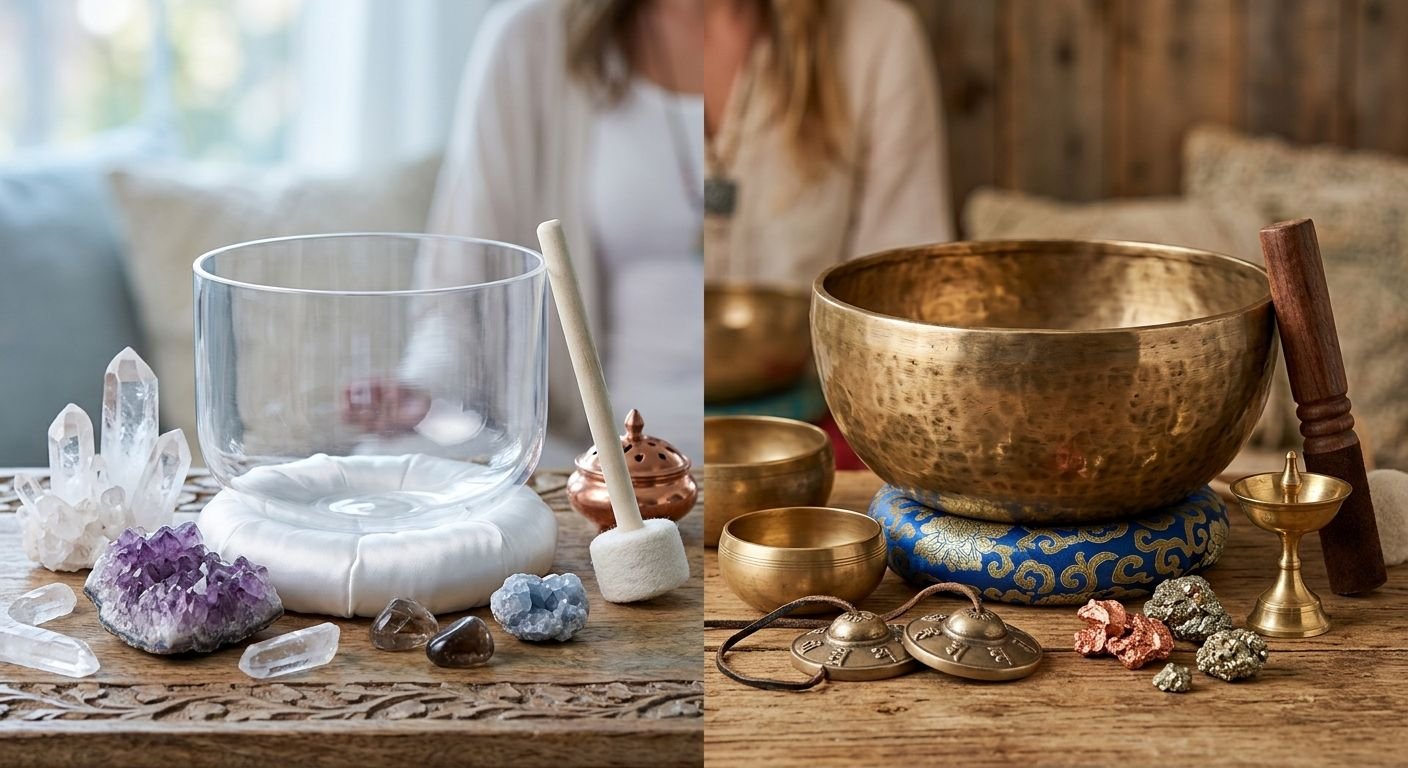
| Factor | Metal Singing Bowl | Crystal Singing Bowl |
|---|---|---|
| Material | Metal alloy (copper, tin, and others) | Fused quartz (silica) |
| Manufacturing | Hand-hammered over hours | Furnace-fused, molded, precision-tuned |
| Sound | Layered, complex overtones | Pure, sustained single tone |
| Typical price | AED 85–450 | Comparable at entry, considerably higher at larger sizes |
| Weight and fragility | Lighter, more impact-resistant | Heavier, more prone to chipping |
| History | Centuries-old tradition | Modern, developed from the 1980s |
| Best suited for | Personal practice, daily meditation, portability | Structured chakra sets, group sound baths |
The Core Difference: Material and Manufacturing
Before getting into sound, price, or which one might suit you better, it's worth starting with the most fundamental distinction: these two instruments are made from entirely different materials, using entirely different production methods, and that single fact explains nearly every other difference covered in this guide.
How a Metal Singing Bowl Is Made
A traditional metal singing bowl — often called a Tibetan or Himalayan singing bowl — starts life as a thick metal disc, cast from an alloy that traditionally combines anywhere from three to more than ten different metals, commonly including copper, tin, iron, and smaller amounts of others. That disc is heated and then hammered, often by more than one craftsperson working in sequence, gradually curving it into the familiar inverted-bell shape. The whole process — heating, hammering, reheating as the metal cools and stiffens, then a final deburring stage to smooth and polish the surface — can take several hours for a single bowl, and it's a technique passed down through generations of artisan families rather than something learned quickly.
Metallurgical analysis of traditional bowls has found compositions varying meaningfully between individual pieces and regions, though a common pattern is roughly 80% copper combined with around 20% tin, sometimes with trace amounts of other metals present depending on the specific ore sources used. This variation between individual bowls is actually part of the appeal for many buyers — no two bowls, even from the same workshop, are ever perfectly identical in composition or tone.
How a Crystal Singing Bowl Is Made
A crystal singing bowl starts from an entirely different point: extremely pure silica sand, heated in an industrial furnace to temperatures above 4,000°C (roughly 7,200°F), then poured into a mold to set into the bowl's shape. The resulting material is a fused, frosted form of quartz — chemically the same silicon dioxide as natural quartz crystal, but produced through an industrial process rather than mined and cut. This method allows manufacturers to tune each bowl quite precisely to a specific musical note during production, which is a meaningfully different approach from how a metal bowl's tone develops.
Some crystal bowl manufacturers also produce colored or specialty versions, adding trace minerals to the silica mixture before fusing to create bowls in different colors, sometimes marketed with a specific gemstone association layered on top of the base crystal properties. This is worth knowing since it means "crystal singing bowl" itself covers some variation in manufacturing detail, not just a single uniform product.
These two manufacturing processes couldn't really be more different — one is a slow, physical, hands-on craft measured in hours of manual labor per piece; the other is a high-temperature industrial process requiring specialized furnace equipment that no traditional artisan workshop would have access to.
Sound Compared: Layered Overtones vs. a Pure Sustained Tone
This is genuinely the most important practical difference, and it's worth understanding why it happens rather than just accepting it as a fact.
A metal bowl's slight structural irregularities — the inevitable, tiny variations in thickness and shape left behind by hand-hammering — cause different parts of the bowl to vibrate at slightly different frequencies simultaneously. This is the physical basis for the layered, complex "singing" hum that metal bowls are known for, sometimes described as several overtones happening at once rather than one clean note. Larger and mid-sized metal bowls can often produce two or three audible frequencies simultaneously, giving the sound its characteristic richness and depth. Smaller metal bowls tend toward a brighter, simpler tone with fewer competing frequencies, while the largest bowls in a range can reveal a genuinely complex, shifting hum that seems to change character the longer you listen to it.
A crystal bowl, by contrast, is manufactured to a much higher degree of physical uniformity, and it's deliberately tuned to a single, specific musical note during production. Played correctly, it produces a purer, more sustained, almost bell-like tone at that one note — often described as sounding more "glassy" or ethereal compared to a metal bowl's warmer, more layered hum. This purity is precisely why crystal bowls are so often described using language like "otherworldly" or "profound" — the near-total absence of competing overtones creates a genuinely different listening experience, closer to a single sustained musical note than a textured hum.
Which Tone Actually Suits Which Purpose
Neither tone is objectively better; they're simply different, and which one resonates with you is a genuinely personal preference. That said, the practical implications differ: a metal bowl's layered complexity tends to reward close, quiet listening, since there's more sonic detail to notice the more attention you give it. A crystal bowl's purer tone tends to project further and cut through ambient noise more cleanly, which is part of why it's favored in some larger or more acoustically challenging spaces.
History and Origin
Metal singing bowls carry a documented history stretching back centuries within Himalayan Buddhist and Hindu spiritual practice, originally serving practical and ceremonial roles — used to mark the beginning and end of meditation, accompany chanting, and mark ritual observance — well before "sound healing" became a phrase used commercially outside monasteries and temples. Antique metal bowls genuinely exist, and some collectors specifically seek out older pieces with real age and provenance.
This long history also means metal bowls carry genuine regional and religious weight beyond their acoustic properties — a connection to a specific, centuries-old craft lineage and spiritual practice that a buyer can trace back through actual documented tradition rather than a marketed backstory. For some buyers, this historical depth is a meaningful part of the appeal in its own right, separate from how the bowl sounds.
Crystal singing bowls are a modern invention by comparison, developed within roughly the last half-century, closely tied to the growth of Western sound healing and sound bath practices from the 1980s onward. This doesn't make crystal bowls any less legitimate as an instrument — they're a genuine, purpose-built tool with real acoustic properties — but it does mean there's no such thing as a genuinely "antique" crystal bowl in the way there can be for metal bowls, since the entire product category simply didn't exist before a few decades ago.
Why This History Still Matters Today
It's worth noting that this historical difference isn't purely academic — it shapes how each instrument is actually marketed and used today. Metal bowls are still commonly framed around their Buddhist and Hindu roots, often incorporating traditional deity motifs and religious symbolism directly into the design. Crystal bowls, lacking that same centuries-deep religious tradition to draw from, are more commonly marketed around contemporary wellness and sound therapy language instead, reflecting the specific modern context they actually emerged from.
Price Compared
Metal bowls generally offer a wider and more accessible price range than crystal bowls. Based on real current pricing across genuinely hand-hammered pieces, a solid, full-featured metal bowl typically runs somewhere between roughly AED 85 and AED 400, depending mostly on size and design complexity — we've broken this down in detail, size by size, in our singing bowl pricing guide.
Crystal bowls, by contrast, generally start around a comparable entry point for the smallest sizes but climb considerably faster as diameter increases, frequently reaching several times the price of a metal bowl of similar size once you move beyond the smallest options. Larger crystal bowls, and those from manufacturers specializing in exceptionally high-purity quartz, can run well into four figures, a price bracket that very few metal bowls ever approach outside of genuine antiques or exceptionally large, elaborately finished pieces.
This price gap comes down directly to the manufacturing difference covered earlier — the specialized furnace equipment, precise temperature control, and individual note-tuning required for a crystal bowl involve a different, more industrially intensive cost structure than hand-hammering, even though hand-hammering itself is far from cheap in terms of skilled labor time.
Why Crystal Bowl Prices Vary So Widely
Within the crystal bowl category itself, price differences are driven heavily by quartz purity, since higher-purity silica sand costs more to source and process than lower-grade material. Precision of tuning is a second major factor — a bowl tuned exactly to a specific note with minimal deviation typically commands a higher price than one with looser tuning tolerance. This is worth knowing if you're comparing crystal bowl listings specifically, since a large price gap between two seemingly similar bowls often reflects one of these two factors rather than an arbitrary markup.
Weight, Fragility and Portability
Metal bowls are generally more forgiving of everyday handling — a bump or minor drop is far more likely to leave a dent than cause real damage, and their comparatively lighter weight for a given size makes them easier to travel with or move between rooms. Crystal bowls are both heavier and more fragile for a comparable size, since fused quartz, while hard, is more brittle than metal and prone to chipping or cracking on a hard impact. This is a genuinely practical consideration if you're likely to travel with your bowl, live somewhere with limited storage space, or simply want something lower-maintenance day to day.
Storage and Transport Considerations
Because of this fragility difference, crystal bowls are typically shipped and stored in padded cases specifically designed to protect them, adding both bulk and cost compared to how a metal bowl is usually packaged. If you're planning to travel regularly with your bowl — bringing it to different practice locations, for instance — a metal bowl's greater resilience to knocks and vibration during transport is a meaningful practical advantage that goes beyond simple weight.
How You Actually Play Each One
Both types are played with a mallet, either struck against the rim or circled around the outer edge to build a sustained tone, but the specific technique and tools differ somewhat. Crystal bowls are typically played with a rubber-tipped mallet, moved in slow, deliberate circles around the rim to build the tone gradually. Metal bowls are more versatile in this regard — they can be struck with a padded mallet for a single resonant tone, or circled with a wooden striker to build the layered "singing" hum, and the choice of striker material genuinely affects the resulting tone in a way that's worth experimenting with. We've covered the specific technique for metal bowls in more detail in our beginner's guide to using a Himalayan singing bowl.
Learning Curve Compared
Neither instrument is difficult to learn, but the two do involve a slightly different initial learning curve. Building a sustained tone on a metal bowl by circling the rim takes a bit of practice to get the pressure and speed right, something we've covered specifically in our beginner's guide. Crystal bowls tend to respond a little more predictably to a consistent circular motion once you find the right speed, since the bowl's uniform manufacturing means less variation in how different points around the rim respond to the mallet compared to a hand-hammered piece with its natural inconsistencies.
Chakra Work and Note-Tuning
Crystal bowls are often marketed and sold specifically tuned to a particular musical note associated with a specific chakra — a C note for the root chakra, for instance — since the manufacturing process allows for that level of precision during production. This makes them popular for practitioners who want to build a structured set matching each of the seven chakras to a specific bowl and note.
Metal bowls approach chakra work differently, relying more on weight and size than a precisely engineered musical note — a larger, deeper-toned bowl is commonly used for grounding, root-chakra-focused work, while smaller, brighter bowls suit the upper, more spiritually-oriented chakras. This isn't an exact science in either case, but it does mean crystal bowls offer a more precisely "tuned" approach to this specific use, while metal bowls offer a looser, more traditional, weight-based approach that's been used this way for considerably longer.
Building a Full Chakra Set
If your specific goal is assembling a full set of seven bowls, one for each chakra, this is where the two categories diverge most in practical terms. A full set of note-tuned crystal bowls represents a significant investment given the per-bowl pricing discussed earlier, while building an equivalent set of metal bowls in a graduated range of sizes is generally more affordable, even though the note-to-chakra correspondence is looser and more traditional than precisely engineered. Some practitioners split the difference by using a single crystal bowl for a specific, important part of their practice — a crown or heart chakra piece, for instance — alongside a broader working set of metal bowls for everything else.
Personal Practice vs. Group Sound Baths
Crystal bowls have become especially popular in larger group sound bath settings, partly because their purer, more sustained tone at a specific note allows several bowls to be played together in an intentional musical arrangement, and partly because their larger sizes project effectively across a bigger room. Metal bowls, with their denser, more layered tone, tend to suit smaller, more intimate settings particularly well — personal meditation, a quiet home practice, or a small group — where the complexity of the sound is more easily appreciated up close rather than needing to fill a large space.
Professional Practitioners Often Own Both
It's worth noting that many professional sound bath facilitators and practitioners don't choose exclusively between the two categories, but instead build a working collection that includes both — crystal bowls for the structured, note-based portions of a session, metal bowls for grounding, opening, or closing segments where their traditional character and layered tone suit the moment better. If you're building toward offering sessions professionally rather than just a personal practice, this combined approach is worth planning for from the start rather than assuming you'll need to choose one category exclusively.
Durability and Longevity
A well-made metal bowl, properly cared for, can realistically last decades or longer — metal simply doesn't degrade under normal handling the way more fragile materials do, and the main risk to longevity is physical impact rather than gradual wear. Crystal bowls are also long-lasting under normal conditions, but their greater fragility means a single significant drop or impact is more likely to end their usable life entirely, rather than simply leaving a cosmetic dent the way a metal bowl typically would.
Everyday Care Differences
Routine care also differs meaningfully between the two. Metal bowls tolerate a fairly wide range of handling and can be wiped clean with a simple soft cloth, developing a natural patina over years of use that many owners consider part of the bowl's character. Crystal bowls require gentler handling day to day, generally cleaned with a soft cloth and mild soap rather than anything abrasive, and are typically kept on a padded stand or cushion specifically designed to prevent the base from chipping against a hard surface — a risk that's much less of a concern for a metal bowl.
Authenticity Considerations for Each
Both categories have their own specific authenticity concerns worth knowing before you buy. For metal bowls, a growing share of what's sold commercially today is machine-stamped rather than genuinely hand-hammered, sometimes deliberately finished to look aged or antique — worth checking carefully, since the sound and craftsmanship differ meaningfully between the two, a topic we've covered in full in our handmade versus machine-made comparison.
For crystal bowls, the main consideration is quartz purity and manufacturing quality rather than "authenticity" in the antique sense, since — as covered earlier — there's no genuinely old crystal bowl to imitate in the first place. Higher-purity quartz and more precise tuning during manufacturing generally command a real premium, and significant price variation between crystal bowl sellers often reflects genuine differences in these factors rather than arbitrary markup.
Questions Worth Asking Either Type of Seller
Regardless of which category you're considering, a seller who can speak specifically about construction — hand-hammered versus machine-stamped for a metal bowl, or quartz purity and tuning tolerance for a crystal bowl — is giving you more useful information than one relying on vague claims like "authentic" or "premium" without further detail. This single habit, asking for specifics rather than accepting general marketing language, is probably the single most useful authenticity check across both categories.
Sourcing and Environmental Considerations
This is a less commonly discussed angle, but worth including for a genuinely complete comparison. Metal bowls rely on mined metal ores and traditional artisan labor, meaning their environmental footprint is tied largely to metal mining and the energy used in the hammering and heating process, spread across a labor-intensive production method that uses relatively modest energy per bowl at any single stage. Crystal bowls require sustained furnace temperatures above 4,000°C to fuse silica, an energy-intensive industrial process by comparison, though manufacturers vary considerably in how they source energy for this stage.
Neither category has a clearly superior environmental profile in any simple sense — it really depends on specific sourcing and production choices made by an individual workshop or manufacturer, which most buyers have limited visibility into either way. If this is a genuine priority for you, it's worth asking a specific seller directly about their sourcing and production practices rather than assuming either material category is automatically the more responsible choice.
Which Should You Actually Buy
If you're drawn to a rich, complex, warmer tone, want a lower-cost entry point, value durability and portability, or feel a pull toward the centuries-old craft tradition specifically, a metal bowl is the more natural fit. If you're specifically drawn to a purer, more sustained single tone, plan to build a structured set tuned to specific notes or chakras, or are working toward larger group sound bath sessions where projection matters more than intimacy, a crystal bowl is worth the higher investment and the extra care it requires.
Neither choice is more "correct" or more spiritually legitimate than the other — this is genuinely a matter of which sound and which practice style suits you, not a hierarchy with one clearly superior option.
A Simple Set of Questions to Ask Yourself
If you're still undecided, a few direct questions can help clarify the choice. Do you want a rich, textured tone to sit with quietly, or a pure, sustained note that cuts cleanly through a room? Is budget a significant factor, or is cost less important than getting the exact sound and note-tuning you want? Will you be traveling with this bowl regularly, or keeping it in one fixed, protected space? Are you drawn more to a centuries-old craft tradition, or to a modern, purpose-built sound therapy tool? Your honest answers to these four questions will point you toward one category far more reliably than trying to determine which bowl is objectively "better" in the abstract.
A Few Real-World Scenarios
To make this more concrete: someone building a quiet morning ritual before work, wanting a single bowl that's easy to keep on a bedside table and pick up without ceremony, is almost always better served by a modest, mid-weight metal bowl. Someone training to lead sound bath sessions professionally, planning to serve a room of twenty or more people, will likely find a set of tuned crystal bowls more suited to that specific goal, even at the higher cost. Someone drawn to the idea primarily through interest in Himalayan Buddhist or Hindu spiritual tradition specifically, rather than the broader modern wellness movement, will almost certainly find more meaning in a genuine hand-hammered metal bowl than in a crystal alternative with no connection to that history. None of these scenarios is more valid than another — they're simply different starting points that point toward different answers.
Cleansing and Energetic Maintenance Compared
For those who incorporate energetic cleansing into their practice, both bowl types are treated similarly — moonlight, sage or palo santo smoke, and sound cleansing using another instrument are all common approaches used for either. There's no specific tradition suggesting one material requires different energetic care than the other, though crystal bowl owners are generally advised to avoid extreme temperature changes during cleansing specifically because of the material's sensitivity to thermal shock, a risk that doesn't really apply to metal bowls in the same way.
Can You Use Both Together
Yes, and plenty of practitioners do exactly this rather than choosing one exclusively. A metal bowl for personal daily meditation and a crystal bowl reserved for structured chakra work or occasional group sessions is a genuinely common combination, since the two instruments serve different enough purposes that owning both isn't redundant the way it might be with two very similar products. There's no rule against layering both sounds within the same broader practice, either, for those who want to experiment with how the two tones interact.
A Practical Way to Combine Both on a Budget
If cost is a concern but you'd still like to experience both, a reasonable approach is starting with a single, mid-range metal bowl for daily use, then adding one small crystal bowl later specifically to experience the different tone quality, rather than trying to build a full set of either category all at once. This staged approach lets you genuinely compare the two sounds side by side in your own practice before committing further to either direction.
Where to Buy Each
It's worth being transparent here rather than pretending otherwise: our own collection focuses specifically on genuine, hand-hammered Himalayan metal bowls, sourced directly through artisan relationships in Nepal — we don't currently carry fused quartz crystal bowls. If a metal bowl is what you're after, based on everything covered in this comparison, you're in the right place. If you've decided a crystal bowl specifically suits your practice better, that's a different, specialized product category worth researching through sellers who focus on that manufacturing process specifically, applying the quartz-purity and tuning-precision considerations covered above.
What to Look for in a Crystal Bowl Specialist
If you do go looking for a crystal bowl elsewhere, the same principle that applies throughout this guide holds: a specialist seller who can speak in specific detail about quartz purity, tuning precision, and manufacturing process is a better bet than one relying on generic wellness marketing language. The same skepticism toward vague claims that serves you well when buying a metal bowl applies just as much here.
Collector and Long-Term Value Considerations
For buyers thinking beyond personal use toward long-term or collector value, the two categories diverge meaningfully. Genuine antique metal bowls, with real documented age and provenance, can hold or even appreciate in value among collectors specifically interested in Himalayan craft history — a market that simply doesn't exist for crystal bowls, given their recent origin. New, non-antique metal and crystal bowls alike are generally best thought of as tools for practice rather than investments, since neither typically appreciates significantly in the way a genuine antique might.
That said, a well-maintained bowl of either type, kept in good condition, tends to hold a reasonable resale value if you ever decide to part with it, particularly for larger, well-known designs from a reputable source. This is a secondary consideration for most buyers, but worth knowing if you're deciding between a larger investment in either direction.
Common Myths About Both Types
A few misconceptions come up repeatedly in online discussion of this comparison, worth addressing directly.
Myth: Crystal Bowls Are Always "More Powerful"
This claim shows up frequently in crystal bowl marketing specifically, but it's more a matter of style than intensity. A crystal bowl's purer tone can feel more piercing or immediate to some listeners, while a metal bowl's layered complexity feels more enveloping to others — neither is measurably more "powerful" in any objective sense, and the perception genuinely varies from person to person.
Myth: Metal Bowls Are Always Cheap Imports
Because low-cost, machine-made metal bowls are common at the entry level of the market, some assume all metal bowls are mass-produced imports. Genuinely hand-hammered metal bowls represent a completely different tier of craftsmanship and cost, as covered throughout this guide, and dismissing the whole category based on its cheapest examples overlooks centuries of genuine artisan tradition.
Myth: You Need Both to Have a "Complete" Practice
Marketing from sellers who carry both categories sometimes implies that a serious practice requires owning both types. In reality, plenty of long-term practitioners use only one category for their entire practice without ever feeling they're missing something essential. Owning both is a genuine option for those drawn to it, not a requirement for a legitimate practice.
Myth: A Bigger Bowl Is Always Better
Size affects depth and volume of tone, but "bigger" doesn't automatically mean "better" for every use case. A large bowl that overwhelms a small personal meditation space, or a large crystal bowl bought for solo home use when a smaller one would have suited the room and the practice just as well, isn't a better purchase simply because it cost more or measures larger. Matching size to your actual space and use case matters more than defaulting to the largest option available in either category.
Real Metal Bowls Worth Considering
If a metal bowl is the direction you're leaning, here's a genuine spread from our current range.
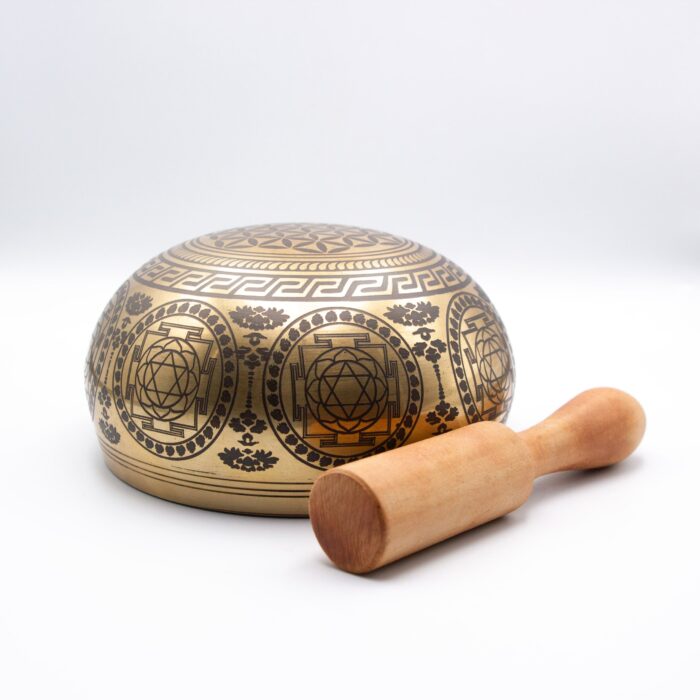
Bodhisattva Singing Bowl (556g)
AED 399
Our largest and heaviest bowl, with a genuinely deep, layered, room-filling tone — the closest metal comparison to a crystal bowl's presence in a larger space.
View Product
Buddha Singing Bowl, Golden Blue (436g)
AED 300
A genuinely versatile mid-weight bowl, well suited to daily personal meditation rather than large group settings.
View Product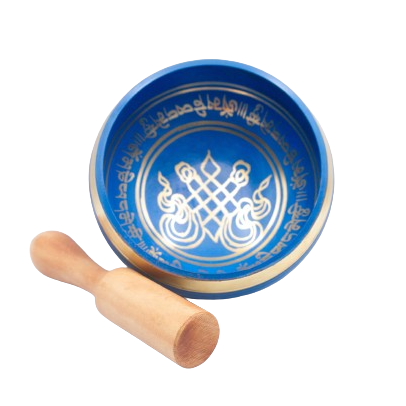
Vibrant Blue Design Bowl (385g)
AED 175
A genuinely affordable entry point into hand-hammered metal bowls, without the price jump that crystal bowls involve at comparable sizes.
View Product
Five Buddha Bowl, Blue & Gold (350g)
AED 85
The most budget-friendly way to try a genuine hand-hammered metal bowl before deciding whether this is the right sound for your practice.
View ProductBrowse the complete range in our singing bowl collection, or read our complete singing bowl buying guide for more on choosing size and design.
Decided a metal bowl is right for you?
Tell us what you're using it for, and we'll point you to the right size and design rather than the most expensive option.
Questions People Ask
Is a crystal singing bowl better than a metal singing bowl?
Neither is objectively better. Crystal bowls offer a purer, more sustained single tone and precise note-tuning, while metal bowls offer a richer, layered tone, greater durability, and a lower typical price. The right choice depends on your practice and sound preference.
Why are crystal singing bowls more expensive than metal ones?
Crystal bowls require specialized furnace equipment to heat silica above 4,000°C and precise tuning during manufacturing, an industrially intensive process that generally costs more than hand-hammering, especially as bowl size increases.
Can a crystal singing bowl be antique?
No. Crystal singing bowls are a modern product developed within the last several decades, so there's no genuinely antique crystal bowl in the way there can be for centuries-old metal bowls.
Which type is better for a group sound bath?
Crystal bowls are generally more popular for larger group sound baths, since their purer, more sustained tone at a specific note projects well and allows multiple bowls to be played together in a musical arrangement.
Are crystal bowls more fragile than metal bowls?
Yes. Fused quartz is more brittle than metal and can chip or crack from a significant impact, while metal bowls are more likely to simply dent under similar circumstances.
Do you sell crystal singing bowls?
No, our collection focuses specifically on genuine, hand-hammered Himalayan metal singing bowls sourced through artisan relationships in Nepal.
Can I use a crystal bowl and a metal bowl in the same meditation session?
Yes, there's no restriction against combining both, and many practitioners do so intentionally, using each instrument for different parts of a session based on the tone and intention they're working with.
Which is easier for a beginner to learn on?
Both are approachable for beginners. Crystal bowls tend to respond a little more predictably to a consistent circular motion due to their manufacturing uniformity, while metal bowls require slightly more practice to build the layered sustained tone, though neither takes long to learn.