

Carnelian: Meaning, Benefits and Who It Actually Suits
A warm, fiery stone worn for over five thousand years. Here’s what carnelian means, what people believe it does, and an honest look at who it really suits.
Carnelian is one of the oldest gemstones people have worn. It was carved into seals in ancient Mesopotamia, strung into beads in the Indus Valley, set in Egyptian amulets and Roman signet rings, and it remains a familiar stone across the Gulf, where it’s widely known as aqeeq. Its warm orange-to-red glow is instantly recognisable. But most guides to carnelian meaning and benefits stop at a list of qualities, “courage, creativity, motivation”, and tell you everyone should wear it. That isn’t very useful. This guide explains what carnelian actually is, the history behind its reputation, the benefits people traditionally associate with it, and then gets practical: who carnelian genuinely suits, who might prefer a different stone, how to wear it, and how to make sure you’re buying real carnelian rather than dyed agate.
Carnelian Meaning and Benefits: The Short Answer
Carnelian is a translucent orange to reddish-brown variety of chalcedony, a form of quartz, coloured by iron. Its meaning in modern crystal traditions centres on warmth, courage, motivation and creativity, and it’s often called a stone of action. The carnelian benefits people describe include confidence, energy, drive to start things, and creative spark; these are traditional beliefs, not proven effects. Carnelian suits people who want a bold, warm-coloured stone for everyday wear, anyone drawn to its themes of confidence and momentum, creatives and people starting something new, and anyone who needs a durable stone that tolerates daily handling and water. People looking mainly for a calming, quiet stone may prefer amethyst or moonstone instead. Hardness 6.5–7 makes it practical for bracelets, rings and tasbih alike.
What Carnelian Actually Is
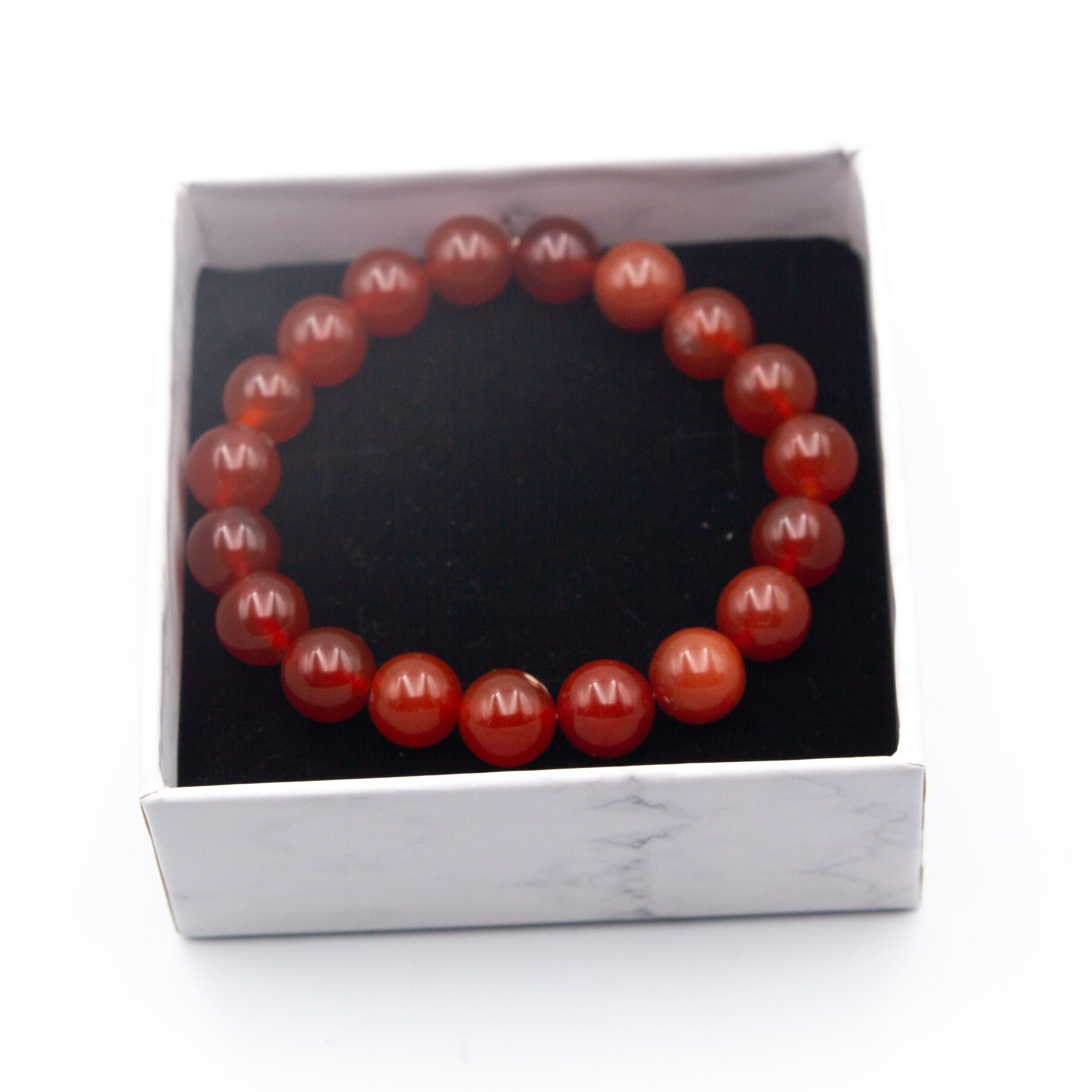
Carnelian belongs to the chalcedony family, the same group as agate, onyx and chrysoprase. Chalcedony is quartz made of microscopic crystals packed tightly together, which is why carnelian looks smooth and waxy rather than glassy and faceted like a clear quartz point.
| Property | Carnelian | Why It Matters |
|---|---|---|
| Mineral family | Chalcedony (microcrystalline quartz) | Tough, dense and long-lasting |
| Colour | Pale orange to deep red-brown | Comes from iron oxides in the stone |
| Hardness | 6.5–7 on the Mohs scale | Resists everyday scratches; good for daily wear |
| Lustre | Waxy to glassy when polished | Takes a beautiful, smooth polish |
| Transparency | Translucent | Light passes through; a key way to tell it from jasper |
| Water | Water-safe | Fine with handwashing and wudu |
Carnelian, sard and agate
The names overlap. Lighter, brighter orange-red chalcedony is usually called carnelian, while darker brownish-red material is traditionally called sard; the boundary is subjective and many sellers use “carnelian” for both. When carnelian shows visible banding, it’s often sold as red or carnelian agate. All are close relatives with the same hardness and care.
Carnelian and aqeeq
In Arabic, Urdu and Persian, the word aqeeq covers carnelian and closely related agates, and it carries special meaning in Islamic tradition. We’ve covered that subject in its own guide: aqeeq stone meaning, benefits and how to spot a real one. This page focuses on carnelian more broadly.
Carnelian Through History
Few stones have been used as continuously as carnelian. Its history helps explain the meanings attached to it today.
Mesopotamia and the Indus Valley. Carnelian beads were treasured in ancient Mesopotamia, and some of the finest came from the Indus Valley civilisation, where craftsmen developed techniques to drill long beads and decorate them with etched white patterns. These beads travelled along ancient trade routes, including through the Gulf region, linking South Asia with Mesopotamia thousands of years ago.
Ancient Egypt. Egyptians used carnelian widely in jewellery and amulets, and its red colour was associated with life and vitality.
Greece and Rome. Carnelian was a favourite for engraved seal stones and signet rings. A practical reason is often given: hot sealing wax doesn’t stick to carnelian, so a carved seal pressed cleanly into wax.
India’s bead-making tradition. The Khambhat (Cambay) region of Gujarat has worked carnelian and agate for centuries. Craftsmen there have long heated stones to deepen and even out their red tones, a traditional technique that’s still used today.
The Islamic world. Carnelian and agate rings, often engraved, have long been worn across the Muslim world, a tradition explained in our aqeeq guide.
This long association with seals, signets and amulets is part of why carnelian is linked today with confidence, identity and taking action: it was the stone people literally put their name to.
Carnelian Meaning Today
In modern crystal practice, carnelian meaning is built around warmth and forward energy. The most common associations are:
- Courage and confidence: standing up, speaking up, stepping forward.
- Motivation and action: getting started, overcoming procrastination, following through.
- Creativity: sparking ideas and creative expression.
- Vitality and warmth: energy, enthusiasm and zest for life.
- The sacral chakra: in Western chakra systems, carnelian’s orange colour links it to the sacral chakra, associated with creativity and emotion. (Some Indian sources link red carnelian to the root chakra instead.) Our 7 chakra guide explains the system.
These meanings come from symbolism and tradition. Carnelian’s colour, the colour of fire, sunsets and embers, does a lot of the work: people naturally connect it with warmth and energy.
Carnelian Benefits: Traditional Beliefs
The carnelian benefits below are what people traditionally believe and report from their own experience. There is no scientific evidence that carnelian changes mood, energy or health. For many people, the value lies in using the stone as a personal reminder of an intention.
1. A boost of confidence
Carnelian’s best-known association is confidence. People wear it before interviews, presentations, difficult conversations or a first day somewhere new. Even if you see it purely as symbolism, a stone you’ve chosen to represent courage is a tangible reminder to show up the way you want to.
2. Motivation and getting started
Often called a “stone of action”, carnelian is linked to motivation and overcoming procrastination. Some people keep a carnelian on their desk as a cue to start the task they’ve been avoiding.
3. Creativity
Artists, writers, designers and makers often choose carnelian for its association with creative flow. Its warm colour is linked to playfulness and expression.
4. Warmth and vitality
Carnelian is traditionally associated with energy and enthusiasm, a stone for when you feel flat or stuck.
5. Protection
Historically, carnelian was worn as a protective amulet in several cultures. Today it’s sometimes included among protective stones alongside darker stones like black onyx or tourmaline. Our guide to crystals for the evil eye covers protection beliefs in more depth.
A note on health claims: you’ll find websites claiming carnelian treats fertility problems, arthritis, depression or addiction. There’s no evidence for any of these, and carnelian should never replace medical care. If you’re dealing with a health concern, please see a qualified professional.
Who Carnelian Actually Suits
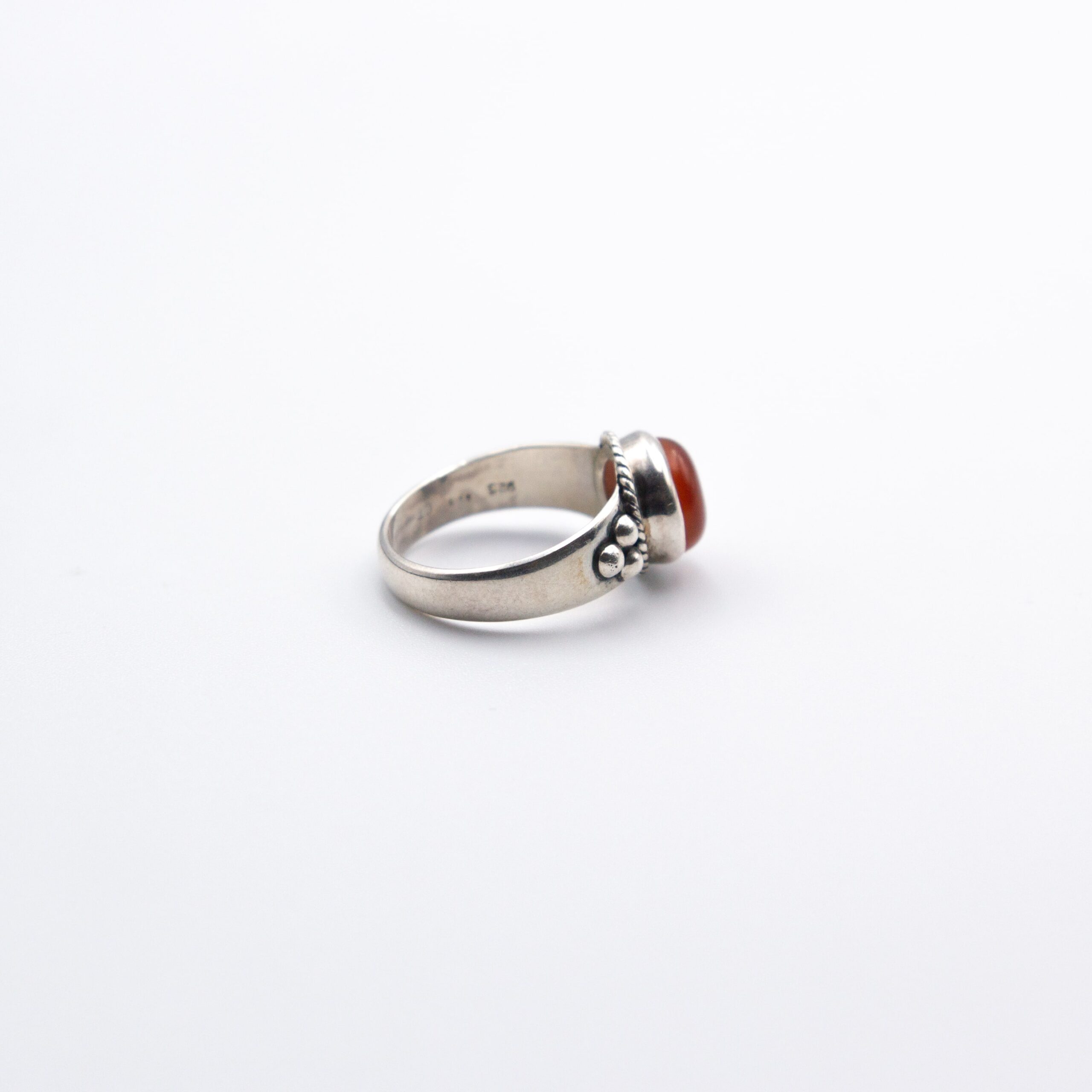
Instead of saying “carnelian suits everyone”, here’s a practical way to decide. Carnelian is likely a good fit if one or more of these describes you.
Who should wear carnelian, by intention
- You’re starting something new: a job, a business, a course, a move. Carnelian’s themes of courage and momentum fit beginnings.
- You want more confidence at work, in public speaking, or socially.
- You procrastinate and want a visual cue to take action.
- You work creatively and like the idea of a stone associated with expression.
- You’re coming out of a low, flat period and want something warm and energising as a symbol. (If low mood persists, talk to a professional too.)
By lifestyle: practical suitability
- Everyday wearers. At hardness 6.5–7, carnelian handles daily wear far better than soft stones like turquoise or lapis lazuli.
- People who wash their hands often or make wudu. Carnelian is water-safe, so you don’t need to remove a bracelet or ring every time.
- Active people. It’s tough enough for a busy day, though, like any stone, it can chip if knocked hard.
- Tasbih users. Its durability and smooth, cool feel make it excellent for prayer beads handled hundreds of times a day.
- Anyone in the UAE climate. Carnelian is reasonably colourfast and stable in heat compared with sun-sensitive stones like amethyst or rose quartz. (Dyed imitations are a different story; see below.)
By style: how it looks on you
- Warm palettes. Carnelian pairs naturally with gold, rose gold, copper and warm neutrals: beige, cream, brown, olive and white.
- Silver lovers too. Deep red carnelian in silver gives a classic, vintage look, which is why it’s so common in traditional rings.
- Every skin tone. Carnelian’s range, from pale apricot to deep red-brown, means there’s a shade that flatters almost everyone. Lighter orange tends to pop on deeper skin tones; deeper red tones look rich on fair and olive skin.
- Men and women alike. Carnelian has been worn by men for millennia, particularly in rings and seals. A 10mm carnelian bracelet looks bold and masculine; a delicate pendant looks elegant. Our crystal bracelet gift ideas for men includes more ideas.
As a gift: who it suits to receive
Carnelian makes a thoughtful gift for moments of beginning and effort: a graduation, a new job, a business launch, someone preparing for exams or a big presentation, or a friend returning to work after time away. Its message is easy to explain, “for courage and a good start”, and its durability means the gift will actually get worn. For someone who prays with a tasbih, a carnelian tasbih is a gift that combines a traditional stone with daily use.
Who Might Choose a Different Stone
Being honest about this is more helpful than claiming any stone suits everyone. In crystal traditions, carnelian is considered an energising, “warming” stone. You might prefer something else if:
- You’re mainly looking for calm or better sleep. Traditional practice usually points to calmer stones such as amethyst, moonstone or rose quartz for bedtime, and some people prefer not to wear energising stones at night. See our guides to amethyst and moonstone.
- You feel already overstimulated or restless and want something grounding. Many people choose smoky quartz or black stones for that. Our smoky quartz guide explains why.
- You prefer cool, understated colours. Carnelian is unmistakably warm. If your wardrobe is blues, greys and silver, aquamarine, clear quartz or blue tiger’s eye may feel more like you.
- An astrologer has advised against it. In Vedic astrology, red stones are linked to Mars, and some practitioners advise caution with them depending on your chart. If you follow that system, it’s worth asking your astrologer.
None of this is a rule. Plenty of people wear carnelian during the day for motivation and switch to a calmer stone in the evening. Our guide to crystal bracelet combinations covers how people balance energising and calming stones.
Carnelian and the Zodiac
Carnelian appears in several astrological traditions, but they don’t agree with each other, so it’s worth seeing them side by side.
| Tradition | Common Association | Note |
|---|---|---|
| Western crystal astrology | Leo, Aries and Virgo are the signs most often linked | Lists vary between writers; fire signs come up most |
| Birthstone lists | Sometimes listed as an alternative for July or August | Not an official modern birthstone |
| Vedic-inspired practice | Linked by some sellers to Mars (Mangal) | Not one of the nine classical navaratna; follow your astrologer’s advice |
| Chakra systems | Sacral chakra (Western); root chakra in some Indian sources | Colour-based association |
If you follow astrology, use the system you trust. If you don’t, the simplest guide is the one in the previous sections: your intention, your lifestyle and whether you love how it looks.
How to Wear Carnelian
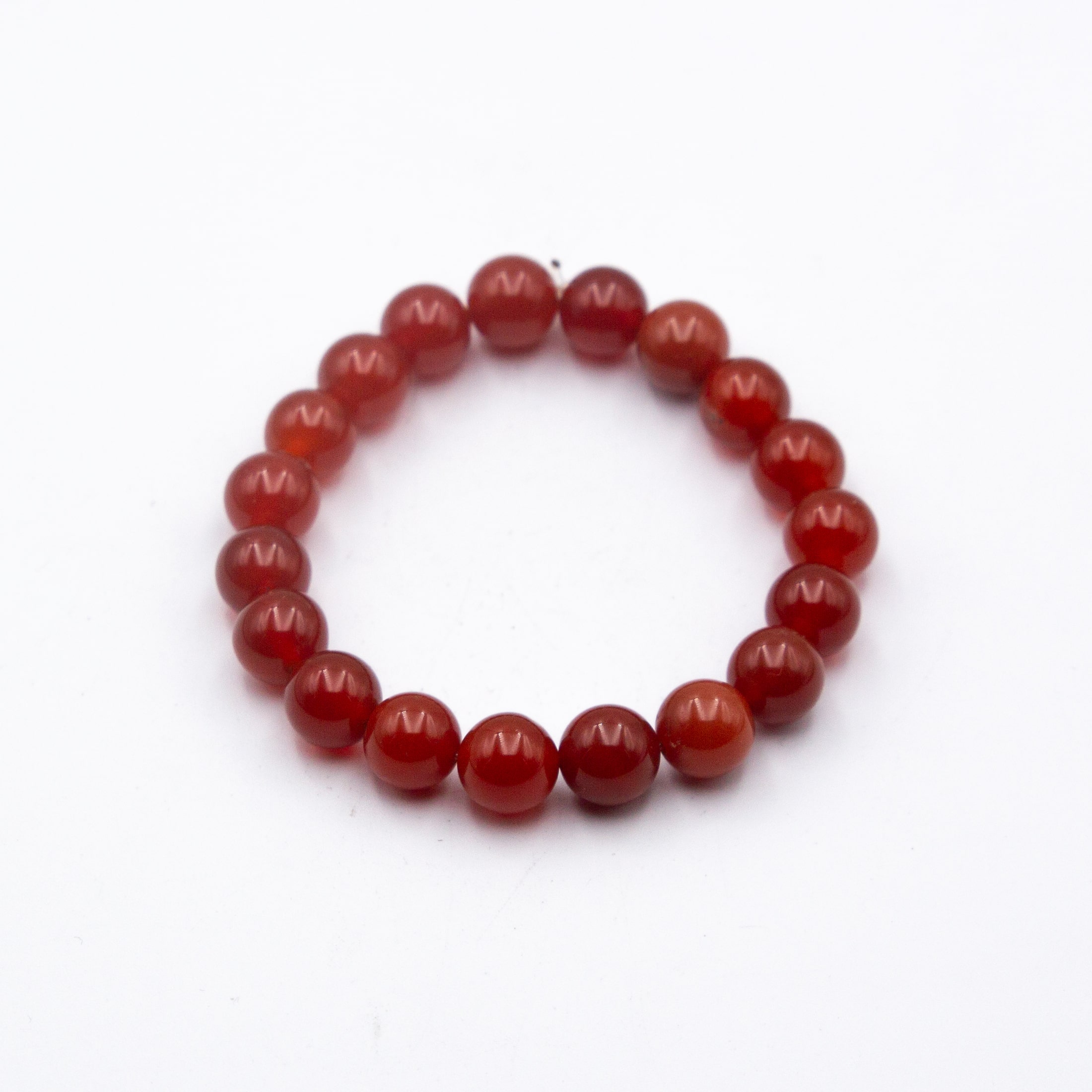
As a bracelet
The most popular way to wear carnelian. It keeps the stone in view as a reminder of your intention. Bead size changes the look: 8mm is versatile and subtle, 10mm is bold. Our crystal bracelet size guide helps you get the fit right.
Which wrist?
In popular crystal practice, the left wrist is said to “receive” energy and the right to “send” it out. Because carnelian is associated with action and putting yourself forward, some people wear it on the right. Others wear it on whichever wrist is comfortable. There’s no evidence either way, so choose what feels right. Our tiger’s eye wrist guide explains the belief in more detail.
As a ring
Carnelian rings have the longest history of all, from Roman signets to traditional aqeeq rings. Rings take knocks, so a sturdy setting and a cabochon (smooth, domed) cut are practical. Our guide to crystal stone rings covers settings and sizing.
As a pendant
Worn close to the heart or at the base of the throat, a carnelian pendant is a quieter, elegant option, and it’s easy to hide under clothing if you prefer.
As a tasbih
Carnelian is one of the most traditional stones for prayer beads. Its smooth, cool, durable beads are ideal for dhikr. See our crystal tasbih buying guide and tasbih bead size guide.
On your desk or in your space
A tumbled carnelian or small piece on a desk, in a studio or near the entrance of a home office is a popular way to keep its themes of motivation and creativity in view. Our room-by-room crystal placement guide has more ideas.
Stones That Pair Well With Carnelian
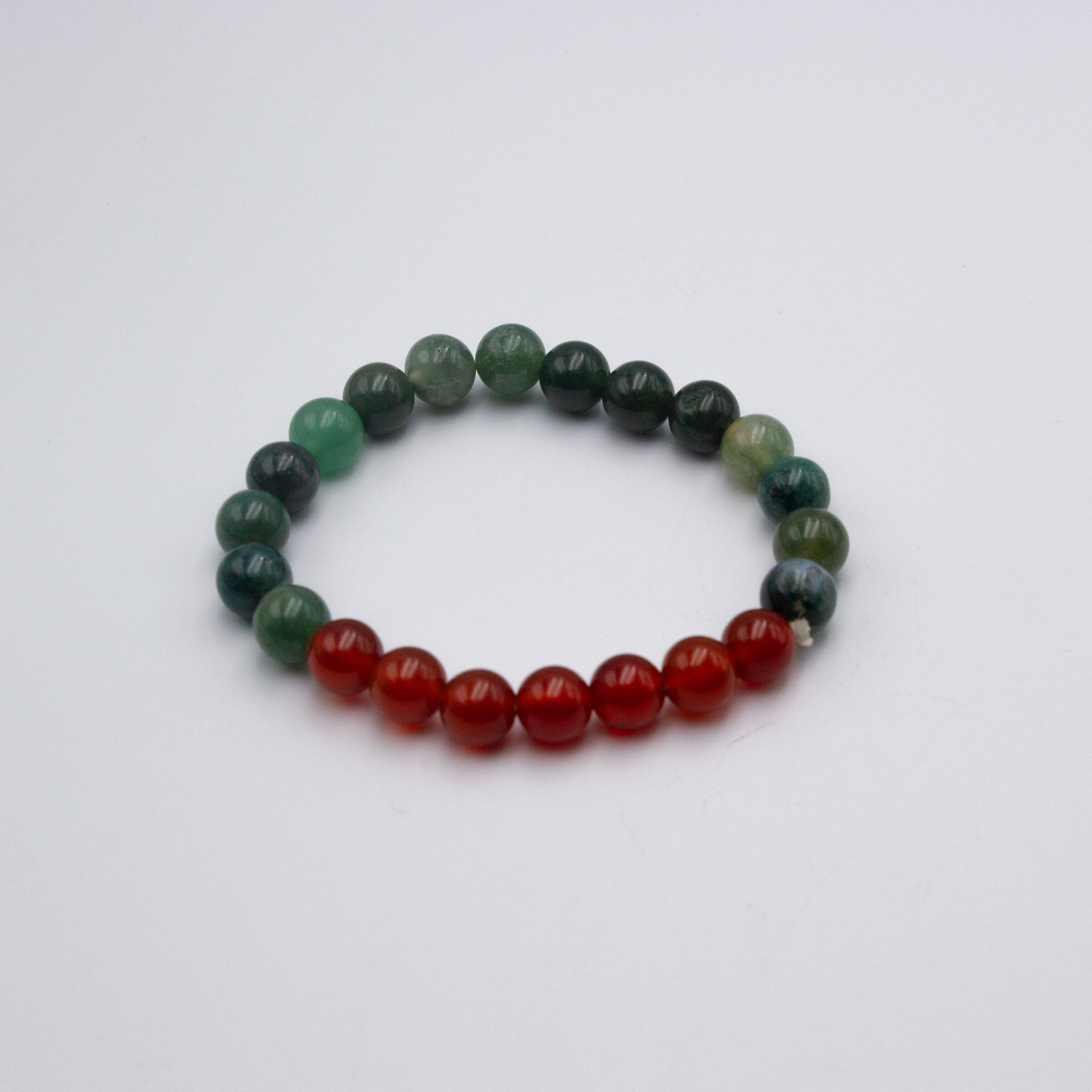
Carnelian combines well with stones that either amplify its warmth or balance it.
- Citrine: both are warm, sunny stones associated with energy and abundance. A combination for ambition. See our citrine guide.
- Tiger’s eye: associated with focus and grounded confidence; together they’re a classic “confidence” pairing.
- Green aventurine: linked with luck and opportunity; with carnelian it represents seizing chances. Our green aventurine guide explains more.
- Clear quartz: often described as an amplifier, it pairs with almost anything.
- Smoky quartz or black onyx: grounding stones that balance carnelian’s fiery energy.
How to Choose a Good Carnelian
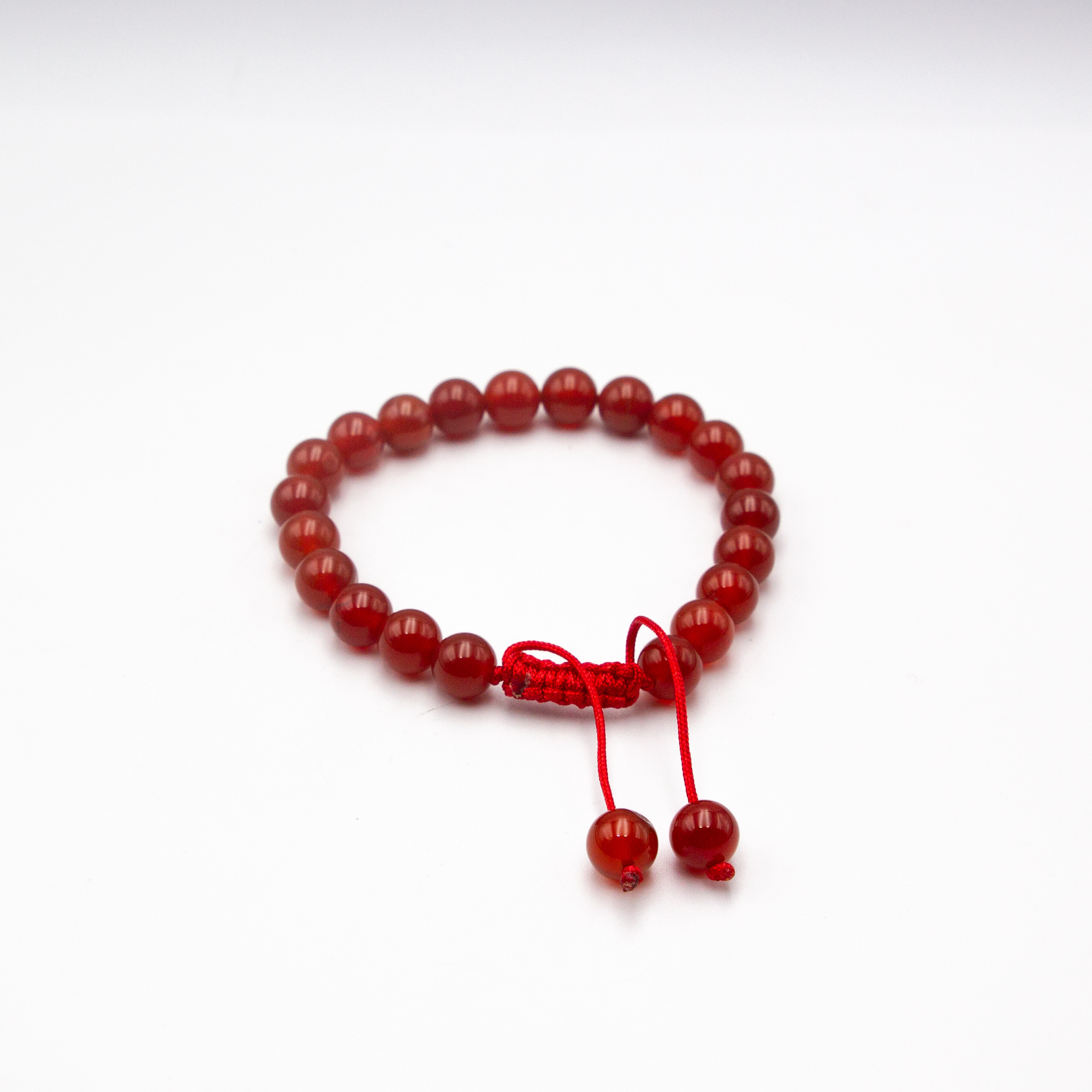
Carnelian quality varies widely, and a few minutes of looking makes a real difference to what you end up with.
Colour. There’s no single “best” shade; it comes down to taste. Bright, clear orange-red with good translucency is generally the most sought after. Deep red-brown (sard) is classic and understated, while pale apricot is softer and more delicate. What matters more than the exact shade is that the colour looks natural, with gentle variation rather than flat, painted-looking uniformity.
Translucency. Good carnelian glows when light passes through it. Very opaque, dull beads are often lower grade, or may be a different stone such as red jasper.
Polish. Beads and cabochons should feel smooth and look glossy, without dull patches, pits or scratches.
Cracks and chips. Small natural lines are normal in chalcedony, but deep cracks that catch your fingernail weaken a bead and can collect dirt or dye. Check around drill holes in particular, where chips are most common.
Construction. For bracelets, check the elastic or thread looks strong and the beads sit evenly. For rings, check the stone is held securely and the setting doesn’t rock. For tasbih, look at the knotting and the imam bead.
The seller. A seller who names the stone clearly, discloses whether it may be heat-treated or dyed, and answers questions is giving you real information. A vague “red crystal” listing with a very low price is a reason to ask more.
Real Carnelian vs Dyed Agate
Carnelian is affordable, but it’s also one of the most frequently imitated stones, usually with dyed agate or glass. It’s also important to understand the difference between heating and dyeing.
Heat treatment vs dyeing
Much carnelian on the market has been heated to deepen and even out its colour. This is a long-standing, widely accepted practice, especially in India; it changes the iron already in the stone and is stable. Dyeing is different: pale or grey agate is soaked in dye to make it look orange or red. Dyed agate is still natural agate, but it’s not natural-colour carnelian, and the colour can fade or bleed over time.
How to check
- Hold it to the light. Natural carnelian shows soft, cloudy colour variation, often slightly lighter and darker zones. Dyed agate often shows sharp, stripy bands with colour concentrated along the bands or in cracks.
- Look at the drill holes and fractures. Dye collects in holes and cracks, making them look darker or more intense than the rest of the bead.
- Watch for unnaturally uniform colour. A strand where every bead is the identical, intense shade can indicate dye.
- Feel the temperature. Stone feels cool and stays cool longer than glass or plastic.
- Check translucency vs red jasper. Shine a phone torch through a bead. Carnelian glows; red jasper is opaque and blocks the light.
- Look for bubbles. Round air bubbles indicate glass.
For more on spotting imitations, see our guide to choosing an authentic crystal.
Caring for Carnelian
Carnelian is one of the easier stones to look after.
- Cleaning: wipe with a soft cloth, or wash gently in lukewarm water with a drop of mild soap, then dry. On a bracelet or tasbih, keep moisture off the cord where possible and dry fully.
- Avoid: harsh chemicals, bleach, and ultrasonic cleaners, especially for jewellery with cracks or dyed stones.
- Storage: keep it away from harder stones and metal that might scratch it, and away from softer stones it might scratch.
- Heat and sun: natural carnelian is generally stable, but don’t leave jewellery in a hot car; heat weakens cords and elastic. Our crystals in UAE heat guide covers this.
- Spiritual cleansing: if you follow these practices, carnelian tolerates most methods: moonlight, sound, smoke, or a brief rinse. See how to charge crystals in moonlight.
For carnelian tasbih specifically, see how to clean and care for a gemstone tasbih.
Carnelian at Alpine Crystals
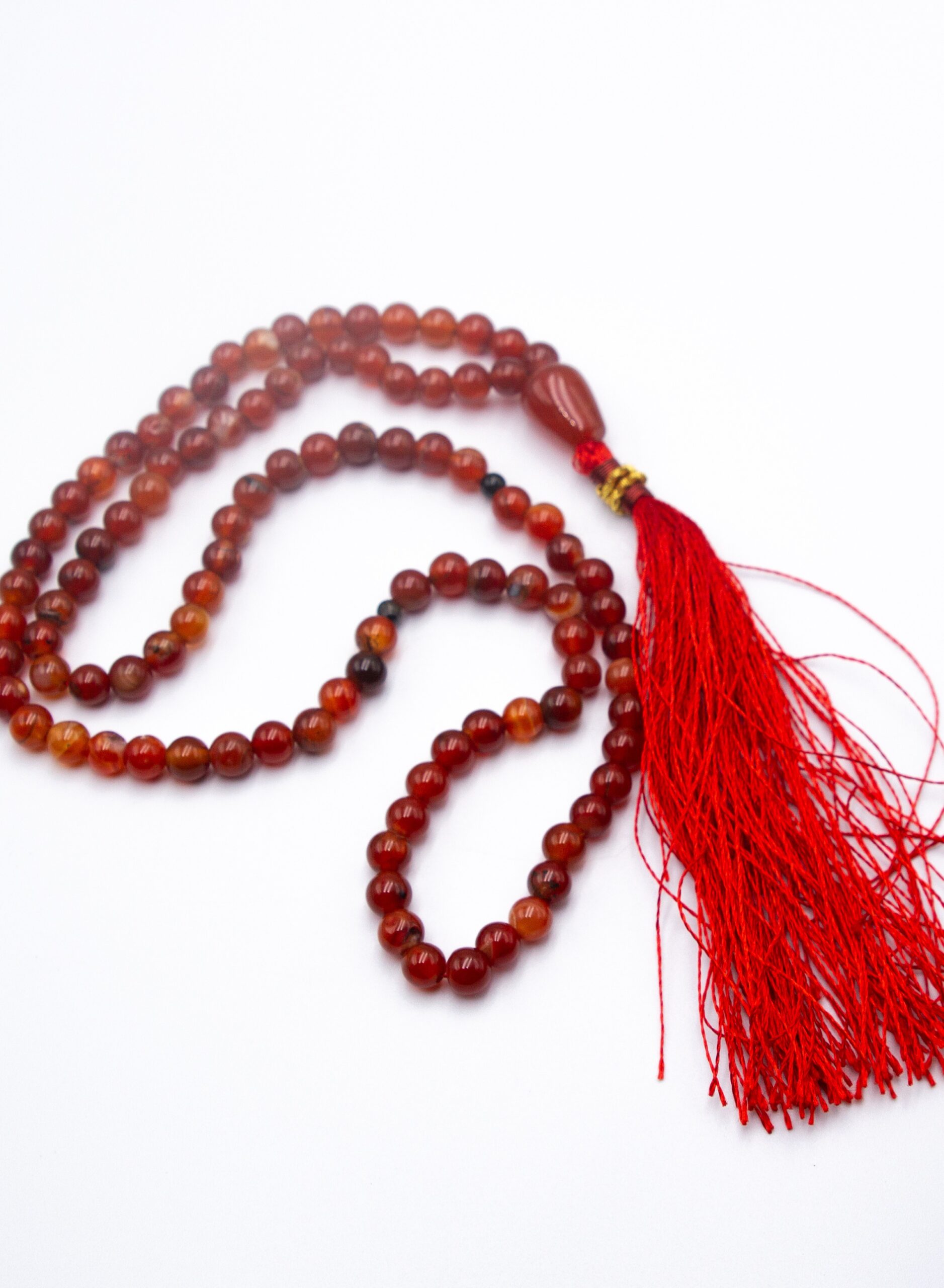
Our carnelian range covers every way of wearing it:
- Bracelets: the 10mm Red Carnelian Bracelet, the 8mm Red Carnelian Bracelet, and the Green Aventurine and Red Carnelian Bracelet.
- Ring: the 925 Sterling Silver Red Carnelian Ring.
- Tasbih: the Red Carnelian Tasbih (10mm, 33 beads) and the Red Carnelian Tasbih (6mm, 99 beads).

Browse everything in our natural crystal collection. Stock changes, so check each product page for availability. Orders over AED 150 ship free within the UAE, usually in 1–2 days.
💬
Not sure if carnelian suits you?
Tell us what you’re hoping for and how you’d like to wear it, and we’ll help you choose the right carnelian piece.
Is Carnelian Right for You?
Carnelian meaning has stayed remarkably consistent over thousands of years: warmth, vitality, courage and the confidence to put your name to something. Its traditional benefits centre on motivation, creativity and self-belief, and practically, it’s one of the most wearable stones there is: tough, water-safe and stable in heat. It suits people starting something new, people who want a confidence reminder, creatives, everyday wearers and tasbih users. If you’re mainly after calm and rest, a gentler stone may serve you better, or you can pair carnelian with one. Whichever you choose, buy natural carnelian rather than dyed agate, and it will last a lifetime.
Questions People Ask
What is the meaning of carnelian?
Carnelian is an orange-to-red variety of chalcedony. In crystal traditions it represents warmth, courage, motivation and creativity, and is often called a stone of action. These meanings are traditional beliefs rather than proven effects.
What are the benefits of carnelian?
People traditionally associate carnelian with confidence, motivation, creativity, vitality and protection. There’s no scientific evidence for these benefits, and carnelian is not a substitute for medical care.
Who should wear carnelian?
Carnelian suits people starting something new, those wanting more confidence or motivation, creatives, and anyone wanting a durable, water-safe stone for daily wear. People looking mainly for calm or sleep may prefer amethyst or moonstone.
Is carnelian the same as aqeeq?
Aqeeq is the Arabic, Urdu and Persian name used for carnelian and related agates. Red and orange aqeeq is usually carnelian.
Can carnelian get wet?
Yes. Carnelian is water-safe and can be washed gently with mild soap. On bracelets and tasbih, dry the cord fully afterwards.
How can I tell if carnelian is real?
Hold it to the light: natural carnelian shows soft, cloudy colour variation. Dyed agate often has sharp bands and dye collected in drill holes and cracks. Glass may contain round bubbles, and red jasper is opaque.
Is heat-treated carnelian fake?
No. Heating to deepen colour is a long-standing, accepted practice and the stone is still natural carnelian. Dyed agate is different: its colour is added and can fade.
Which zodiac sign is carnelian good for?
In Western crystal astrology it’s most often linked with Leo, Aries and Virgo. Some Vedic-inspired sources link it to Mars. Traditions vary, so follow the system you trust.