

Amazonite: Meaning, Benefits and How to Wear It
A soft sea-green stone with white streaks and a gentle sheen. Here's what amazonite really is, what people believe it brings, how to tell it from turquoise and aventurine, and the best ways to wear it.
Amazonite has one of the most soothing colours of any crystal: a soft blue-green, somewhere between the sea and a summer sky, often crossed with fine white streaks. It's easy to love at first sight, but it's also easy to confuse with turquoise, green aventurine and dyed imitations. Most guides to amazonite meaning give you a quick list of qualities and stop there. This one goes further. We'll explain what amazonite actually is, where its colour comes from, its surprising history, the benefits people traditionally associate with it, how to wear it, and how to tell real amazonite from the stones it's often mistaken for.
Amazonite Meaning and Benefits: The Short Answer
Amazonite is a blue-green variety of microcline, a feldspar mineral, which makes it a relative of moonstone and labradorite. It usually shows white streaks and a soft sheen. In crystal traditions, amazonite's meaning centres on calm, harmony, honest communication and courage, and it's often called a "stone of truth". The amazonite benefits people describe include feeling calmer, speaking more clearly and confidently, and a sense of balance; these are traditional beliefs, not proven effects. It's a lovely stone for everyday bracelets and pendants. With a hardness of 6–6.5 and two directions of easy cleavage, it's fairly durable but can chip if knocked, so it's best kept away from hard impacts, strong heat and harsh chemicals.
What Amazonite Actually Is

Amazonite belongs to the feldspar group, the most abundant family of minerals in the Earth's crust. Specifically, it's a coloured form of microcline, a potassium-rich feldspar. Most microcline is white, cream or pink and isn't used as a gem; amazonite is the exception.
| Property | Amazonite |
|---|---|
| Mineral | Microcline (potassium feldspar), blue-green variety |
| Hardness (Mohs) | 6 to 6.5 |
| Cleavage | Perfect in two directions: can split or chip if knocked |
| Colour | Pale green to blue-green and turquoise-green |
| Typical pattern | White streaks, stripes or a grid-like texture |
| Lustre | Glassy, often with a soft sheen on polished surfaces |
| Transparency | Opaque to slightly translucent |
| Notable sources | USA (Colorado), Russia, Brazil and Madagascar, among others |
| Relatives | Moonstone and labradorite, also feldspars |
Those white streaks
The white lines and patches in amazonite are a natural part of the stone, not a flaw. As the crystal cooled, a second feldspar, albite, separated out in thin streaks inside it. These intergrowths give amazonite its characteristic striped or grid-like look, and they're one of the best signs that a stone is genuine.
Because amazonite is a feldspar, it's a cousin of moonstone. If you like soft, glowing stones, our moonstone guide covers that side of the family.
Where Amazonite's Colour Comes From
For a long time, scientists debated what turned ordinary feldspar blue-green. The explanation now generally accepted is that amazonite contains tiny traces of lead and water within its crystal structure, and that natural radiation in the surrounding rock, over very long periods, changed how those traces absorb light. The result is the soft blue-green we see.
Two practical points follow from this. First, colour varies a lot, from pale mint to deep teal, depending on how much of these traces each stone contains. Second, because the colour depends on the crystal's internal structure, strong heat can fade it. That's one reason to keep amazonite out of very hot places, like a car dashboard in a UAE summer. The trace lead is locked inside the crystal, so normal wearing and handling are safe, but amazonite shouldn't be ground up, ingested, or used to make "crystal water".
The Name, and Amazonite Through History
Amazonite is named after the Amazon River, but there's a twist: no significant amazonite deposits are known in the Amazon region. The name probably comes from early explorers and traders who brought green stones back from South America and called them "Amazon stones". Those stones may well have been other green minerals, but the name stuck to this one.
The stone itself has a much older history. In ancient Egypt, amazonite was carved into beads, amulets and inlays, and it's reported among the materials used in jewellery from the tomb of Tutankhamun. It was also used in the ancient Near East and in the Indus Valley region. Today, some of the finest specimens come from Colorado in the United States, where deep blue-green amazonite crystals grow alongside dark smoky quartz, a famous pairing among collectors.
Amazonite Meaning Today
In modern crystal traditions, amazonite meaning centres on a handful of themes:
- Calm and balance: its soft, watery colour is associated with soothing an agitated mind and finding balance.
- Honest communication: often called a "stone of truth", it's linked with speaking clearly, kindly and honestly.
- Courage: associated with the confidence to speak up and set boundaries.
- Harmony: linked with balancing different perspectives, which makes it a popular stone for relationships and teams.
- Hope: in some traditions it's called a stone of hope and good luck.
Amazonite is most often associated with the throat and heart chakras, because of its blue-green colour. Our guide to the 7 chakra bracelet explains these energy centres. In Western crystal astrology, amazonite is commonly linked with Virgo, and sometimes with Aquarius. As always, these associations vary between traditions.
Amazonite Benefits: Traditional Beliefs
The amazonite benefits below are what people traditionally associate with the stone. They're beliefs and personal experiences, not scientifically proven effects, and amazonite is not a substitute for medical or professional advice.
1. A calmer state of mind
The most common reason people choose amazonite is its soothing quality. Many wear it as a reminder to pause, breathe and respond calmly during busy or stressful days.
2. Clearer, more confident communication
Because of its link with the throat chakra, amazonite is popular with people who want to express themselves more clearly: before presentations, interviews, difficult conversations, or simply to speak up more often.
3. Courage and boundaries
In crystal traditions, amazonite is associated with the courage to say what you mean and to set healthy boundaries, kindly but firmly.
4. Harmony in relationships
Its association with balance and honest communication makes it a favourite for couples, families and teams who want calmer, more open conversations.
5. Hope and optimism
Some people simply find amazonite's colour uplifting, a small, everyday reminder of calm seas and clear skies.
Who Amazonite Suits
- People who want a calm, gentle stone for everyday wear.
- Teachers, managers, salespeople and anyone who speaks for a living, drawn to its association with clear communication.
- People working on confidence or learning to speak up and set boundaries.
- Couples and families who like its theme of harmony.
- Anyone who loves turquoise colours but wants a different look, or a stone that's easier to care for than turquoise.
- Gift buyers: its soft colour suits almost everyone, men and women alike.
Amazonite is less suited to heavy manual work or rough sports, because its cleavage means it can chip if knocked hard. If you need a very tough everyday stone, quartz-family stones such as tiger's eye or green aventurine are more forgiving.
How to Wear Amazonite

As a bracelet
A bead bracelet is the most popular way to wear amazonite. Its soft colour goes with almost everything, from office wear to a white kandura or abaya to casual weekend clothes. 8mm beads suit most wrists; our crystal bracelet size guide helps you choose the right fit.
Which wrist?
In crystal practice, some people wear calming stones on the left wrist, traditionally called the "receiving" side, and stones for action and expression on the right. Since amazonite is associated with both calm and communication, either wrist works. Choose the side that's most comfortable, ideally not the hand you use most for heavy tasks.
As a pendant or necklace
Because amazonite is associated with the throat chakra, many people prefer to wear it close to the throat, as a pendant or bead necklace. A pendant also keeps the stone away from knocks.
As earrings or a ring
Amazonite earrings are a beautiful, low-risk choice. Rings look lovely but take more knocks, so choose a protective setting and take it off for cleaning, sport and heavy work.
At your desk
A tumbled amazonite stone on a desk, or a bracelet you can see while you work, is a simple way to keep its calm colour in view during long days.
Stones That Pair Well With Amazonite
- Amethyst: for a doubly calming, soft-coloured combination.
- Rose quartz: pairs harmony with warmth, a popular combination for relationships.
- Lapis lazuli: another throat-chakra stone, often combined for communication.
- Smoky quartz: nature's own pairing, as the two grow together in Colorado.
- Clear quartz: a clean, bright partner that lets amazonite's colour stand out.
Our guide to crystal bracelet combinations has more ideas for stacking bracelets.
Amazonite vs Turquoise, Aventurine and Others

Amazonite is often confused with several other blue-green stones. Here's how to tell them apart:
| Stone | What it is | How to recognise it |
|---|---|---|
| Amazonite | Feldspar (microcline) | Blue-green with white streaks or a grid pattern; soft sheen; opaque |
| Turquoise | Copper aluminium phosphate | Sky blue to green, often with brown or black matrix veins; waxy surface; softer and porous |
| Green aventurine | Quartz with mica inclusions | Greener; often shows a fine glitter in light; no white stripes |
| Chrysoprase | Chalcedony (quartz) | Apple-green and slightly translucent; very even colour |
| Jade | Nephrite or jadeite | Usually deeper green; smooth, waxy feel; very tough |
Amazonite or turquoise?
This is the most common mix-up. Turquoise usually has brown, black or golden veins of matrix running through it and a waxy look; amazonite has white streaks and a glassier sheen. Turquoise is also softer and porous, so it needs to be kept dry, while amazonite is more forgiving. Our firoza and turquoise guide explains turquoise in detail.
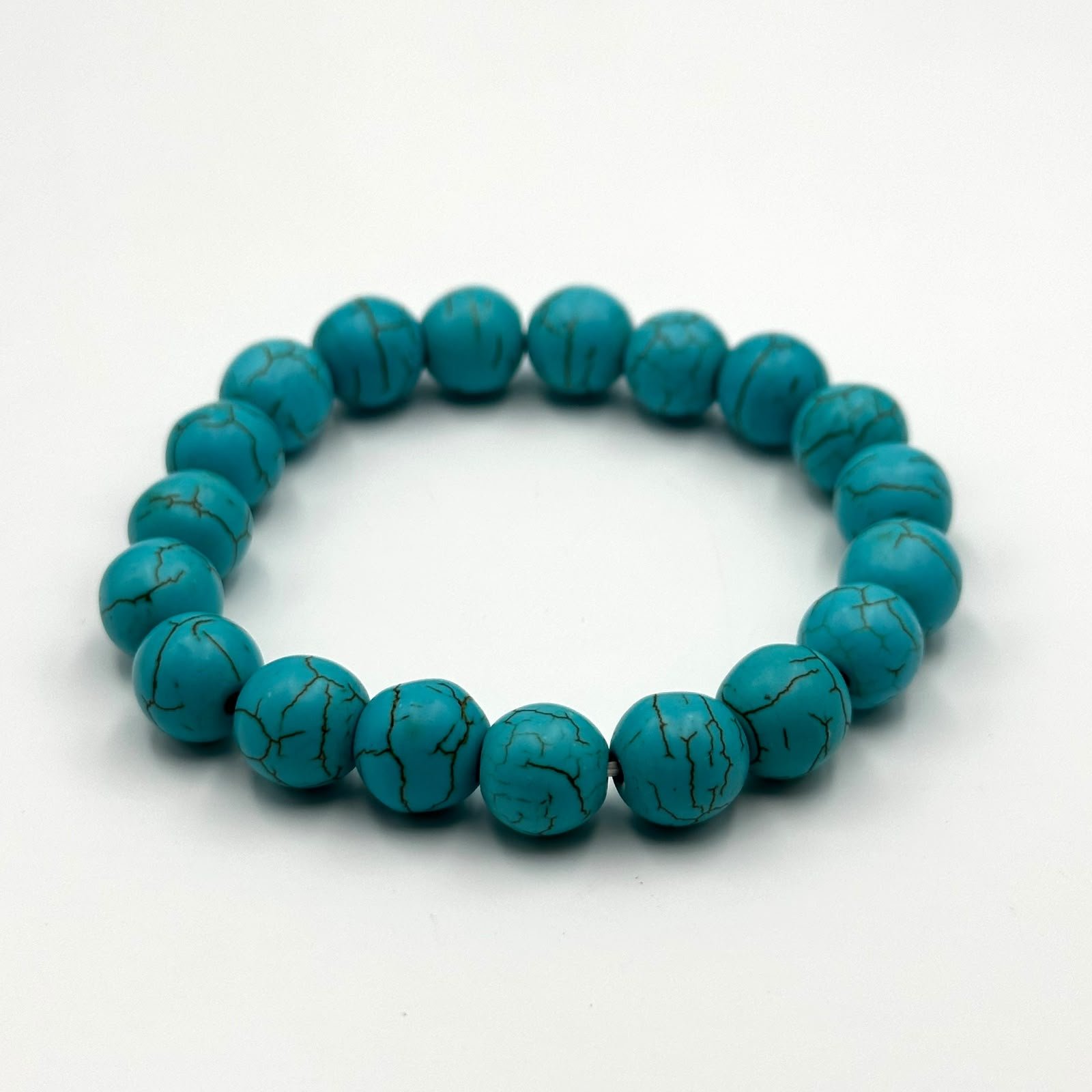
Amazonite or green aventurine?
Green aventurine is a quartz, and it often sparkles faintly in the light because of tiny mica flakes inside. Amazonite doesn't glitter, it's usually bluer, and it shows white stripes. See our green aventurine guide for more.
How to Spot Fake Amazonite
Imitations are usually dyed white stones such as howlite or magnesite, or coloured glass. These checks help:
- Look for white streaks. Real amazonite almost always shows natural white lines, patches or a grid-like texture. Perfectly even colour on every bead is a warning sign.
- Check the drill holes and cracks. Dye tends to collect in holes and fine cracks, making them darker than the rest of the bead.
- Beware of very bright, uniform turquoise-blue. Natural amazonite is usually softer and more varied in tone.
- Look for bubbles. Round bubbles inside a bead point to glass.
- Notice the sheen. Polished amazonite often has a soft, silky shimmer as you turn it; dyed howlite looks flatter and chalkier.
- Temperature: natural stone feels cool at first; plastic warms almost immediately.
For more tips, see our guide to choosing an authentic crystal.
Caring for Amazonite
- Avoid knocks: amazonite cleaves easily, so it can chip or split if dropped onto tiles or marble.
- Avoid strong heat: heat can fade its colour. Don't leave it in a hot car or on a sunny dashboard. Our crystals in UAE heat guide explains more.
- Limit long, direct sun: to keep its colour at its best, store it out of strong sunlight.
- Cleaning: wipe with a soft cloth, or rinse briefly in lukewarm water with a drop of mild soap, then dry straight away, especially the cord.
- Avoid: ultrasonic and steam cleaners, bleach, harsh chemicals and long soaking.
- Perfume and attar: apply them before your jewellery and let them dry, to protect the polish and the cord.
- Storage: keep it in a soft pouch, away from harder stones that could scratch it.
- No crystal water: don't use amazonite in drinking water or elixirs.
Amazonite at Alpine Crystals

Our Natural Amazonite Thread Bracelet (8mm) uses genuine amazonite beads with natural colour variation and white streaks, so each bracelet is slightly different. If you'd like to pair it with another stone, these work beautifully alongside it:
- Amethyst and Rose Quartz Bracelet 8mm, for a calm, soft-coloured stack.
- Green Aventurine Thread Bracelet 8mm, for a green-on-green look.
- Seven Chakra Crystal Bracelet 8mm, if you're interested in chakra practice.
Browse more in our crystal bracelets collection. Stock changes, so check each product page for availability. Delivery across the UAE usually takes 1–2 days: free on orders of AED 150 and above, AED 20 below, with cash on delivery available.
See it in person
Amazonite's colour varies from bead to bead, and it looks different in daylight than on a screen. Visit our store at BurJuman Mall, 2nd Floor, Mankhool, Dubai to see the colour for yourself and compare it with turquoise and aventurine side by side.
Want to see the colour before you buy?
Message us and we'll send a photo or short video of the amazonite bracelet in natural daylight.
Is Amazonite Right for You?
Amazonite is a soft blue-green feldspar with a story that runs from ancient Egyptian jewellery to the mountains of Colorado. In crystal traditions, its meaning centres on calm, harmony, honest communication and courage, and the benefits people describe are about staying balanced and speaking clearly. It suits anyone who wants a gentle everyday stone, people who speak for a living, and lovers of turquoise colours who want something a little easier to care for. Look for natural white streaks to be sure it's genuine, wear it as a bracelet or close to the throat, and keep it away from knocks and strong heat.
Questions People Ask
What is the meaning of amazonite?
In crystal traditions, amazonite represents calm, harmony, honest communication and courage, and it's often called a "stone of truth". These meanings are traditional beliefs rather than proven effects.
What are the benefits of amazonite?
People traditionally associate amazonite with a calmer mind, clearer and more confident communication, courage, and harmony in relationships. There's no scientific evidence for these benefits, and amazonite is not a substitute for medical or professional advice.
How should I wear amazonite?
A bead bracelet is the most popular choice, and either wrist is fine. Because amazonite is linked with the throat chakra, many people also wear it as a pendant or necklace close to the throat.
Is amazonite the same as turquoise?
No. Amazonite is a feldspar with white streaks and a glassy sheen. Turquoise is a copper mineral, usually with brown or black matrix veins and a waxy look, and it's softer and more porous.
How can I tell if amazonite is real?
Real amazonite usually shows natural white streaks and slight colour variation. Perfectly even, very bright colour, dye collected in drill holes, or bubbles inside the bead suggest dyed stone or glass.
Can amazonite get wet?
A brief rinse with mild soap is fine if you dry it straight away. Avoid soaking, harsh chemicals and ultrasonic cleaners, and don't use it in drinking water.
Does amazonite fade?
Strong heat can fade amazonite's colour, and long exposure to intense sun is best avoided. Keep it out of hot cars and store it away from direct sunlight.
Which zodiac sign is amazonite good for?
In Western crystal astrology it's most often linked with Virgo, and sometimes with Aquarius. Traditions vary, so follow the system you trust.