

Sound Healing at Home: A Simple Daily Singing Bowl Routine


Sound healing at home does not need a studio, a teacher or a long free afternoon. A single handmade singing bowl, a quiet corner and a few minutes a day are enough to build a routine you will actually keep. Whether you live in Dubai, Abu Dhabi or Sharjah, a short daily session with a bowl can become a simple way to pause, slow your breathing and mark the start or end of the day.
At Alpine Crystals, we bring authentic, handcrafted Himalayan singing bowls directly from Nepal to your doorstep in the UAE. This guide shows you how to play one, how long to spend each day and how to set up a calm corner for it. Browse our full range of handmade singing bowls in the UAE.

What Is Sound Healing at Home?
Sound healing is a broad name for practices that use sustained tones, such as bowls, gongs and bells, as a focus for relaxation and meditation. Doing it at home simply means bringing that practice into your own space, on your own schedule, rather than booking a session elsewhere.
Himalayan singing bowls are traditionally hand-hammered metal bowls from Nepal and the surrounding region. They are often described as being made from a blend of seven metals, although most are a bronze alloy in practice; our guide to seven-metal singing bowls explains what that tradition really means. When a bowl is struck or circled with a wooden mallet, it produces a layered, ringing tone that can carry on for a minute or more. Bowls like this are used in meditation, yoga, mindfulness practice and some religious traditions.
Why People Make a Singing Bowl Part of Their Day
Everyone uses a bowl a little differently, and the reasons below come from tradition and from what people tell us about their own practice. They are personal experiences, not medical effects.
- A cue to pause. Many people find that listening to the tone fade is an easy way to step away from the day, whether that is after work or after a long drive across Dubai.
- A wind-down ritual. Some like to play for a few minutes before bed as part of an evening routine, the same way others read or make tea.
- A focus for meditation. Following a single sound gives a busy mind something simple to rest on, which many beginners find easier than silence.
- Chakra traditions. In some traditions, different tones are linked with different chakras, and bowls are used in sets for that reason. This is a spiritual belief rather than a measurable effect.
- A moment of intention. Students, professionals and creatives often tell us a short session helps them settle into a task with more focus.
If you want to read more about what people believe singing bowls do, and what the evidence does and does not say, see our article on Tibetan singing bowl benefits.

Choosing a Bowl for Your Home Practice
The size and weight of a bowl shape its sound. Smaller, lighter bowls give a brighter, higher tone that fades fairly quickly; larger, heavier bowls give a deeper tone that lingers. For sound healing at home, the right bowl is mostly about where and how you will play it.
- Small bowls (around 8–9cm). Easy to keep on a desk or bedside table and gentle enough for a shared flat. The small teal singing bowl (8.5cm) is a good, affordable first bowl.
- Medium bowls (around 11–13cm). The most versatile size for daily practice, with enough depth of tone for rimming. The Golden Buddha singing bowl set (11cm) and the Buddha Eye singing bowl (13cm) both sit in this range.
- Large and full moon bowls. Deeper, longer tones for longer meditation sessions, such as our Himalayan full moon singing bowl.
Whatever size you choose, a handmade bowl usually has a richer, more complex sound than a machine-made one; our guide to handmade vs machine-made singing bowls shows how to tell them apart. For a full comparison of sizes, designs and budgets, read our best singing bowl guide.


How to Play a Singing Bowl
Playing a singing bowl is simple, but a little technique makes a big difference to the sound. If you are completely new, our beginner’s guide to using a Himalayan singing bowl goes into more detail.
1. Choose a Peaceful Environment
Find a quiet space, perhaps your prayer corner, yoga mat or bedroom. Make sure you are seated comfortably, with your back supported if you plan to sit for more than a few minutes.
2. Hold the Bowl in Your Palm
Place the bowl in your non-dominant hand with your palm flat and your fingers straight, and hold the mallet in your dominant hand. Gripping the sides with your fingers dampens the sound, so let the bowl rest on your palm.

3. Striking the Bowl
Gently tap the outer rim with the mallet to create a clear, bell-like tone. A single strike is a good way to mark the start of a session; a soft tap is usually enough.
4. Rimming (Playing the Bowl)
Press the mallet against the outer edge of the bowl and slowly move it in a circle, clockwise. You will hear the tone start to build. Keep the pressure and speed steady, and continue circling four to six times to let the sound fully develop. If the bowl buzzes or will not sing, our guide on why a singing bowl won’t sing covers the usual fixes.
5. Deep Breathing While Playing
Breathe in slowly and let the sound guide the pace of your breath. Many people like to imagine tension easing a little with each long exhale as the tone fades.
6. Use with Intentions or Prayers
You can say an affirmation, intention or prayer silently or out loud while playing. For many people, pairing the sound with words that matter to them is what gives the practice its personal meaning.
A Simple Daily Sound Healing Routine at Home
You do not need long sessions. Short, regular practice is easier to keep up than an hour once a week. Here is a simple structure you can adapt:
| Time of Day | Practice | Duration |
|---|---|---|
| Morning | A few strikes and a gratitude intention | 5 minutes |
| Afternoon | Short session during a break | 2–3 minutes |
| Evening | Meditation or a longer, chakra-focused session | 10–15 minutes |
| Before bed | Gentle rimming as part of winding down | 5 minutes |
A 10-Minute Evening Session, Step by Step
- Sit comfortably, put your phone on silent and dim the lights.
- Take three slow breaths before you touch the bowl.
- Strike the rim once and listen until the sound has completely faded.
- Rim the bowl slowly for about two minutes, keeping the pressure even.
- Stop, rest the bowl on its cushion and sit in silence for a minute.
- Repeat the rimming once more, then close with a single soft strike.
- Sit for a final minute before getting up.
Living in an apartment? Rim gently rather than striking hard, and try to play away from shared walls. Air conditioning hum can mask the quieter part of the tone, so some people switch it to a lower fan setting for the few minutes they play.
Setting Up a Calm Corner
A dedicated spot makes the routine easier to keep. Choose a corner you pass every day, add a cushion or mat to sit on, and keep the bowl on a stable surface where it will not be knocked. A handmade silk cushion lifts the bowl off the surface so it can ring freely and protects it from scratches.
Avoid leaving your bowl in a hot car or in direct afternoon sun, and wipe it with a soft, dry cloth after use. Fingerprints and humidity can dull the finish over time, and our guide on how to clean a singing bowl explains how to keep it looking and sounding its best.
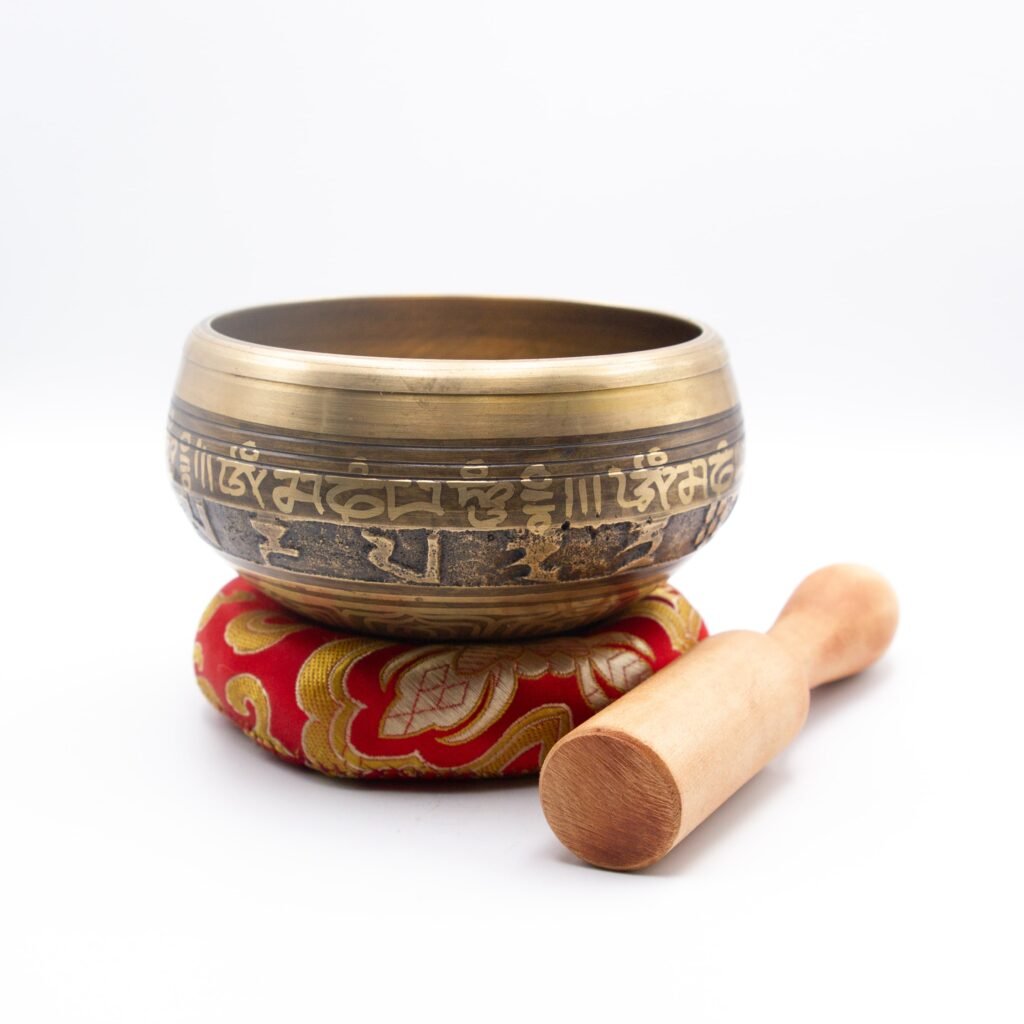
If you like the look of an engraved bowl for your corner, the script-engraved singing bowl set comes with its own cushion and striker.
Combining Your Bowl with Crystals or Incense
Many people like to place healing crystals such as amethyst, rose quartz or sodalite beside the bowl during a session, as a visual focus for their intention. If you want to put a stone inside the bowl, choose a small, smooth one and remove it before rimming, as loose stones can scratch the inside and rattle against the metal.
Others burn natural incense or resin to mark the start of a session. Keep incense a safe distance from fabrics and cushions, and open a window afterwards.

Why UAE Customers Love Our Singing Bowls
- ✅ 100% Handmade in Nepal
- ✅ Shipped with love from Alpine Crystals Dubai
- ✅ Ideal for all religions and spiritual practices
- ✅ Great as gifts for Ramadan, Eid, Mother’s Day & more
Final Thoughts
Sound healing at home is less about the perfect technique and more about showing up for a few minutes each day. Many people find that a handmade Himalayan singing bowl gives their day a calm, steady rhythm, and it is simple enough to learn in one evening.
Singing bowls are a personal and spiritual practice, not a medical treatment, so if you have a health concern please speak to a qualified healthcare practitioner.


Explore our collection at Alpine Crystals and choose a bowl that suits your space. Orders of AED 150 and above ship free within the UAE, usually in 1–2 days.
💬
Not sure which bowl to start with?
Tell us where you will play it, how much space you have and the kind of sound you like, and we will help you choose the right singing bowl.